
 Support
Silver surges to record $81 amidst escalating geopolitical risks
Silver futures contracts have ascended to a historic peak of $81 per ounce, driven by intensifying global geopolitical instability. Concurrently, energy supply chains are facing significant disruptions as the outlook for Venezuelan crude reserves remains precarious. While Chevron’s Venezuelan operations continue to facilitate exports to the United States, the state-run PDVSA may be compelled to suspend production due to acute storage constraints.

Silver futures reached an all-time high of $81, propelled by heightened geopolitical risks across Latin America and Europe.
While Chevron’s exports from Venezuela to the US remain functional, shipments to Asian and European markets face total opacity due to domestic political instability.
The S&P 500 and Dow Jones indices achieved fresh record highs, underpinned by robust corporate earnings expectations and the prospect of monetary easing should upcoming labour data underperform.
German inflation has decelerated beyond market expectations, falling to 1.8% in December due to cooling energy prices and a slowdown in goods inflation.
Silver prices reach historic high amidst geopolitical tensions
The flight to safe-haven assets persists as tensions escalate between the United States and various counterparts in Latin America and Europe. Following military actions by the United States in Venezuela over the past weekend, President Nicolás Maduro is currently facing trial in a US court. Simultaneously, the sovereignty and future of the nation’s vast crude reserves have become a central point of contention between the two governments.
Furthermore, US President Donald Trump has issued a series of diplomatic threats targeting several nations, most notably Colombia, Cuba, Mexico, and Greenland. Regarding the latter, Greenland remains a territory of Denmark, a key member of NATO. Danish Prime Minister Mette Frederiksen has warned that any unilateral intervention in Greenland would be interpreted as a direct assault on Danish sovereignty. Given that both the US and Denmark are NATO members, such a transgression could theoretically lead to the dissolution of the alliance, significantly magnifying global systemic risk.
Consequently, investors and hedgers have intensified their pursuit of precious metals to mitigate exposure. Silver has emerged as the primary beneficiary of this trend, closing at an unprecedented high. The silver futures contract appreciated by approximately 5.65%, breaching the $81 per ounce threshold.
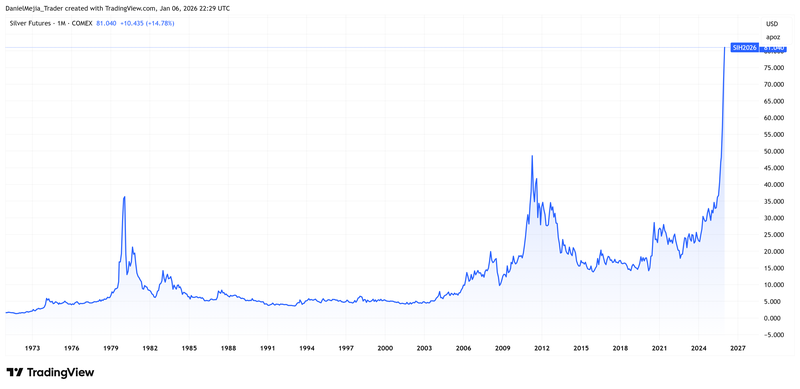
Figure 1. Silver future contract SIH26 (1971-2026). Source: Data from the COMEX Exchange; Own analysis conducted via TradingView.
Venezuelan oil exports maintain US flows but face global uncertainty
Exports from Venezuela to the United States via Chevron remain operational, currently standing as the sole exception to the maritime blockade imposed by Washington approximately one month ago. In contrast, according to information from Reuters, the state-owned Petróleos de Venezuela (PDVSA) may be forced to implement drastic production cuts. This is a direct consequence of the blockade, which has led to a near-total exhaustion of the country’s onshore storage capacity.
Consequently, the status of exports to Asia and Europe remains unconfirmed. As China is a primary importer of Venezuelan crude, a prolonged disruption could destabilise oil supply chains throughout the Asian region in the near term.
Despite these supply-side constraints, the primary benchmarks, Brent and WTI, experienced a parallel decline. The Brent futures contract (BRNH26) closed down 1.72% at $60.70 per barrel, while WTI (CLG26) fell by approximately 1.90% to $57.08 per barrel. This counter-intuitive depreciation may be attributed to market participants pricing in an anticipated supply increase, following signals that the United States intends to expand domestic extraction and refining investments. Nevertheless, the violation of Venezuelan sovereignty remains a volatile factor for long-term price stability.
US equity indices extend gains as investors await labour data
Major US equity benchmarks closed in positive territory, buoyed by optimism surrounding significant capital expenditure (CAPEX) within the technology sector—specifically regarding semiconductors and artificial intelligence. Although the geopolitical risk premium remains elevated, stock market participants are currently prioritising the upcoming corporate earnings season and the US employment report scheduled for release this Friday, January 9.
The earnings cycle is set to commence on Tuesday, January 13, led by the major banking institutions. Investors are particularly focused on the Unemployment Rate and Non-Farm Payrolls (NFP). A weaker-than-anticipated labour report could bolster the case for more aggressive rate cuts by the Federal Reserve. Conversely, a resilient labour market would provide the central bank with the necessary leverage to maintain a "higher-for-longer" neutral stance.
In a synchronised rally, the S&P 500 and the Dow Jones Industrial Average reached new record peaks of 6,944 and 49,462 points, respectively. Similarly, the Nasdaq-100 and the Russell 2000 closed near their respective historical ceilings at 25,639 and 2,582.
German inflation decelerates below analyst forecasts
Data from the Federal Statistical Office of Germany reveals that the year-on-year (YoY) inflation rate decelerated from 2.3% in November to 1.8% in December, undershooting the 2% consensus forecast. This represents the lowest inflationary pressure since October 2024, placing the figure below the European Central Bank’s (ECB) medium-term target.
According to Trading Economics, the primary catalysts for this disinflationary trend were goods inflation (which cooled from 1.1% to 0.4%) and energy prices (which contracted from -0.1% to -1.3%). In contrast, services inflation remained "sticky" at 3.5%. While the headline figure aligns with the ECB’s mandate, it may also signal underlying weakness in household consumption. Continuous monitoring will be essential throughout the first quarter of 2026 to determine if this trend persists or if prices will revert to the 2% mean.
