
 Support
Wall Street closes mixed amid strong Nvidia results, falling jobless claims
US equity indices finished the session with mixed results amid a decline in continuing jobless claims and a significant quarterly earnings beat from Nvidia Corp. Market sentiment was dampened by growing uncertainty regarding the Federal Reserve’s future monetary policy trajectory and mounting scepticism over the sustainability of artificial intelligence (AI) returns relative to the substantial capital expenditure (capex) currently being deployed.

US continuing jobless claims fell to 1,833K, down from 1,864K and below consensus forecasts, suggesting a possible stabilising of the employment sector.
Following the resilient labour data, interest rate expectations shifted; the CME FedWatch Tool now indicates that market participants have pushed the anticipated commencement of rate cuts from June to July.
Although Nvidia exceeded revenue and earnings-per-share (EPS) estimates and issued optimistic forward guidance, its shares declined by over 5% as investors questioned the long-term viability of AI-driven returns.
Continuing jobless claims decrease: FedWatch Tool signals delay in expected rate cuts
According to data released by the US Department of Labour, continuing jobless claims decreased from 1,864K to 1,833K, coming in below the analysts' estimate of 1,860K. As illustrated in Figure 1, this suggests a potential inflection point in the labour indicator, as current levels appear to be breaking the upward momentum observed over the previous three years. Coupled with a marginal decrease in the unemployment rate to 4.3% in the latest reading, the data points toward a possible recovery or "normalisation" within the employment sector.
Consequently, the CME’s FedWatch Tool revealed a shift in market expectations regarding the Federal Reserve’s easing cycle. Investors are now pricing in a 25-basis-point interest rate cut for the July meeting, a delay from previous expectations of a June commencement. However, the odds of a second rate cut in October remain largely unchanged. Market focus has now pivoted to upcoming employment and inflation data, as well as the Federal Reserve’s meeting on 18 March, where the central bank is expected to update its economic projections.
Market reaction to these developments was fragmented. The S&P 500 retreated by 0.54% to 6,908 points, while the Nasdaq 100 fell more sharply by 1.16% to 25,034 points, reflecting intensified concerns over AI returns. Conversely, the Dow Jones Industrial Average remained resilient, appreciating marginally by 0.03% to close at 49,499 points.
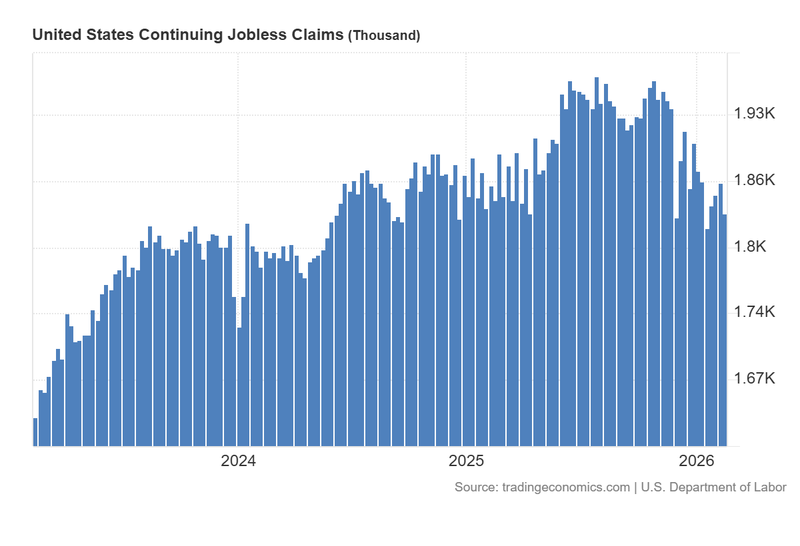
Figure 1. US Continuing Jobless Claims (2023–2026). Source: Data from the US Department of Labour; Figure obtained from Trading Economics.
Nvidia shares drop despite an impressive quarterly report
Nvidia Corporation once again outperformed analyst expectations for both revenue and earnings per share (EPS), sustaining its consistent performance of surpassing consensus forecasts. For the fourth quarter of 2025, the semiconductor leader reported total revenue of $68.13 billion, representing a 3% surprise over the $66.13 billion anticipated by the market. Furthermore, the company reported an EPS of $1.62, exceeding the $1.54 forecast by 5.5%. These results represent a formidable year-on-year (YoY) growth rate of 73.2% in revenue and 82% in earnings per share.
Despite this exceptional financial performance and the provision of forward guidance that exceeded market estimates, Nvidia's shares depreciated by 5.46%, closing at $184.89. The sell-off suggests that investors are increasingly preoccupied with the "monetisation" phase of artificial intelligence. There is a growing concern regarding whether the real economic returns from AI technology can be sustained at a level that justifies the current high valuations and the immense capital investments being made across the technology sector.
