
 Support
Alphabet TurboQuant reshapes AI economics ahead of earnings
Alphabet’s latest announcement around its TurboQuant algorithm arrives at a moment when the market is actively searching for the next inflection point in the AI trade. What the company’s researchers have introduced is not simply an incremental upgrade.

TurboQuant algorithm arrives at a moment when the market is actively searching for the next inflection point in the AI trade.
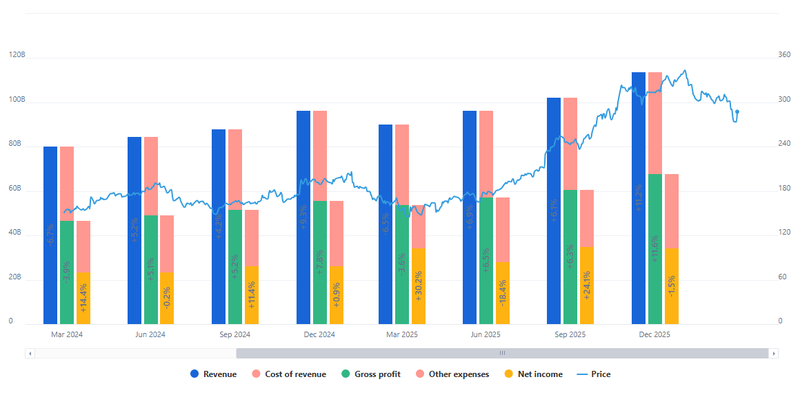
Net income has expanded by 32%, while gross profit growth has reached 18%.
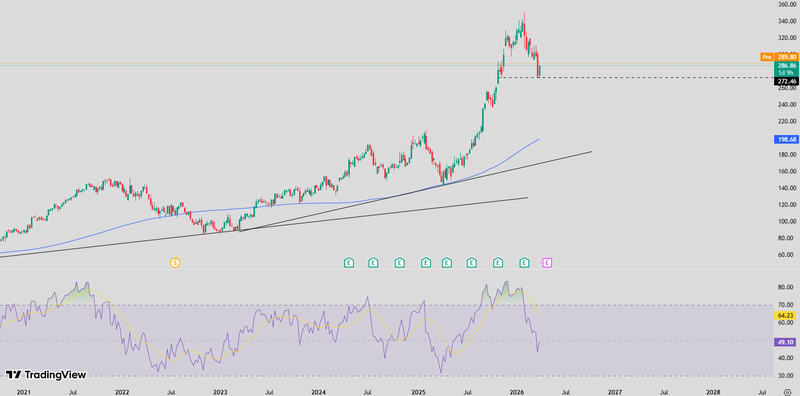
The recent bounce from the support level near 272.46 suggests that demand remains intact.
A structural shift in AI economics
Alphabet’s latest announcement around its TurboQuant algorithm arrives at a moment when the market is actively searching for the next inflection point in the AI trade. What the company’s researchers have introduced is not simply an incremental upgrade, but a potentially meaningful shift in how large-scale AI systems is designed and deployed.
TurboQuant enables substantial compression of memory requirements for large language models and vector search systems without sacrificing performance. If the technology scales as promised, it directly targets one of the most expensive constraints in modern AI infrastructure: memory intensity. For years, the prevailing assumption has been linear more AI requires more hardware, more storage, and more capital. Alphabet’s breakthrough begins to challenge that logic.
Market reaction and memory sector pressure
The initial market response has been immediate and directional. Memory-linked equities, particularly those exposed to DRAM and NAND cycles, faced selling pressure as investors recalibrated demand expectations. The reasoning is straightforward: if AI workloads require less memory per unit of compute, then pricing power across the memory supply chain may soften.
For companies such as Micron and SanDisk, whose recent growth narratives have been closely tied to AI-driven demand, even a modest shift in expectations can carry significant valuation consequences. The market, in this phase, is reacting to first-order effects, which have reduced hardware intensity.
Fundamental strength ahead of earnings
Alphabet’s underlying financial performance remains notably strong. Net income has expanded by 32%, while gross profit growth has reached 18%, reinforcing the view that the company is not only scaling effectively but also beginning to extract meaningful operating leverage from its AI and infrastructure investments.
With earnings approaching and expectations centered around earnings per share of approximately 2.605 and revenue near 106.67 billion, attention is likely to shift toward execution and monetization. TurboQuant, while framed as a technical innovation, may ultimately express itself through improved margins, particularly across cloud and AI-driven services where cost efficiency directly impacts profitability.
Source: Fullratio
Positioning and forward outlook
What emerges from this development is a subtle but important reallocation of value within the AI ecosystem. As efficiency improves, the advantage shifts toward companies that operate at the platform and application layers, where scalability and monetization are concentrated.
Alphabet sits squarely in this position. Rather than being exposed to the risks of commoditization, it stands to benefit from lower costs and broader adoption. The market’s current focus on immediate disruption may be overlooking these second-order effects.
As the company approaches its next earnings release, the setup reflects a balance between strong fundamentals and neutral technical positioning. Should Alphabet demonstrate continued growth alongside early signs of margin expansion, the current consolidation phase may resolve to the upside.
Technical outlook
The stock is currently exhibiting characteristics of consolidation rather than weakness. The recent bounce from the support level near 272.46 suggests that demand remains intact at lower price ranges, indicating continued institutional interest.
Momentum indicators reinforce this neutral stance. The relative strength index, positioned around 49, reflects equilibrium between buyers and sellers, often a precursor to directional movement rather than a sign of exhaustion. This balance suggests that the market is waiting for a catalyst, most likely earnings to define the next move.
At the same time, the broader trend remains firmly positive. With the stock trading well above its long-term moving average near 198, the underlying structure continues to favor the upside. The current phase appears less like a reversal and more like a pause within a sustained upward trajectory.
Source: Trading View


