
 Support
Brent crude recovers to $65 as geopolitical risk premium rises
The Brent futures contract closed with an appreciation of 2.5%, accumulating an increase of approximately 9% over the past week. This recovery is primarily attributed to the escalation of global geopolitical tensions.

The Brent futures contract regained the $65 per barrel threshold amidst escalating tensions involving Iran, Venezuela, and Russia.
Protests in Iran have intensified significantly, leading to a period of heightened social instability; concurrently, the threat of US intervention has sharply inflated the geopolitical risk premium.
Energy market participants remain apprehensive regarding potential disruptions to Iranian crude exports.
While the long-term trend for the Brent contract remains bearish, momentum indicators suggest a short-term increase in bullish strength.
Oil prices recover amid supply concerns and social instability in Iran
Crude oil prices have recovered considerably following concerns over a potential decline in Iranian energy exports triggered by domestic social unrest. The Brent futures contract (BRNH26) rose by approximately 2.5% at the market close, reaching $65.44 per barrel. Following a sustained decline in recent months, Brent has reclaimed approximately 9% of its value within the last week. This trajectory is driven by multiple factors, most notably the fear of supply chain disruptions and a heightened geopolitical risk premium.
The ongoing Russia-Ukraine conflict continues to keep market participants on high alert. A significant portion of Ukrainian strategic strikes has focused on Russian energy infrastructure, specifically targeting supply chains to diminish Russia’s financial capacity. Simultaneously, the wave of protests in Iran has escalated to a degree of social destabilisation that raises fears regarding the negative impact on the production and exports of Iranian crude.
Furthermore, crude oil has demonstrated significant sensitivity to geopolitical friction, particularly when major oil-producing nations are directly involved. In recent days, the geopolitical risk premium has ascended following warnings from US President Donald Trump regarding potential intervention in Iran’s internal conflict.
Technical analysis of the Brent futures contract (BRNH26)
From a technical perspective, the Brent futures contract remains confined within a bearish channel pattern and continues to trade below its long-term 200-period moving average. Key observations include:
- Trend Context: In the long term, the Brent futures contract maintains its position within a descending channel and trades below its 200-period moving average. However, in the short term, the price is breaching the 50 and 100-period moving averages to the upside. Momentum indicators signal increasing demand-side strength driven by escalating geopolitical uncertainty.
- Resistance Levels: Should the resistance at $65.60 per barrel (a level in close proximity to the 200-period moving average) be breached, the next significant ceiling is $69.00 (a medium-term resistance). A decisive break above $69.00 would suggest potential for an extension into higher price zones.
- Support Levels: If the support at $60.00 per barrel (a medium-term support and a critical psychological level) is breached to the downside, the next relevant floor is $55.00 (the lower boundary of the bearish channel). A loss of the $55.00 zone would increase the probability of a deeper correction.
- Momentum Indicators: The MACD (Moving Average Convergence Divergence) is currently exhibiting a bullish divergence, suggesting a potential exhaustion of short-term selling pressure. Additionally, the RSI (Relative Strength Index) is trending upwards, reflecting a strengthening short-term bullish trend within a high-volatility environment.
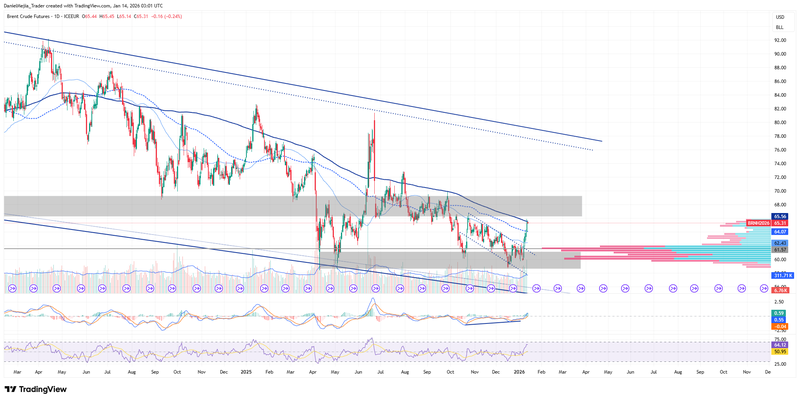
Figure 1. Brent futures contract BRNH26 (2024-2026). Source: Data from the ICE-EUR Exchange; own analysis conducted via TradingView.


