
 Support
Brent rises sharply on geopolitical tensions, tests key technical levels
The Brent crude futures contract has surpassed the significant $90 threshold as geopolitical tensions in the Middle East intensify. While the commodity is currently challenging a critical technical zone, the rally remains underpinned by a substantial risk premium.

Brent crude has surged past $90 per barrel following military engagements that led to a critical blockade of the Strait of Hormuz.
Approximately 15 million barrels of daily crude oil exports are currently stagnant, threatening global energy security and complicating the battle against "sticky" inflation around the world.
Asian economies are increasingly pivoting toward alternative crude sources to offset Middle Eastern deficits, though analysts warn that damaged infrastructure may hinder any immediate logistical recovery.
Oil prices surpass $90 threshold amid rising risk premium
The global energy market is currently navigating a period of intense volatility, with Brent and WTI crude benchmarks surpassing the $90 mark to reach their highest valuations since November 2023. The implied 50% rally over the past two months is primarily driven by escalating geopolitical friction between the United States, Israel, and Iran, which has culminated in a near-complete blockade of the Strait of Hormuz.
Given that approximately 20% of global oil and natural gas consumption typically transits this strategic maritime chokepoint, the current disruption has left an estimated 15 million barrels of crude oil per day stagnant—according to reports from Reuters. This bottleneck severely threatens global energy security and complicates the efforts of global central banks to curb persistent inflationary pressures.
Asian markets remain particularly exposed to this supply shock, as roughly 60% of their crude imports originate from the Middle East. Consequently, global trade flows are shifting rapidly; for instance, Indian refineries have significantly increased their intake of Russian crude under time-limited US waivers to mitigate the shortfall. Analysts warn that even if the Strait were to be reopened promptly, the time required to repair damaged infrastructure suggests that energy prices could remain elevated for a recovery period, that currently defies precise estimation.
Technical analysis of the Brent futures contract
From a technical perspective, while the Brent futures contract had maintained a bearish trend over the last four years, price action is currently undergoing a significant shift in its medium-term structure. Key observations include:
- Trend Context: Throughout the medium term, Brent futures had been contained within a bearish channel pattern. However, the contract is now decisively breaching key resistance levels to the upside and is trading significantly above its 50, 100, and 200-day Simple Moving Averages (SMAs). The price is currently testing a critical technical ceiling, propelled by bullish strength largely fuelled by the geopolitical risk premium.
- Resistance Levels: If the medium-term resistance level near $95.00 per barrel is decisively breached, the next significant technical level is $100.00—a prominent psychological barrier. A sustained move above the $100.00 mark would signal a potential extension into higher price territories.
- Support Levels: Should a market correction occur, immediate support is identified at $82.00 per barrel. If this level fails to hold, the next relevant floor sits at the $76.00 level. A breach of the $76.00 zone would significantly increase the probability of a deeper market correction.
- Momentum Indicators: Both the Moving Average Convergence Divergence (MACD) and the Relative Strength Index (RSI) exhibit an ascending trajectory, signalling a strengthening of upward momentum in the short term. Nevertheless, it is important to note that both indicators are approaching overbought territory.
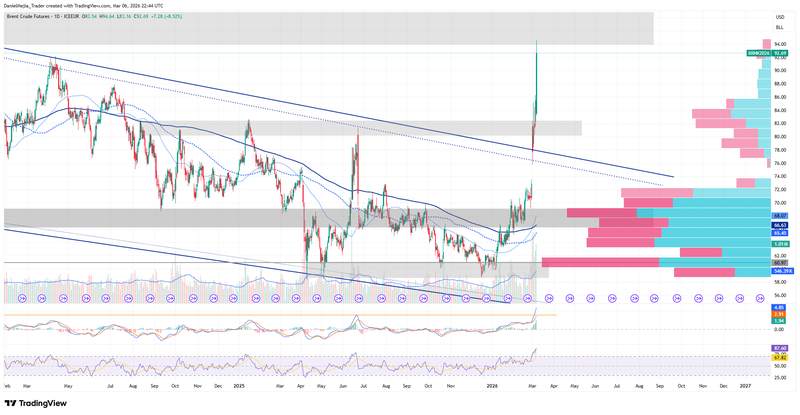
Figure 1. Brent futures contract BRNK26 (2024–2026). Source: Data from the ICE-EUR Exchange; own analysis conducted via TradingView.


