
 Support
Crude stocks surprise to the upside, pressuring WTI oil prices
West Texas Intermediate (WTI) crude oil prices experienced a marginal retracement following a significantly higher-than-anticipated accumulation in US crude inventories. Market participants remain focused on the evolving conflict in the Middle East, the duration of which hinges on forthcoming talks between the involved nations.

EIA crude inventories rose by 5.451 million barrels, substantially exceeding analyst forecasts of an 0.8 million-barrel increase.
This latest reading marks the sixth consecutive week of higher-than-anticipated builds in crude oil stockpiles.
Amidst escalating US–Israel–Iran tensions and severe energy supply chain disruptions, the WTI futures contract has breached a multi-year bearish trend and is currently consolidating near the $100 per barrel threshold.
Oil prices retrace following significant build in US crude inventories
According to data from the US Energy Information Administration (EIA), crude oil stockpiles increased by 5.451 million barrels in the latest weekly reading. This figure was considerably above the market consensus, which had anticipated a modest build of 0.8 million barrels. Notably, this represents the sixth consecutive period in which inventory accumulation has outpaced analyst expectations. Consequently, the West Texas Intermediate (WTI) futures contract (CLK26) declined by 1.30%, settling at $100.08 per barrel.
Substantial increases in crude inventories typically exert downward pressure on market prices, as they often signal either overproduction or a softening of global demand. Beyond the inventory data, market participants are closely monitoring the US–Israel–Iran conflict in the Middle East. Sentiment is currently divided between the potential for a diplomatic resolution and the risk of a further escalation that could obstruct energy supply chains for a protracted period.
Technical analysis of the WTI futures contract
From a technical perspective, the WTI futures contract has decisively breached a multi-year downward trend, buoyed by the severe oil supply disruptions emanating from the Middle East. Key observations include:
- Trend Context: In the short term, the WTI futures contract has surged by approximately 50% over the last month, driven by acute supply chain volatility. However, momentum indicators currently signal overbought conditions, suggesting the market may be entering a period of consolidation.
- Resistance Levels: If the psychological resistance near $110.00 per barrel is decisively breached, the next significant technical ceiling is identified at $120.00. This level represents a prominent psychological barrier that converges with a historical structural resistance. A sustained move above $120.00 would signal a potential extension into significantly higher price territories.
- Support Levels: Should a market correction materialise, immediate support is identified at $95.50 per barrel. If this level fails to hold, the next relevant floor is situated at $87.00. A breach of the $87.00 zone would significantly increase the probability of a deeper market correction.
- Momentum Indicators: Both the Moving Average Convergence Divergence (MACD) and the Relative Strength Index (RSI) are currently trading in overbought territory. This technical positioning suggests that a period of consolidation or a temporary retracement is a high-probability outcome for the upcoming trading sessions. However, fundamental data will drive oil’s performance going forward.
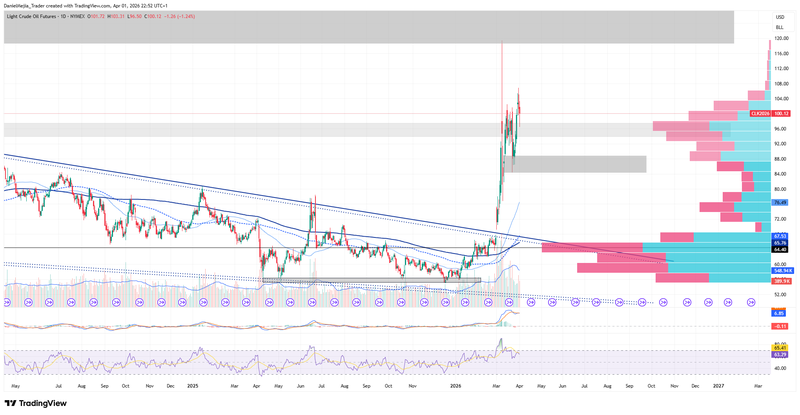
Figure 1. WTI futures contract CLK26 (2024–2026). Source: Data from the NYMEX Exchange; own analysis conducted via TradingView.


