
 Support
Intel’s gains momentum as AI partnerships with Nvidia
Intel is showing renewed signs of life at a critical moment in its restructuring story. After months of investor skepticism over heavy capital spending and pressured margins, a mix of improving fundamentals, AI-linked partnerships, and pricing power is beginning to shift sentiment.

Nvidia’s increased investment in Intel and closer cooperation around custom Xeon processors.
Operating income climbed 81% compared with last year.
Market focus remains on Intel’s “Foundry 2.0” strategy.
Nvidia backing validation with competition
One of the most notable developments is Nvidia’s increased investment in Intel and closer cooperation around custom Xeon processors. For shareholders, this serves as a form of external validation of Intel’s AI and foundry ambitions. When a key industry rival deepens ties, it signals strategic relevance.
However, the relationship is layered. Nvidia is simultaneously expanding into Intel’s traditional CPU territory in data centers and laptops, competing directly alongside AMD and manufacturing powerhouse TSMC. That dual dynamic partnership and competition keep execution risk squarely in focus. Investors will ultimately judge success not by announcements but by sustained orders, improved fab utilization, and margin expansion.
Pricing power and AI demand
Recent reports suggest Intel and a key rival plan to raise server CPU prices by up to 10% in China due to supply constraints. That move signals a shift in pricing power at a time when supply-demand imbalances in AI infrastructure remain tight.
The backdrop is further strengthened by Amazon’s massive $200 billion capital spending plan for 2026, aimed largely at cloud and AI expansion. This is particularly relevant for Intel, which previously secured an agreement to produce custom Xeon 6 server chips for Amazon. If those orders scale meaningfully, they could provide a multi-year revenue tailwind and stronger visibility for Intel’s data center segment.
Adding to the positive tone, Seaport Research Partners recently upgraded Intel from Neutral to Buy, citing growing confidence in product momentum and potential market share recovery.
Financial performance rebounds
Intel’s latest results point to meaningful operational improvement. Net income surged 99% year-on-year, reflecting a sharp recovery in profitability after a challenging period marked by restructuring costs and heavy investment. Net margin rose by the same magnitude, underscoring improved efficiency and stronger cost control across core segments.
Operating income climbed 81% compared with last year and increased 7% sequentially, signaling that momentum is not only cyclical but also building quarter over quarter. Operating margin expanded in tandem, suggesting that revenue gains are increasingly flowing through to the bottom line rather than being absorbed by expenses.
Together, these figures indicate that Intel’s turnaround strategy focused on streamlining operations, prioritizing high-margin segments, and optimizing manufacturing capacity is beginning to translate into tangible financial strength rather than just forward-looking promises.
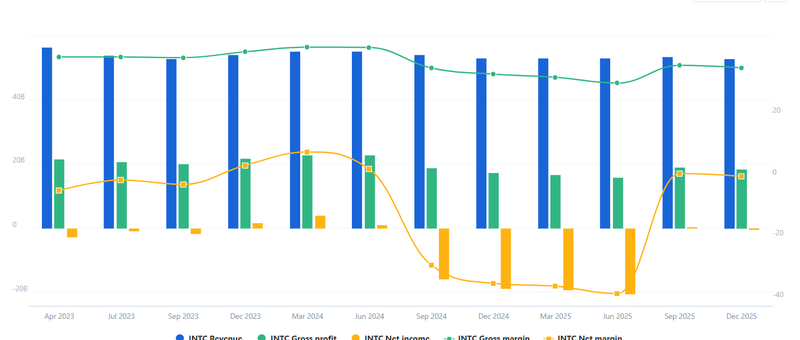
Source: Full ratio
Technical outlook
Intel is currently in a technical consolidation phase, trading between $44 and $47 after last year’s strong momentum. The stock has slipped below its 20- and 30-day moving averages, with the RSI near 50, signaling neutral conditions and a cooling of prior overbought levels. Immediate resistance sits at $50, while the 200-day moving average in the mid-$30s continues to provide long-term support.
Market focus remains on Intel’s “Foundry 2.0” strategy, execution on 18A and 14A nodes, and its $37 billion cash buffer for capex. Upcoming catalysts include April earnings
Still, the combination of improved earnings momentum, strategic partnerships, and sector-wide AI investment creates a more constructive setup than Intel has seen in recent years. If execution continues to improve and AI-linked demand proves durable, the company’s turnaround narrative may shift from hope to measurable recovery a transition that markets tend to reward decisively.
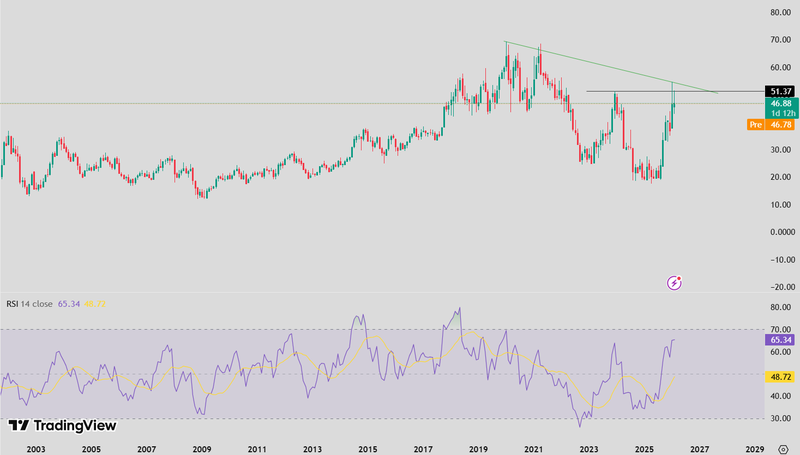
Source: Trading View


