
 Support
Oracle shifts from AI assistants to AI operators
Oracle is starting to move beyond the typical AI narrative. While much of the industry has focused on “copilot” tools that assist users, Oracle is pushing toward something more autonomous. Its newly introduced Fusion Agentic Applications are designed to act within workflows, not just support them.

Oracle reported revenue of $17.2 billion in its latest quarter.
Oracle has lifted its 2027 revenue target to $90 billion.
Price is currently hovering near a key support area around $146.
Strong numbers back the story
The financial side is keeping pace with the narrative. Oracle reported revenue of $17.2 billion in its latest quarter, up 22% year-on-year, driven by continued strength in cloud and infrastructure demand. Earnings also moved higher, with GAAP EPS rising 24% to $1.27 and non-GAAP EPS going up 21% to $1.79.
One of the standout numbers is Remaining Performance Obligations, which reached $553 billion, up an extraordinary 325% from a year earlier. That figure, which represents contracted future revenue, underlines how strong the demand pipeline has become, particularly in AI-related infrastructure. At the same time, Oracle is maintaining shareholder returns, with a $0.50 quarterly dividend that signals confidence in its cash generation despite heavy investment plans.
Looking ahead, these trends suggest Oracle is still in the early stages of monetizing its AI and cloud opportunity. If even a modest portion of its RPO converts on schedule, revenue growth could remain well above traditional enterprise software rates over the next few years, especially as more AI workloads migrate to its infrastructure. The key question for investors is not whether demand exists, but how efficiently Oracle can scale capacity and margins around it if execution stays on track, the current numbers may prove to be a steppingstone rather than a peak.
Heavy spending, bigger ambitions
Oracle is not holding back on expansion. The company is guiding for about $67 billion in revenue for fiscal 2026 alongside roughly $50 billion in capital expenditures, underscoring how aggressively it is positioning itself in cloud and AI infrastructure.
Oracle has lifted its 2027 revenue target to $90 billion, reflecting confidence that demand will continue to accelerate. Much of this outlook is tied to AI workloads, data centres, and broader enterprise adoption of automation tools, including its new agentic systems. The strategy is clear: spend heavily now to secure long-term dominance in high-growth areas. The trade-off is pressure on near-term margins, but for now the market appears willing to tolerate that in exchange for stronger future growth.
Valuation and market position
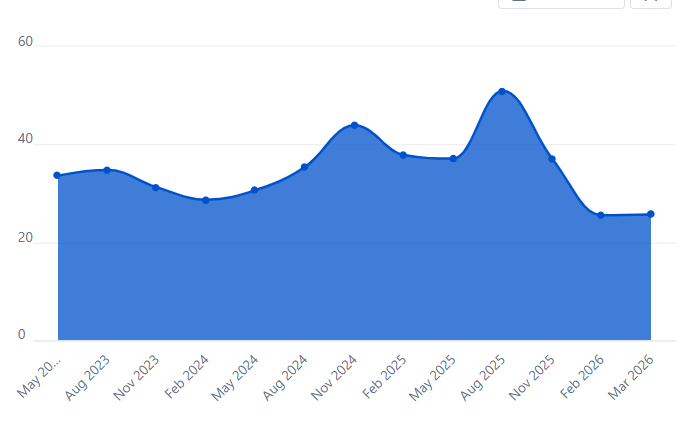
Oracle doesn’t look particularly stretched when you stack it up against its own track record. Right now, its forward P/E sits a solid 32% below where it averaged over the last four quarters, and it’s trading roughly 19% under its five-year mean. That’s not the kind of multiple you’d expect from a company sitting on $553 billion in backlog revenue and guiding toward $90 billion by 2027.
The discount tells a story either the market isn’t fully buying the AI growth narrative yet, or it’s slapping on a healthy dose of skepticism about whether Oracle can execute at this scale without hiccups. Both views have merit, but for anyone convinced the company can convert even half that pipeline into sustained growth, the current valuation leaves real room to run.
Source: Fullratio
Technical outlook
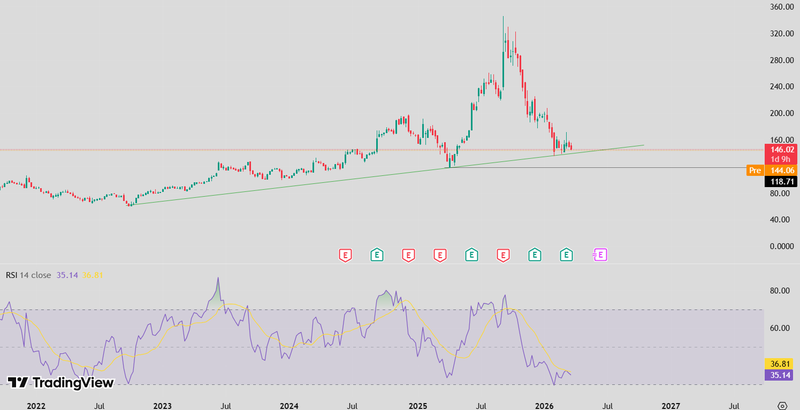
Oracle’s price action is holding up reasonably well. The stock remains above its main trendline, indicating that the broader uptrend is still intact despite recent volatility.
Price is currently hovering near a key support area around $146, while the RSI is sitting close to 30, which puts the stock near traditional oversold territory. That combination often attracts dip buyers looking for a rebound as long as the bigger trend remains constructive. If support holds, a bounce could follow, supported by both technical positioning and ongoing optimism around AI growth. A clear break below that zone, however, would likely shift the tone and point toward a deeper consolidation phase rather than an immediate continuation of the uptrend.
Source: Trading View


