
 Support
USD/JPY consolidates near highs as energy becomes the core driver
The recent move in USD/JPY is no longer just about interest rate differentials or dollar strength. Energy has re-emerged as the dominant force shaping the pair, acting as a transmission channel that feeds directly into inflation while simultaneously raising risks to global growth.

If energy prices remain elevated, this imbalance is likely to deepen.
If inflation continues to rise while growth slows, fiscal flexibility could become increasingly constrained.
161.95 represents the next key level. A break above would signal a continuation of the structural trend.
Energy becomes the core driver
The recent move in USD/JPY is no longer just about interest rate differentials or dollar strength. Energy has re-emerged as the dominant force shaping the pair, acting as a transmission channel that feeds directly into inflation while simultaneously raising risks to global growth.
For the United States, the impact appears relatively contained at least in the early phase. While the economy remains exposed to global energy pricing, its substantial domestic production capacity provides a buffer. The more immediate effect is likely to come through inflation rather than a meaningful hit to activity. If disruptions persist, however, that balance could shift, particularly if higher input costs begin to weigh on consumption and margins.
Japan, by contrast, sits on the more vulnerable side of this dynamic, and that divergence is becoming increasingly central to the direction of the currency pair.
If energy prices remain elevated, this imbalance is likely to deepen, reinforcing downside risks to growth while limiting the scope for policy normalization.
Fiscal concerns add pressure
These vulnerabilities are not new, but they are becoming more visible. The election of Sanae Takaichi earlier this year, with a reflationary policy bias, had already raised concerns about Japan’s fiscal direction.
With government debt to GDP hovering around 230% of GDP, alongside ageing demographics and heavy reliance on global trade, Japan’s economic framework is particularly sensitive to external shocks. The current energy environment is amplifying these structural pressures rather than creating them.
If inflation continues to rise while growth slows, fiscal flexibility could become increasingly constrained. For currency markets, that combination typically translates into sustained depreciation pressure, particularly in an environment where global capital is seeking yield and stability.
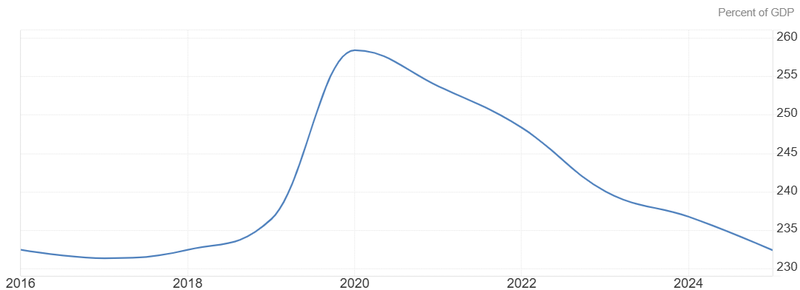
Source: Trading economics
Technical outlook
USD/JPY remains firmly in an uptrend, with the pair continuing to print higher highs and higher lows. This pattern reinforces the prevailing market behavior of buying dips rather than fading rallies.
Momentum indicators still lean supportive, although there are early signs that the pace of the move is beginning to slow. The RSI remains elevated but has started to flatten, suggesting that while the trend is intact, the market may be entering a phase of consolidation or slower appreciation rather than accelerating gains.
The 160 level remains a critical focal point. Beyond its psychological importance, it carries clear policy implications, given the history of intervention by Japanese authorities when the yen weakens beyond this threshold. A sustained move above it would increase the likelihood of official response, even if such actions only slow rather than reverse the trend.
On the top side, 161.95 represents the next key level. A break above would signal a continuation of the structural trend, with little immediate resistance ahead. In that scenario, the market could begin to look toward much higher historical reference points, including levels not seen in decades.
On the downside, 157.50 continues to act as a near-term pivot. A move below it would likely trigger a deeper pullback, though within the context of the broader uptrend. More meaningful support sits near 150.00, where a major moving average provides a stronger structural floor. A test of that level would suggest a more pronounced correction, but not necessarily a reversal unless accompanied by a shift in macro fundamentals.
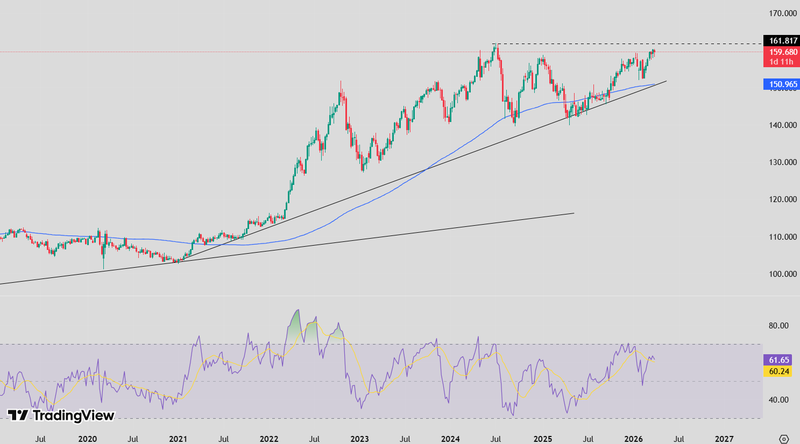
Source: Trading View


