
 Support
Yen under pressure as markets demand BoJ action
Political developments begins to reshape the outlook for the USD/JPY. Markets are increasingly looking ahead to the upcoming Bank of Japan meeting, where policymakers are expected to hold rates steady for now but with a noticeably more hawkish tone.

BoJ could signal a hawkish bias, laying the groundwork for a potential rate hike as early as May.
Prime Minister Sanae Takaichi is set to meet Donald Trump this week in a high-stakes discussion that highlights Japan’s delicate position in global geopolitics.
Government has already begun releasing oil from emergency reserves.
Break above 159 would require a combination of continued dollar strength and a significant shift in BoJ messaging.
Policy pauses, but a shift in direction
While no immediate rate move is expected this week, the tone of the BoJ’s communication is likely to matter more than the decision itself. Policymakers are still balancing fragile domestic demand with rising external inflation pressures, which makes a cautious approach understandable.
However, markets are beginning to price in a change. There is growing speculation that the BoJ could signal a hawkish bias, laying the groundwork for a potential rate hike as early as May. If inflation continues to be driven by currency weakness and energy costs, maintaining ultra-loose policy may become increasingly difficult to justify.
A more hawkish BoJ would likely support the yen, especially if it signals that policy normalization is approaching after years of accommodation. On the other hand, any hesitation or dovish tone could quickly reverse that momentum, keeping the yen under pressure.
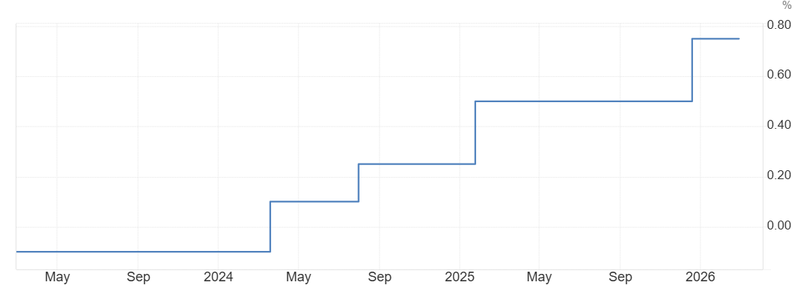
Source: Bank of Japan
US–Japan talks in focus
Prime Minister Sanae Takaichi is set to meet Donald Trump this week in a high-stakes discussion that highlights Japan’s delicate position in global geopolitics. The meeting follows Trump’s earlier call for Japan to deploy warships to the Strait of Hormuz, a request he later retracted. Tokyo must balance its heavy reliance on Middle East oil imports with ongoing US security guarantees, making the diplomatic dialogue particularly sensitive.
Historically, periods of political uncertainty or shifts in US policy direction have had a noticeable impact on USD/JPY. If talks hint at pressure on Japan regarding currency levels or trade balances, it could introduce volatility into the pair, particularly in the short term.
While the meeting may not produce immediate policy changes, signals from both sides are likely to be closely scrutinized for indications of how Japan will navigate increasing external pressures in the months ahead.
Middle East tensions and inflation spillover
The global backdrop is adding another layer of complexity. The conflict involving Iran has pushed oil prices higher, raising concerns about global supply disruptions. For Japan, which relies heavily on energy imports, this translates directly into higher costs across the economy.
To manage the immediate impact, the government has already begun releasing oil from emergency reserves. While this may provide short-term relief, it does little to change the broader trend. If elevated energy prices persist, inflation could remain higher for longer than policymakers had expected just months ago.
This dynamic strengthens the case for a gradual policy shift. Even if domestic demand remains uneven, imported inflation may force the BoJ to act sooner rather than later.
Technical outlook
Key resistance now sits near 159, while support lies around 152. A sustained break above 159 would require a combination of continued dollar strength and a significant shift in BoJ messaging, as verbal interventions alone may no longer be enough to influence the market. Traders increasingly expect tangible policy measures rather than statements to move the pair.
On the downside, a drop below 152 could signal a deeper shift in trend, particularly if driven by hawkish hints from the BoJ or a broader US dollar pullback. Momentum indicators are flattening, with the RSI at 60, suggesting that the pair may be entering a consolidation phase. This aligns with market behaviour ahead of the policy meeting, where traders appear cautious and are waiting for clear directional signals before committing to stronger positions.
If policymakers open the door to tightening in the coming months, particularly as early as May, it could mark the beginning of a more sustained recovery for the yen. On the other hand, if caution dominates and the bank avoids signaling a clear shift, the currency may remain under pressure for longer.
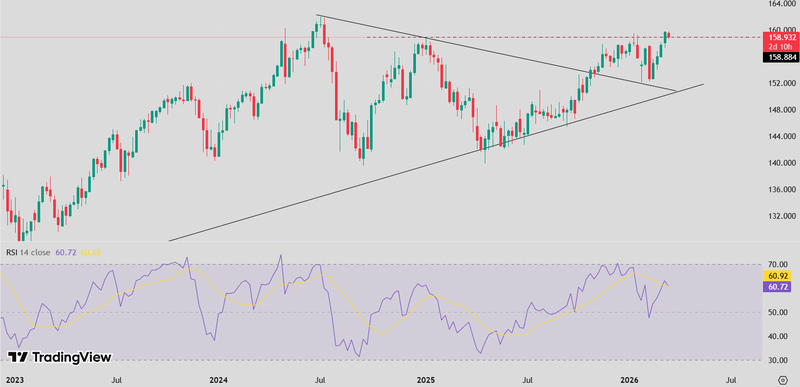
Source: Trading View


