
 Help
Help Fed and BoC hold rates steady, flag economic risks; Tech giants beat expectations
The Fed and Bank of Canada held rates steady at 3.75% and 2.25% respectively, citing geopolitical and economic risks. Central banks adopted neutral stances amid energy volatility. Simultaneously, Alphabet, Microsoft, Amazon, and Meta crushed Q1 2026 earnings estimates, propelling Nasdaq futures toward record highs.

Fed kept rates at 3.75% in a divided 8-4 vote, marking Jerome Powell’s final meeting as Chair while shifting toward a more neutral policy stance.
Bank of Canada maintained rates at 2.25%, citing Middle East conflicts and energy shocks as primary risks to 2026 growth.
Big Tech outperformed; Alphabet and Amazon saw EPS growth of 81.8% and 74.8%, respectively, pushing Nasdaq futures toward new historical peaks.
Amid high volatility, market reactions were mixed: Treasury yields rose to 4.43% and the DXY strengthened as investors weighed global risks.
Fed and BoC maintain rates; Federal Reserve shifts to neutral stance
Two of the world’s most influential central banks—the Bank of Canada (BoC) and the US Federal Reserve (Fed)—have concluded their latest monetary policy meetings. In both instances, the North American central banks held interest rates steady, a move that aligned with broad market expectations.
Bank of Canada decision and economic outlook
The Bank of Canada maintained its benchmark interest rate at 2.25%. The BoC continues to grapple with inflationary pressures stemming from a sharp appreciation in energy prices; however, the current headline inflation rate remains near the bank’s target at 2.4%. Conversely, the labour market has shown signs of cooling, with the unemployment rate rising to 6.7%. The Canadian central bank noted that while energy costs are elevated, they have not yet permeated broader economic sectors. It further updated its growth forecasts, projecting an expansion of 1.2% for 2026 and 1.7% for 2027.
The BoC declined to offer specific forward guidance on future rate trajectories, citing the high degree of geopolitical and economic uncertainty resulting from the ongoing US-Israel-Iran conflict in the Middle East. Regarding the market reaction, the Canadian dollar saw a marginal depreciation against the US dollar, which was simultaneously influenced by the Federal Reserve’s policy announcement.
Fed adopts neutral stance amid concerns over central bank independence
The Federal Reserve held its benchmark interest rate steady at 3.75%. This FOMC meeting, the final session with Jerome Powell serving as Chair, provided critical insights into the US economic outlook. The decision proved to be the most contentious since 1992, with the committee deeply divided; eight officials voted to maintain the federal funds rate at 3.5%–3.75%, while four members dissented. Of the dissenters, three questioned the Fed’s inherent bias toward monetary easing, while one advocated for an immediate rate cut. The committee maintained its "meeting-by-meeting" approach but formally noted a shift to a more neutral stance, given the prevailing instability caused by the energy shock in the Middle East.
During the subsequent press conference, Jerome Powell reaffirmed the Federal Reserve’s independence: "Monetary policy decisions are guided solely by economic data and not by political considerations."
Furthermore, Powell stated he would remain on the FOMC committee for as long as necessary to ensure a stable transition. He clarified that he would not act as a dissenting member against the incoming Chairman, Kevin Warsh, and emphasised that all Federal Open Market Committee decisions would remain focused on fulfilling the dual mandate of maximum employment and price stability.
Market reactions were mixed following the announcement. The Dow Jones Industrial Average fell 0.57% to 48,861 points, and the S&P 500 slipped marginally by 0.04% to 7,135. In contrast, the Nasdaq 100 gained 0.58% to reach 27,186 points. Fixed-income markets saw the 10-year US Treasury yield rise sharply by 8 basis points to 4.43%, while the Dollar Index (DXY) appreciated by 0.39% to 98.97 points.
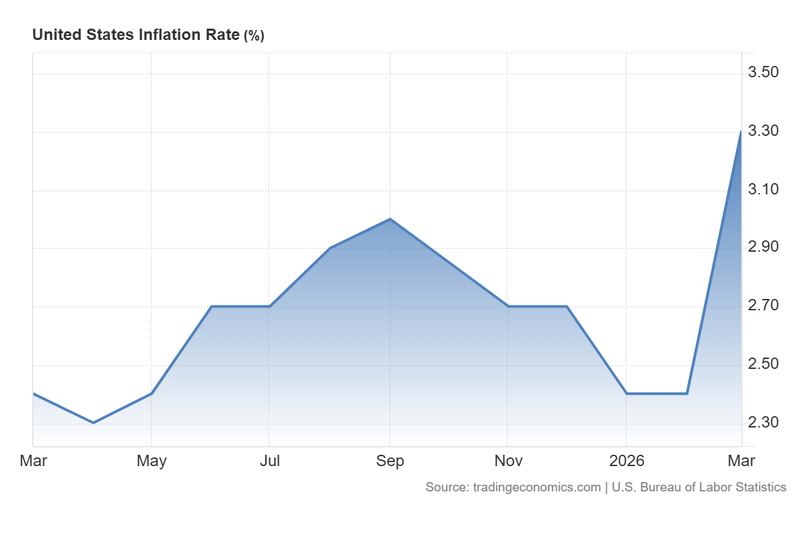
Figure 1. US Inflation Rate (2025-2026). Source: Data from the US Bureau of Labor Statistics; Figure obtained from Trading Economics.
Alphabet, Microsoft, Amazon, and Meta exceed expectations with robust Q1 2026 results
Four prominent members of the "Magnificent Seven"—Alphabet, Microsoft, Amazon, and Meta—surpassed analyst consensus for both total revenue and earnings per share (EPS) in their Q1 2026 reports.
Alphabet (GOOGL) reported revenue of $109.90 billion, exceeding the $106.79 billion forecast. The company posted an EPS of $5.11, significantly higher than the estimated $2.62. These results represent a year-on-year (YoY) revenue growth of 21.8% and an extraordinary 81.8% increase in EPS. Consequently, Alphabet's shares rose 6.57% in post-market trading.
Microsoft achieved total revenue of $82.90 billion, surpassing the $81.29 billion forecast. The firm reported an EPS of $4.27, ahead of the $4.05 analyst estimate. These figures reflect a YoY revenue growth of 18.3% and a 23.4% rise in EPS. However, the stock saw a marginal post-market depreciation of 0.08%.
Amazon disclosed total revenue of $181.50 billion, beating the market consensus of $177.13 billion. The e-commerce and cloud giant reported an EPS of $2.78, well above the $1.63 forecast. This represents a YoY revenue increase of 16.6% and a 74.8% surge in EPS. Amazon shares appreciated by 2.58% in after-hours trading.
Meta Platforms reached total revenue of $56.31 billion, slightly above the $55.52 billion forecast. The social media conglomerate achieved an EPS of $10.44, considerably higher than the $6.65 estimate. These results show a YoY revenue growth of 33% and a notable 62.3% increase in EPS. Despite these strong fundamentals, Meta’s shares declined by 6.55% in the post-market session.
The aggregate strength of these earnings drove an appreciation in the Nasdaq futures contract (NQM26) of approximately 0.55%. If these gains are sustained through the next market close, the index is poised to reach a new historical record.
