
 Help
Help BoJ holds rates amid higher-than-expected unemployment; Yen approaches key level
The Bank of Japan maintained interest rates at 0.75% despite a surprising rise in unemployment to 2.7%. Although three members favored a hike, the yen remains pressured near ¥159.50 against the dollar. Technical indicators suggest neutral momentum with a bearish divergence, leaving the market awaiting fundamental catalysts for a decisive breakout.

Japan’s unemployment rate climbed to 2.7%, exceeding consensus estimates and signalling potential vulnerability in the labour market amidst global macroeconomic headwinds.
The BoJ held rates at 0.75%, though the 3–6 vote split reveals growing internal pressure to address persistent inflationary risks.
The USD/JPY pair is currently testing the ¥160.00 psychological barrier, while momentum indicators such as the MACD and RSI oscillate within neutral territory.
Japanese unemployment rate exceeds Forecasts, but BoJ maintains neutral stance
According to data released by Japan’s Ministry of Internal Affairs and Communications, the unemployment rate rose from 2.6% in February to 2.7% in March, surpassing the analysts’ estimate of 2.6%. This figure represents a notable peak over recent years, suggesting that labour market pressures could intensify should the global macroeconomic environment continue to deteriorate. Despite this, the Bank of Japan (BoJ) elected to keep its interest rates unchanged at 0.75%. The BoJ’s policy report indicated that three of the nine board members voted for a 25-basis-point hike, suggesting that heightened concerns regarding inflationary pressures are increasingly influencing the central bank’s economic outlook.
Following the announcement, the Japanese yen experienced a modest appreciation against the US dollar, trading in the vicinity of ¥159.50. In the context of broader price action, the USD/JPY pair is currently confronting a critical long-term structural resistance.
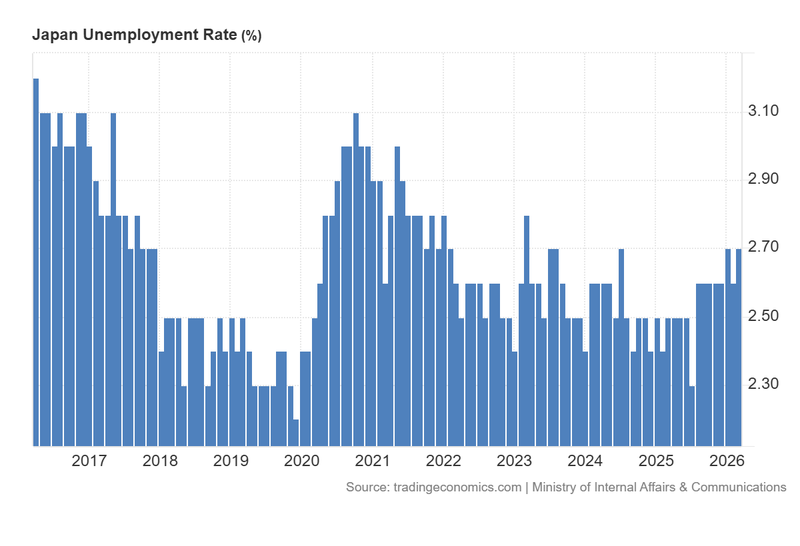
Figure 1. Japan Unemployment Rate (2016–2026). Source: Data from the Ministry of Internal Affairs & Communications of Japan; Figure obtained from Trading Economics.
Technical analysis of the USD/JPY pair
From a technical perspective, the USD/JPY pair exhibits bullish momentum as it tests a pivotal resistance level within a long-term consolidation pattern. Key observations include:
- Trend Context: Over the long term, the pair remains within a broad consolidation range, reflecting persistent market indecision. However, the medium-term trajectory maintains a technically bullish structure—defined by a sequence of higher highs and higher lows—as the price tests a critical resistance zone.
- Resistance Levels: Should the immediate short-term resistance at ¥160.00 be breached, the next significant technical ceiling is identified at the historical peak of ¥161.50. A decisive break above this level would signal the potential for further bullish extension.
- Support Levels: If the short-term support at ¥157.60 is invalidated, the next critical floor is located at ¥155.00. This level serves as the base of the current bullish channel; a breach of this zone would significantly increase the probability of a deeper market correction.
- Momentum Indicators: Both the Moving Average Convergence Divergence (MACD) and the Relative Strength Index (RSI) are currently trading within neutral zones, suggesting a lack of a clear predominant direction. Notably, the MACD is signalling a bearish divergence. Nevertheless, given the prevailing uncertainty, fundamental developments are likely to serve as the primary catalyst for the next major market reaction.
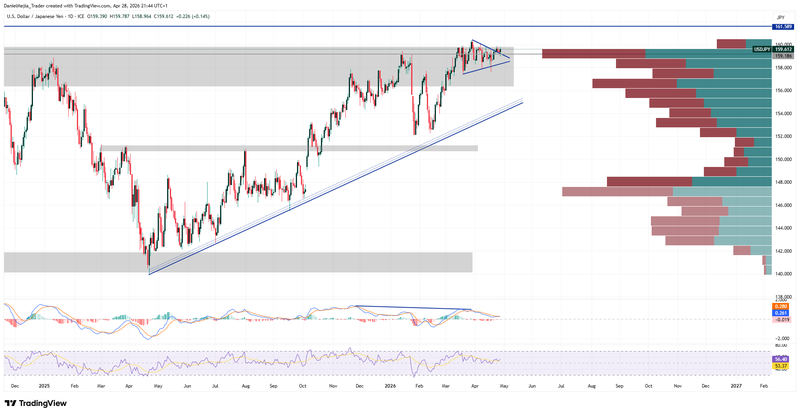
Figure 2. USD/JPY Pair (2025–2026). Source: Data from the Intercontinental Exchange (ICE); Own analysis conducted via TradingView.


