
 Help
Help

JPMorgan doubles on AI investments
JPMorgan strategy for 2026 is focused on AI and technology and treating it as core infrastructure rather than a peripheral experimental project, for Q1 the technology spending has reached $19.8B a 10% increase from the last year.

JPMorgan was honored as the digital banker innovation award as the best AI payments.
326–330 zone remains a firm resistance band.
Controlling the banking infrastructure
JPMorgan strategy for 2026 is focused on AI and technology and treating it as core infrastructure rather than a peripheral experimental project, for Q1 the technology spending has reached $19.8B a 10% increase from the last year. $1.2B of this increase is earmarked for high impact Ai initiatives, including generative AI and data infrastructure, on the other the cost rise to as high-performance AI chips and liquid cooled data centers needed to handle intensifying AI workloads.
Jamie Dimon emphasized that this scale of spending is necessary to maintain the competitive moat against their traditional rival Bank of America, while the net profit margin increased to 34.85% is driven by high-margin fee income and reduction in credit reserves.
The projections for Q2 are to maintain a robust return on tangible common equity in range 20-21% slightly lower than Q1 that recorded 23%.
One of the biggest projects was scale-up Ai from 450 to 1,000 use cases, and they moved beyond the pilot phase and focusing more on deployment velocity that has already on Q1 integrated over 450 AI use cases not live production with targeting in the end of 2026 to aim 1,000 active use cases.
The last core focus was on customer service to automate call centers and personalized next-best-action for 80 million consumers. The latest insights showed that 60,000 engineers have already shown 20% productivity gains, and that tools like contract intelligence are estimated to save 360,000 hours of manual work annually by auditing legal documents.
The latest project was Turbo that currently is internally developed as AI-powered platform designed by the testing innovation and intelligence team to upgrade the payment system delivery that used large language mode; to parse natural language an automatically generate test scenarios and code for payment flows this project is one of the most efficient projects in the banking sector honored as the digital banker innovation award as the best AI payments and best Ai powered platform.
Technical outlook
The rally from the low 200s into the 330–340 region was structurally strong, with higher highs and consistent support from the rising moving average that phase has clearly ended. Since peaking, price has formed a sequence of lower highs, and the descending trendline drawn from the top has acted as a persistent ceiling. Each rally attempt into that line has been met with supply, reinforcing the idea that positioning is changing rather than simply pausing.
The current area around 313–315 is critical. It is not just a horizontal level; it is where multiple forces intersect. Price is hovering near the moving average, which is still trending upward, but no longer acting as clean support. Instead, price is oscillating around it. That shift matters. When price trades comfortably above a rising average, it reflects control by buyers. When it starts to move through it repeatedly, it signals uncertainty and weaker conviction.
At the same time, the 326–330 zone remains a firm resistance band. It aligns with previous highs and sits just below the descending trendline. For the market to regain a constructive structure, price would need to break and hold above that area. Without that, rallies are likely to remain corrective rather than impulsive.
On the downside, the 313 level is the immediate line of defense, but the more meaningful support sits lower, near 280. That level marks the base of the previous consolidation and the point where buyers previously stepped in with strength. A break below 313 would not immediately confirm a trend reversal, but it would increase the probability of a move toward that deeper support. If 280 were to come under pressure, the broader structure would shift from consolidation into a more pronounced correction.
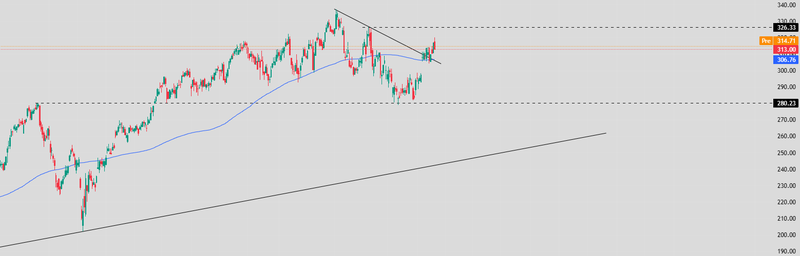
Source: Trading View


