
 Help
Help 
Rising energy Pushes the ECB back toward a hawkish tone
Eurozone inflation accelerated to 3.0% in April, up from 2.6% in March, with the move driven largely by energy shocks tied to the escalating conflict in the Middle East.
Lagarde pushed back against fears of stagflation.
ECB is moving away from its baseline scenario.
EUR/USD is transitioning from a bearish structure into a potential medium-term recovery phase.
Energy inflation changes the policy equation quickly.
Energy-driven inflation behaves differently from demand-led inflation. It moves fast and spreads quickly through the economy, from fuel and transport costs into factory input prices and household expenses. That creates a more complicated challenge for policymakers because it puts pressure on prices while also weighing on growth at the same time. It is exactly that combination that has pushed the June rate hike back into the conversation.
A June hike is now firmly back on the table
ECB had been moving toward a more neutral policy stance, expecting inflation to gradually normalize. But the recent rise in oil and energy costs is beginning to challenge that baseline.
Lagarde pushed back against fears of stagflation, dismissing the comparison as a “1970s term” that does not fit today’s economic conditions. Her argument is straightforward… the labor market remains resilient, employment remains stable, and underlying economic conditions are stronger than the typical stagflation framework would imply.
That distinction matters
Stagflation is not simply high inflation and slower growth it is persistent inflation combined with economic stagnation and labor weakness. Europe is not there yet.
But Lagarde also made it clear that the ECB is moving away from its baseline scenario.
It suggests policymakers are no longer treating the energy shock as a temporary volatility event. Instead, they are beginning to incorporate the possibility that prolonged geopolitical disruption could have broader and more persistent inflation consequences.
Lagarde warned that the longer the war in the Middle East continues, the stronger the inflation spillover into the broader economy becomes. That is not just about oil prices it is about business costs, consumer confidence, and inflation expectations.
ECB is now firmly in a meeting-by-meeting framework
That gives policymakers flexibility, but it also increases market sensitivity to every inflation release and every geopolitical headline. Short term, this keeps European bond yields supported and limits downside pressure on the euro as rate hike probabilities rise. But the broader challenge is balance.
If inflation remains elevated while growth slows, the ECB may be forced to maintain restrictive policy longer than markets expected. The immediate message is not tightening is certain. It is that inflation is becoming difficult again to keep tightening alive as a real possibility.
Technical outlook
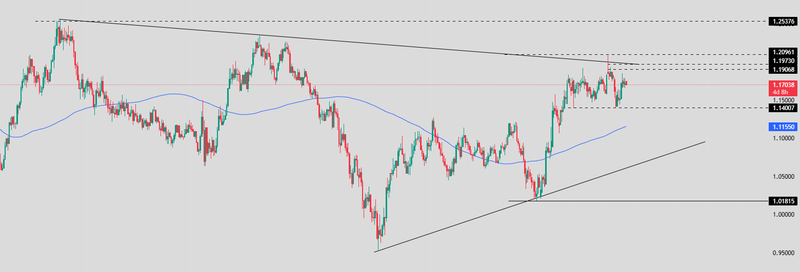
EUR/USD is transitioning from a bearish structure into a potential medium-term recovery phase, although the pair remains trapped beneath a dominant descending resistance trendline that has capped upside momentum for an extended period. The recent sequence of higher lows from the 1.018 area indicates that bearish momentum has weakened materially and buyers are beginning to establish a more constructive base.
The thing is that the price formed ascending support trendline. That creates a large triangular consolidation structure, which often precedes a significant macro move. Price is currently holding above the 126-day moving average near 1.115, which is a constructive signal because it suggests the market is gradually shifting from defensive dollar positioning toward a more balanced outlook between the euro and the dollar. The repeated defense of the 1.14–1.15 support zone also shows that institutional flows continue entering on pullbacks rather than allowing the pair to collapse back into its previous bearish range.
The bullish scenario develops if EUR/USD successfully breaks and closes above the descending resistance area around 1.19–1.21. Such a move would represent a major technical regime shift because it would invalidate the long-term sequence of lower highs that has controlled price action for years. Under that scenario, markets would likely interpret the breakout as confirmation that the dollar cycle is weakening, potentially driven by future Federal Reserve easing, declining Treasury yields, or improving European economic momentum. If buyers hold the price above 1.21, the next major upside target becomes the 1.25 region, which historically acted as a major macro resistance level.
The bearish scenario emerges if prices fail once again beneath the descending trendline and lose the 1.14 support region. That would indicate the broader downtrend remains dominant and that the recent recovery was only corrective rather than structural. In that environment, stronger US economic data, sticky inflation, or renewed geopolitical uncertainty could drive another wave of dollar strength. A breakdown below the ascending trendline would likely expose the pair back toward 1.08 and potentially the 1.01 support zone.
Source: Trading View


