Support
Global bond yields hit their highest levels since the financial crisis
Long-dated government bond yields around the world have climbed to levels not seen since the global financial crisis, as investors rethink how much compensation they need to hold duration in a world of higher energy costs, stubborn inflation risks and widening fiscal pressures. What began as an oil shock is now feeding into a broader repricing of the long end of the market.

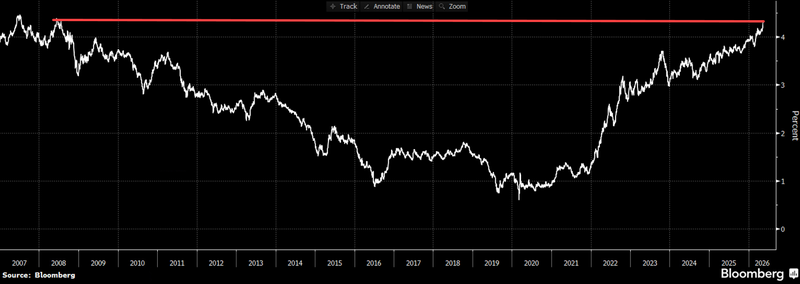
Global long-term government bond yields have climbed to their highest levels since 2008.
Rising oil prices, sticky inflation fears and heavier government borrowing are driving the selloff.
The global long-duration bond index has fallen 4.6% this year after being solidly positive in late February.
Yields may still have further to rise unless the Middle East shock begins to ease.
Long bonds are under pressure again
The selloff in long-dated government bonds is no longer a US story alone. It has become a global move, and it is pushing yields to levels last seen during the financial crisis.
Yields average on sovereign debt maturing in 10 years or more has climbed to its highest level since July 2008, as investors demand greater compensation to hold longer-maturity paper. The move reflects a market that is repricing inflation, fiscal risk and policy uncertainty all at once.
And for now, few in the market sound convinced that the adjustment is over.
Source: Bloomberg
The trigger was oil, but the repricing has spread far beyond energy
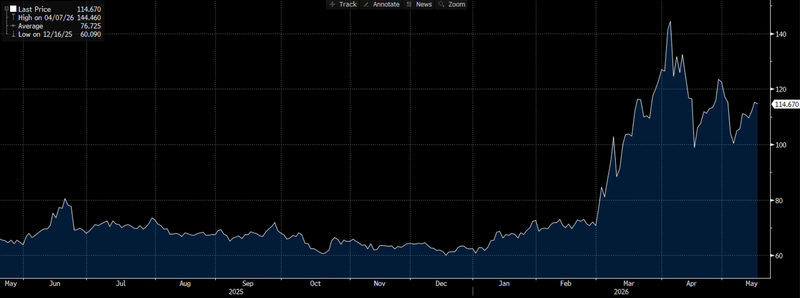
The immediate spark has been the rise in oil prices following the Iran war and the disruption around the Strait of Hormuz. Investors are increasingly worried that higher energy costs will not stay confined to crude and gasoline, but will bleed into a wide range of prices across the economy.
That is the real concern now. Oil does not just make fuel more expensive. It raises transport costs, production costs and input costs across sectors, from agriculture to manufacturing to consumer goods. Once the market starts to believe that kind of inflation pressure will linger, long-term bonds usually suffer first.
Source: Bloomberg
Fiscal worries are making the move worse
The selloff is not being driven by inflation alone. Bond investors are also confronting a less comfortable fiscal backdrop in several major developed markets, including the US, the UK and Japan.
Higher government spending, heavier issuance and a larger term premium are all feeding into the same trade. Investors are not just asking whether inflation will stay elevated. They are also asking whether governments will keep borrowing heavily into that environment — and what yield they should demand in return.
That combination is especially toxic for the long end of the curve.
The US is leading the move, but it is not alone
The clearest example remains the US Treasury market. Yields on 30-year Treasuries have jumped almost 60 basis points since the Iran war began, reaching 5.20%, their highest level since July 2007.
But this is not an isolated move. Long-dated UK gilts have climbed to levels not seen since 1998, and Britain has now overtaken Australia as the highest-yielding developed bond market at that tenor. That shift says a lot about how broad the pressure has become.
The message from the market is increasingly straightforward: investors want more yield, and they want it now.
The bond rally many investors expected this year has unraveled
This has been a painful reversal for investors who began the year expecting the global easing cycle to continue. At the end of February, the global index of bonds maturing in a decade or longer was up around 3% for the year. It has since swung to a loss of 4.6% in 2026.
That is a sharp turn in a short period of time, and it reflects how quickly the market has moved from pricing disinflation and rate cuts to pricing persistent inflation and the risk of more hawkish central banks.
The bond market is not yet saying rate hikes are certain everywhere. It is saying the path to easier policy now looks much less clean than investors had hoped.
The market still sees room for yields to go higher
That is why strategists remain cautious. Some argue the next key level for the US 10-year is above 4.75%, while others see 5.25% as the next near-term target for the US 30-year. In other words, the move has already been large, but there is no strong sense yet that yields have reached a ceiling.
Part of the reason is that the fundamental drivers have not gone away. Oil prices remain elevated. The war still lacks a credible off-ramp. Fiscal issuance remains heavy. And in the background, the private-sector investment boom tied to artificial intelligence is supporting growth enough to keep the inflation question alive.
That mix makes it difficult for bond bulls to step in with confidence.
Technical selling is adding fuel to the move
The selloff is not purely fundamental either. Technical factors are playing a role, with systematic strategies and algorithmic selling helping amplify the move. Once yields begin breaking through closely watched levels, those flows can accelerate the repricing and make the market feel even more unstable than the fundamentals alone would suggest.
That matters because it means the bond market is not just adjusting — it is feeding on its own momentum.
For now, the bias is still toward higher yields
The broader tone in the market suggests investors are increasingly willing to believe that inflation will stay sticky, that central banks may have to sound tougher again, and that long-dated bonds need to offer more compensation than they did even a few months ago.
A genuine reversal would probably require one of two things: a clearer de-escalation in the Middle East that brings oil lower in a durable way, or a meaningful shift in growth expectations that makes the inflation scare look overdone.
At the moment, neither condition is fully in place.
The bond market is repricing a more difficult world
What this selloff really shows is that the market is adjusting to a less comfortable macro regime. The old assumption — that inflation would keep fading and central banks would keep easing — has run into a new set of risks.
Higher oil, persistent inflation, fiscal deterioration and resilient growth are now colliding at the long end of the market. Until that mix changes, long-dated government bonds are likely to stay under pressure.
And that means the global repricing in yields may still have further to run.