
 Support
 US–Iran tensions lift oil prices; Canadian inflation accelerates
Escalating tensions between the United States and Iran, coupled with near ceasefire deadline, have propelled oil prices upwards by more than 5%. Simultaneously, Canadian headline inflation rose to 2.4% in March, primarily driven by surging energy costs.

US military threats and the potential closure of the Strait of Hormuz pushed Brent crude to $95.48 as the 21 April ceasefire deadline approaches.
Uncertainty surrounding negotiations in Pakistan triggered sharp price spikes, causing WTI futures to rally by 5.85% and gasoline to advance by 3.76%.
Canadian inflation reached 2.4% in March, fuelled by a 21.2% monthly surge in gasoline prices, yet remained within the BoC’s 1% to 3% target corridor.
Market participants remain focused on quarterly earnings reports from industry leaders including Tesla, Boeing, and Intel.
Geopolitical volatility persists as US–Iran negotiations approach ceasefire deadline: Oil prices rally sharply
According to reports from CNBC, US President Donald Trump has threatened Iran with increased military force—specifically targeting infrastructure such as bridges and power plants—should a diplomatic resolution not be reached before the ceasefire expires on the evening of Tuesday, 21 April. Official information remains opaque, as it is currently unclear whether Iranian officials will attend the second round of negotiations scheduled in Islamabad, Pakistan.
Furthermore, significant doubts persist regarding the feasibility of a bilateral agreement, as the primary objectives of the United States and Iran appear fundamentally opposed. Consequently, geopolitical analysts do not have a clear understanding of the current basis for negotiation. In a bilateral show of strength, Iranian forces continue to restrict access to the Strait of Hormuz—a critical maritime artery for global energy commodities—while US forces maintain a blockade of Iranian ports.
This heightened uncertainty has sparked intense volatility across financial markets, particularly within the energy sector, where prices jumped by over 5% during the trading session. At the market close, the Brent futures contract (BRNM6) had increased by 5.64% to $95.48 per barrel, while the West Texas Intermediate (WTI) futures contract (CLM6) advanced by 5.85% to $87.43 per barrel. Similarly, the gasoline futures contract (RBM6) appreciated by 3.76% to $3.04 per gallon.
Investors remain acutely focused on the outcome of the US–Iran talks and the potential long-term implications. Meanwhile, global concerns are mounting regarding the potential impact of a persistent US–Israel–Iran conflict on inflationary pressures and broader economic growth.
Canadian inflation accelerates while remaining below analyst estimates
Data from Statistics Canada reveals that the headline inflation rate accelerated from 1.8% in February to 2.4% in March, primarily driven by a prominent increase in energy prices. Notably, this figure was slightly lower than the analyst consensus of 2.5%. Concurrently, core inflation—which excludes volatile components such as energy and unprocessed food—rose from 2.3% to 2.5%. Nevertheless, as inflation remains within the Bank of Canada’s control range of 1% to 3%, the probability of the BoC adopting a more hawkish monetary policy stance in the near term has diminished.
An analysis by Trading Economics indicates that energy prices rose by 3.9% following a negative performance of 9.3% in the preceding month. This acceleration was largely underpinned by a 21.2% monthly increase in gasoline costs. Additionally, price increases were noted in shelter (rising from 1.5% to 1.7%) and the recreation and education sector (increasing from 0.5% to 2.6%).
In the currency markets, the USD/CAD pair depreciated by 0.30% to 1.3644. This move coincided with a decline in the US Dollar Index (DXY), which faced downward pressure due to the prevailing uncertainty surrounding the resolution of the Middle East conflict.
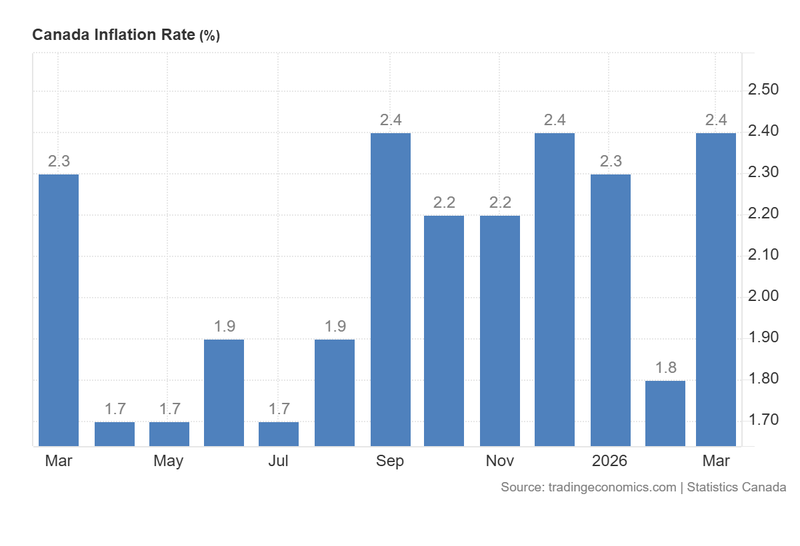
Figure 1. Canada Inflation Rate (2025–2026). Source: Data from Statistics Canada; Figure obtained from Trading Economics.
Quarterly US financial results
The first-quarter 2026 earnings season continues this week. The following key institutions are scheduled to report, which may contribute to further volatility in the US equity markets:
Tuesday
- UnitedHealth Group (UNH)
- 3M Company (MMM)
Wednesday
- Tesla Inc. (TSLA)
- International Business Machines (IBM)
- Boeing Co. (BA)
Thursday
- Intel Corporation (INTC)
- American Express (AXP)
Friday
- Procter & Gamble (PG)
Key economic events this week
Several critical economic indicators are scheduled for release this week, with the following being of particular importance to market participants:
Monday
- Canada: Inflation Rate
Tuesday
- United Kingdom: Unemployment Rate
- Germany: ZEW Economic Sentiment Index
- US: Retail Sales
- Japan: Balance of Trade
Wednesday
- United Kingdom: Inflation Rate
- US: EIA Crude Oil Stocks Change
Thursday
- Japan: Inflation Rate
Friday
- United Kingdom: Retail Sales
- Germany: Ifo Business Climate
