
 Support

From AI chips to the backbone of the computing transformation
Nvidia is no longer just an AI chip story; it is becoming the backbone of an entire computing shift. The latest developments reinforce that transition, the launch of Ising, the first open-source AI model family designed for quantum computing workflows

The launch of Ising is not just a technical milestone, it is positioning.
Price is likely to rotate back toward the $180–185 region.
Fundamentals are expanding beyond AI into infrastructure
NVIDIA is no longer just an AI chip story; it is becoming the backbone of an entire computing shift. The latest developments reinforce that transition, the launch of Ising, the first open-source AI model family designed for quantum computing workflows, is not just a technical milestone, it is positioning. Nvidia is moving early into the intersection of AI and quantum, specifically targeting error correction and system calibration, which are among the biggest bottlenecks in scaling quantum systems, this is not about near-term revenue, it is about owning the next layer of computing infrastructure.
At the same time, partnerships are extending their reach deeper into enterprise deployment. The collaboration with SUSE on the AI factory is a direct response to a real problem companies are struggling to move from experimentation to production. Nvidia is now embedding itself not just in model training, but in the full lifecycle of AI deployment. That shifts its role from hardware provider to ecosystem enabler.
Even though the supply chain reflects this demand intensity, the 60% surge in Victory Giant Technology’s IPO highlights how critical Nvidia’s ecosystem has become printed circuit boards are not a headline product, but they are essential, when suppliers rally like this, it signals that demand is not isolated it is spreading across the entire stack.
Technical outlook
Nvidia after a prolonged period of consolidation marked by lower highs, price has pushed back into the $200–202 zone, which aligns with the descending trendline that has capped every rally since the previous peak. This is not just another resistance level. It is the point where the correction phase either ends or extends.
What makes the current move different from prior attempts is the path taken to get here. The stock did not simply bounce. It has a rebuilt structure. The recovery from the $165–170 area was strong and, more importantly, it held above the 126-day moving average around the mid-$180s. That matters because it signals that buyers are not just reacting at extremes, they are stepping in earlier and with more conviction. Momentum has shifted from defensive to constructive, but it has not yet been confirmed.
Price is now pressing against resistance from a stronger position, but it has not cleared it. A clean break and hold above the $200 area, particularly if it sustains above the trendline, would mark a structural shift. That would signal that the sequence of lower highs has been broken and the market is ready to transition back into an expansion phase, with room toward the $215–220 area where previous highs begin to come into focus.
If that break fails, the implication is different. It would suggest that the market is still in a rebalancing phase, not yet ready to extend higher. In that case, price is likely to rotate back toward the $180–185 region, using the moving average as support again, and continue trading within a broader range.
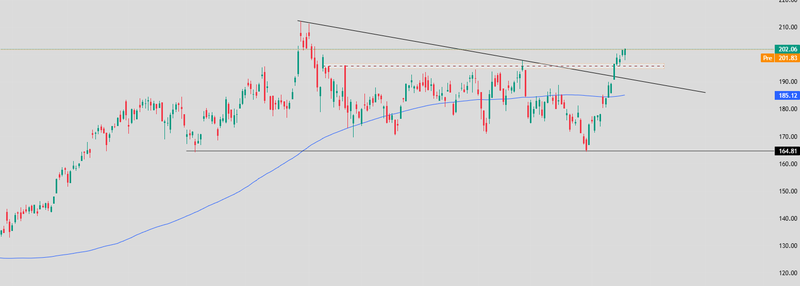
Source: Trading View


