
 Support
IonQ: big quantum promises, but the market wants proof
IonQ successfully connected two independent trapped-ion quantum systems using photonic interconnects, advancing modular quantum computing capabilities.

The upside scenario depends on continued contract wins, deeper government partnerships.
First major level to watch is around $50–55. This is where previous rallies have struggled and where supply is likely still present.
IonQ from quantum hardware to quantum networks
IonQ is no longer just a “quantum computing company” in the traditional sense. The story is shifting toward something broader and potentially more important: quantum networking. The recent milestone of successfully connecting two independent trapped-ion systems using photonic interconnects is not just a technical achievement, it’s a signal about where the industry is going.
Quantum computing has always faced a scaling problem. Building a single, massive quantum machine is incredibly complex. IonQ’s approach linking smaller systems together mirrors how classical computing evolved into distributed cloud infrastructure. If this model works, it could redefine how quantum systems are built and deployed, making scalability more achievable over time.
That’s where the DARPA HARQ program becomes significant. Being selected to develop high-speed interconnects between different types of qubits positions IonQ at the center of a key bottleneck in the industry: interoperability. Most quantum systems today are siloed. If IonQ helps solve that, it becomes more than a hardware provider it becomes part of the infrastructure layer.
The company is still early stage, with around $130 million in revenue for 2025. That tells you two things at once. First, demand is real and growing, particularly from governments and research institutions. Second, this is still a long-duration story, not a near-term earnings play.
The market is starting to price that dual reality. On one hand, investors are willing to assign a premium to companies tied to next-generation computing themes like AI and quantum. On the other hand, they are becoming more selective. The key question now is whether IonQ can translate technical progress into sustained commercial growth.
The upside scenario depends on continued contract wins, deeper government partnerships, and proof that quantum networking can move from lab to real world deployment. The risk is timing. If commercialization takes longer than expected, the stock can remain volatile, even if the long-term thesis stays intact.
Technical outlook
IonQ chart tells a story of excitement followed by reality. The stock experienced a sharp rally into the 2025 highs near the $80–90 zone, driven by enthusiasm around quantum computing and next-generation tech themes. But what followed was a significant correction, bringing price back into a more balanced structure.
Right now, the key observation is stabilization. The stock has pulled back into the $30–35 region, which is acting as a demand zone. This area aligns with a rising long-term trendline and a key moving average, suggesting that longer-term buyers are stepping in.
The recent bounce from that zone is important, but it’s not yet a confirmed reversal. It looks more like an attempt to build a base after a prolonged decline. Price is currently trading in the mid-$40s, which puts it back into a transitional zone not quite bullish, but no longer in free fall.
On the upside, the first major level to watch is around $50–55. This is where previous rallies have struggled and where supply is likely still present. A clean break and hold above that zone would signal a shift in momentum and could open the door toward a broader recovery, potentially retesting higher levels over time.
On the downside, the $35–30 area remains critical. If the stock holds above this zone, the current structure can evolve into a consolidation base. If it breaks below, it suggests that the market is still repricing the story and that further downside is possible.
Momentum indicators also reflect this transition phase. The stock is recovering from oversold conditions, but it has not yet entered a strong bullish regime. That reinforces the idea that this is a rebuilding process, not a completed trend reversal.
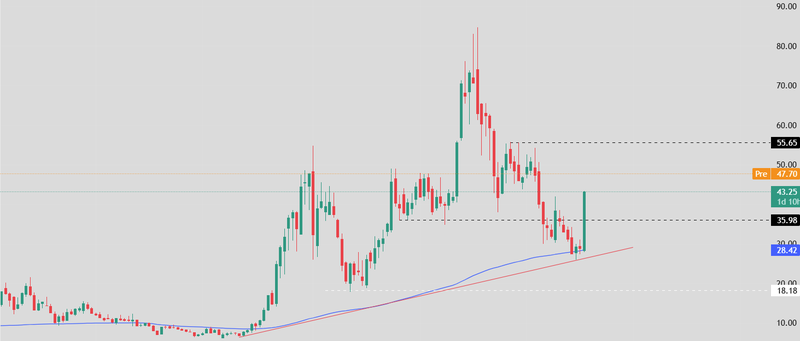
Source: Trading View


