Support
A guide to global stock market trading hours
Global stock market trading hours depend on the exchange and region, with most major markets open during local business hours from Monday to Friday. Understanding these schedules helps traders track opportunities across markets.
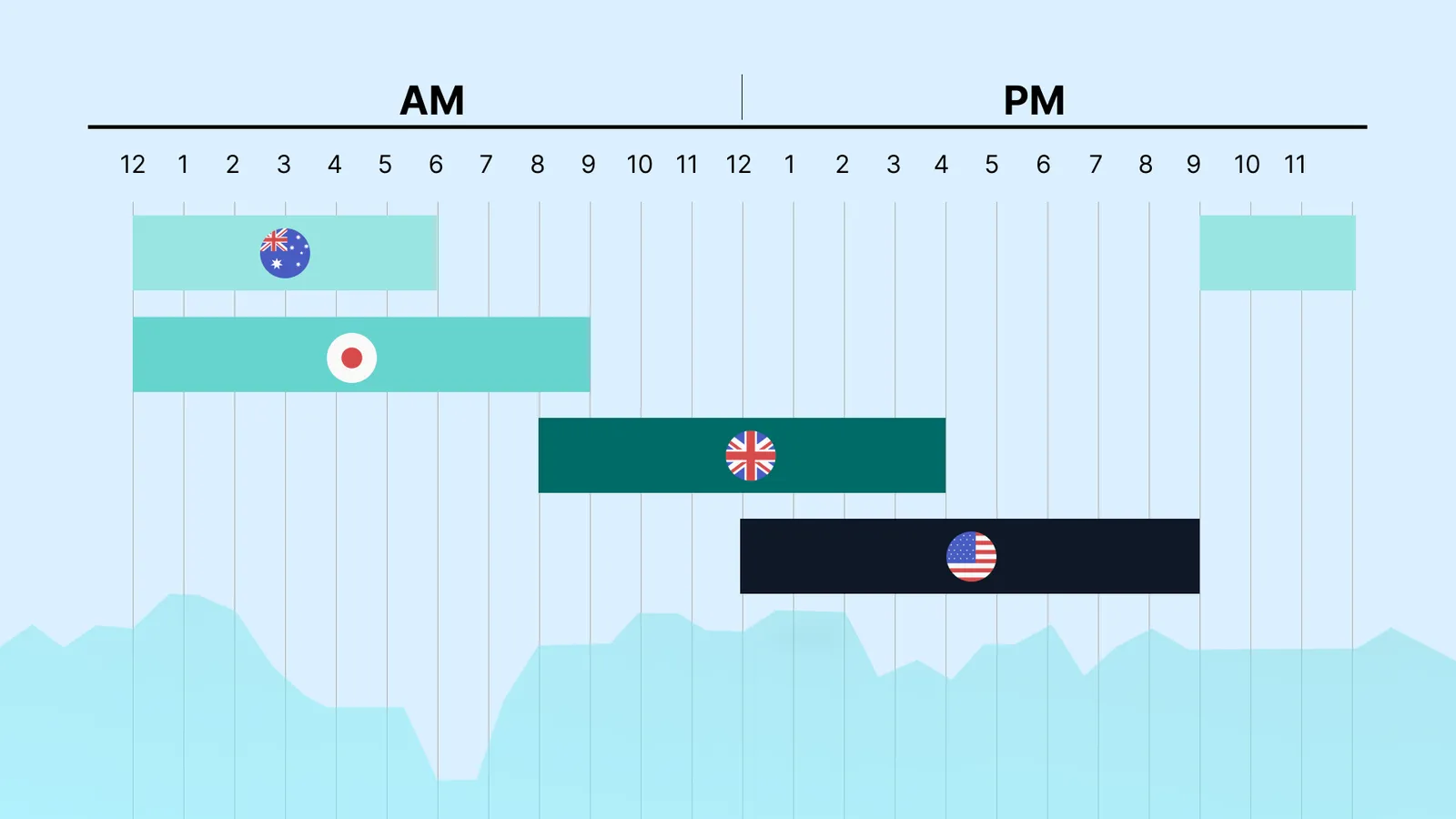
The U.S. stock market open marks the start of regular trading on the New York Stock Exchange and Nasdaq.
In the United Kingdom, the main exchange is the London Stock Exchange.
In Japan, the Tokyo Stock Exchange is the primary stock exchange.
U.S. Stock market open
The standard U.S. stock market open refers to the regular trading session for the New York Stock Exchange and Nasdaq. Both exchanges open at 9:30 a.m. Eastern Time and close at 4:00 p.m. Eastern Time, Monday through Friday, excluding market holidays and the biggest stocks around the world trade in these hours such as NVDA, TSLA, GOOG.
The U.S. trading week
U.S. stock markets trade from Monday to Friday. They are closed on weekends and on official market holidays, including dates such as New Year’s Day, Martin Luther King Jr. Day, Presidents’ Day, Good Friday, Memorial Day, Juneteenth, Independence Day, Labor Day, Thanksgiving, and Christmas. The official NYSE and Nasdaq holiday calendars should always be checked because holiday observance can shift when dates fall on weekends.
U.S. extended trading hours
Outside the regular 9:30 a.m. to 4:00 p.m. ET session, U.S. stocks may trade during extended hours. Nasdaq lists pre-market trading from 4:00 a.m. to 9:30 a.m. ET and after-hours trading from 4:00 p.m. to 8:00 p.m. ET. However, access depends on the broker, the security, liquidity, and order-routing arrangements. Extended-hours trading is usually handled through electronic systems and often comes with wider spreads, lower volume, and higher execution risk.
Early close days in the U.S.
The U.S. stock market sometimes closes early, most commonly at 1:00 p.m. ET. For 2026, Nasdaq lists close early on Friday, November 27, 2026, the day after Thanksgiving, and Thursday, December 24, 2026, Christmas Eve. NYSE also states that markets close early at 1:00 p.m. on those dates.
Early close rules differ by country and exchange. A day that is normal in the U.S. may be a holiday in Europe or Asia, while local markets can also close early for national holidays, weather events, or exchange-specific reasons.
United Kingdom stock market hours
The main stock exchange in the United Kingdom is the London Stock Exchange, commonly known as the LSE. The market operates Monday through Friday and is generally open from 8:00 a.m. to 4:30 p.m. London time. During winter, trading hours follow Greenwich Mean Time (GMT), while in summer the UK shifts to British Summer Time (BST), which is GMT+1.
The London market is one of the most important financial centers globally and attracts strong institutional participation from banks, hedge funds, and asset managers. Trading activity is usually highest during the first two hours after the open and again during the overlap with U.S. markets, when liquidity and volatility increase significantly.
Unlike several Asian exchanges, the London Stock Exchange does not have a lunch break and operates continuous trading throughout the day. However, the exchange uses opening and closing auction periods to help establish fair pricing and manage large institutional orders.
The market closes on weekends and major UK holidays such as Christmas, Good Friday, and bank holidays. On certain days before major holidays, the exchange may also close early. Traders should always check the official LSE calendar because holiday schedules and early close sessions can vary from year to year.
Japan stock market hours
The primary stock exchange in Japan is the Tokyo Stock Exchange. The market operates Monday through Friday and is divided into two trading sessions. The morning session runs from 9:00 a.m. to 11:30 a.m. Japan Standard Time, while the afternoon session runs from 12:30 p.m. to 3:30 p.m. JST.
One of the defining features of the Japanese market is its midday lunch break. Trading stops for one hour before resuming in the afternoon. This structure is still common across several Asian exchanges and can influence liquidity and volatility patterns throughout the day. Japan does not observe daylight saving time, meaning its market hours remain consistent year-round. However, the time difference between Tokyo and markets such as London or New York changes seasonally because Western countries adjust their clocks.
The Tokyo market is heavily influenced by global economic sentiment, export demand, and movements in the Japanese yen. Many Japanese companies rely on international trade, so currency fluctuations often affect stock performance. The exchange closes on weekends and Japanese national holidays, including the New Year period and Golden Week holidays.
Lunch breaks and market structure differences
Not every stock market trades continuously throughout the day. Several Asian exchanges still have lunch breaks. Tokyo pauses between the morning and afternoon sessions, Hong Kong has a midday break, and Shanghai also stops trading between the morning and afternoon sessions. This matters because liquidity can change sharply before and after the break.
Some European markets also include auction mechanisms rather than simple continuous trading from open to close. London, for example, has auction periods, and market structure sources commonly note a brief midday auction window. Euronext and Xetra also use opening and closing auction phases around their continuous trading sessions.
Time zones and daylight-saving
Time zones are one of the biggest sources of confusion when checking market hours. U.S. stock market hours are quoted in Eastern Time, which shifts between Eastern Standard Time and Eastern Daylight Time depending on the season. London shifts between GMT and BST, while much of continental Europe shifts between CET and CEST. Japan does not use daylight saving time, so the time difference between Tokyo and New York can change seasonally. The safest approach is to treat the exchange’s local time as the official baseline, then convert using a live world clock or broker platform during daylight saving transition weeks.
Nasdaq 23-Hour trading plan
A major change is coming, but it is important to separate what is currently live from what is approved or planned. Nasdaq currently operates regular trading from 9:30 a.m. to 4:00 p.m. ET, with pre-market and post-market sessions around it, the SEC approved Nasdaq’s proposal to expand trading toward a 23-hour, five-day structure for NMS stocks and ETPs. The approved framework includes a day session from 4:00 a.m. to 8:00 p.m. ET and a night session from 9:00 p.m. to 4:00 a.m. ET. This does not mean the regular U.S. market open has already changed. For now, the standard stock market open remains 9:30 a.m. ET, and the regular close remains 4:00 p.m. ET.
FAQs
What time does the U.S. stock market open?
The NYSE and Nasdaq regular trading session opens at 9:30 a.m. ET and closes at 4:00 p.m. ET.
Is the stock market open on weekends?
No. U.S. stock markets are closed on Saturdays and Sundays.
What are pre-market hours?
Nasdaq pre-market trading typically runs from 4:00 a.m. to 9:30 a.m. ET, though broker access can vary.
What time does the stock market close early?
On U.S. early-close days, the stock market usually closes at 1:00 p.m. ET.
Is Nasdaq already open 23 hours a day?
No. The 23-hour trading structure has been approved, but the standard regular session remains 9:30 a.m. to 4:00 p.m. ET.