Support
 What moves USD/MXN in currency trading
USD/MXN is influenced by a mix of economic, geopolitical and trade factors. The gap between Federal Reserve and Bank of Mexico policy is a key driver, while trade agreements, fiscal conditions, elections and oil prices also affect the pair.
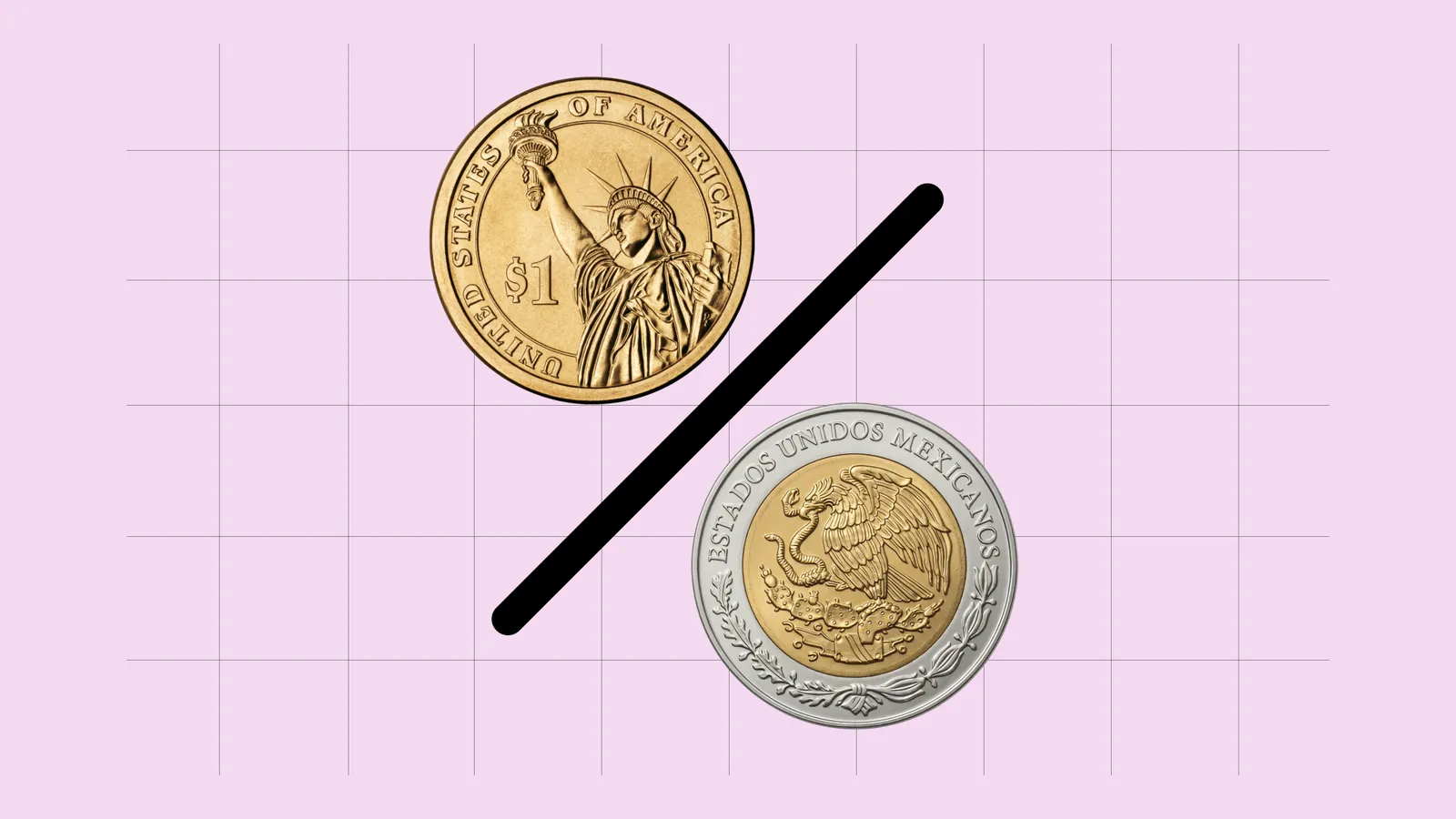
The difference between Banxico and Fed interest rates can strengthen the Mexican peso’s appeal through carry trade demand.
USMCA trade links make the USD/MXN exchange rate highly responsive to tariff threats and geopolitical friction.
The Mexican peso is often treated as a risk-on asset, tending to depreciate during presidential elections or global crises.
Mexico’s public revenues and external accounts are sensitive to oil price moves, with crude declines often weighing on the currency.
What factors move the USD/MXN pair?
The exchange rate parity between the US dollar and the Mexican peso (USD/MXN) is driven by a multifaceted array of determinants, resulting in persistent volatility that necessitates a rigorous risk management framework. Among the most influential factors are the divergence in monetary policy stances between the central banks of the United States and Mexico, macroeconomic outlooks and fiscal stability, and cross-border trade flows within the trilateral United States-Mexico-Canada Agreement (USMCA)—one of the most heavily transacted trade blocs globally.
Monetary policy divergence between the Federal Reserve and the Bank of Mexico
Rate differential and the Carry Trade phenomenon
The interest rate differential between Mexico and the United States stands as a cornerstone of the historical appreciation or depreciation of the Mexican peso. During intervals when Banxico maintains policy rates substantially above those of the Fed (for instance, 7.0% relative to 3.5%), this spread enhances the attractiveness of sovereign debt securities denominated in Mexican pesos, thereby stimulating international capital inflows and boosting demand for the currency.
Consequently, the "carry trade" phenomenon—whereby market participants borrow capital in a low-yielding currency (such as the US dollar) to invest in a higher-yielding alternative (such as the Mexican peso)—has historically amplified this appreciative bias. However, this strategy extends beyond simple yield spreads; heightened exchange rate volatility can rapidly erode profit margins and trigger substantial capital losses. As a result, market participants continuously evaluate the underlying macroeconomic metrics and fiscal rectitude of both nations.
Mandates of the Federal Reserve and the Bank of Mexico
The Bank of Mexico and the Federal Reserve operate under fundamentally distinct institutional mandates. Banxico maintains a primary mandate to preserve the purchasing power of the national currency, which operationalises as anchoring inflation near a 3.0% target. Conversely, the Fed operates under a dual mandate: maintaining price stability around a 2.0% inflation target whilst fostering maximum sustainable employment. Understanding these divergent institutional objectives allows investors and traders to form more accurate projections regarding potential central bank interventions by closely monitoring inflation and employment indicators and evaluating their direct implications for the USD/MXN exchange rate.
Macroeconomic factors impacting USD/MXN
Macroeconomic fundamentals are crucial for comprehending the directional behaviour of the Mexican peso against the US dollar. Rather than focusing exclusively on nominal interest rate differentials, global market participants continuously scrutinise systemic macroeconomic performance and fiscal stability to determine whether to retain exposure to peso-denominated assets or liquidate holdings in response to escalating volatility.
Macroeconomic stability and fiscal discipline
Macroeconomic stability—characterised by maintaining core variables such as inflation close to official targets—is a foundational pillar for emerging market currencies like the Mexican peso, as it provides a predictable environment for domestic consumption and capital investment. Concurrently, strict fiscal discipline, achieved by managing a balanced budget between state revenues and expenditures, underpins long-term currency stability. An unsustainable reliance on external debt to finance structural fiscal deficits risks undermining sovereign creditworthiness, potentially jeopardising the government's capacity to service obligations to bondholders.
Trade policy and geopolitics: The USMCA factor
Reflecting the deep structural integration of cross-border supply chains between Mexico and the United States under the auspices of the USMCA (alongside Canada), the USD/MXN currency pair exhibits acute sensitivity to trade-related uncertainty. Furthermore, the exchange rate has historically demonstrated heightened vulnerability during periodic reviews regarding the continuity of the treaty, which frequently serves as a mechanism for geopolitical leverage and a primary source of market volatility.
Tariffs and trade uncertainty
While the USMCA framework provides an institutional architecture for mutually beneficial free trade, protectionist episodes and trade disputes throughout the history of bilateral relations have significantly perturbed the USD/MXN pair. For instance, aggressive shifts in US trade policy, such as the unilateral imposition of tariffs on steel and aluminium imports in 2025, introduced profound exchange rate volatility and generated considerable risk aversion among institutional investors holding peso-denominated fixed-income instruments.
Historical outlook: Volatility in the USD/MXN pair
Longitudinal analysis of historical patterns within the USD/MXN pair reveals that the exchange rate experiences pronounced clusters of volatility during domestic presidential election cycles and epochs of global macroeconomic duress.
On one hand, the Mexican peso routinely exhibits a depreciative bias during domestic electoral processes due to political uncertainty surrounding potential regime shifts, reflecting investor anxiety regarding structural reforms or fiscal realignments under an incoming administration. On the other hand, the peso systematically depreciates during global financial crises, driven by a classic "flight-to-safety" dynamic wherein international capital flees emerging market assets to seek refuge in risk-free instruments like US Treasury bonds, systematically driving up demand for the US dollar.
The role of crude oil in the USD/MXN pair
Although Mexico's export base has become highly diversified towards manufacturing due to the USMCA, crude oil extraction and exportation maintain a structurally significant role within the nation's trade balance. Consequently, both the balance of payments and state fiscal revenues (via Pemex) remain highly exposed to fluctuations in international crude benchmarks, specifically the Mexican crude oil mix. Sharp contractions in oil prices typically trigger a depreciation of the Mexican peso, as reduced public sector revenues could unbalance the fiscal deficit and compromise sovereign credit metrics.
Conclusion
In conclusion, the trajectory of the USD/MXN currency pair is not dictated by any single variable in isolation, but rather emerges from a complex ecosystem of deeply interconnected macroeconomic forces. While nominal interest rate differentials, foundational macroeconomic stability, and trade flows under the USMCA govern medium-term structural trends, domestic fiscal rectitude, cyclical political risk, and commodity price shocks serve as immediate catalysts for volatility. Navigating this currency pair successfully demands continuous, sophisticated monitoring that seamlessly synthesises fundamental macroeconomic analysis with a rigorous risk-mitigation framework.
If you're interested in trading indices, foreign exchange, shares, or commodities, consider exploring the CFD contracts offered by Equiti Group. Please note that trading leveraged derivatives involves a high level of risk and may not be suitable for all investors.
FAQs
How does the interest rate differential affect the USD/MXN pair?
When the Bank of Mexico (Banxico) maintains a higher benchmark policy rate than the US Federal Reserve (Fed), Mexican sovereign bonds become highly attractive to international institutional capital. This spread incentivises the carry trade—a speculative strategy in which market participants borrow capital in low-yielding US dollars to invest in high-yielding peso-denominated instruments. This steady capital inflow drives structural demand for the peso, fostering its appreciation against the US dollar, provided that broader market volatility remains suppressed and does not erode the nominal yield advantage.
Why is the USMCA treaty so influential in the pricing of the USD/MXN pair?
Mexico and the United States exhibit a profound degree of economic interdependence, characterised by tightly integrated cross-border value chains. Owing to this systemic connection, any emergence of trade friction, tariff disputes, or bilateral geopolitical tension instantly dampens economic growth forecasts and disrupts physical export volumes. Financial markets react dynamically by adjusting cross-border portfolios and peso-denominated hedges, establishing the USD/MXN exchange rate as an exceptionally liquid and highly sensitive barometer for shifts in regional trade policy.
What role do presidential elections and global crises play in historical USD/MXN volatility?
Historically, the Mexican peso undergoes pronounced depreciation cycles during domestic electoral transitions due to potential changes surrounding structural reforms or fiscal reorientations by an incoming administration. Conversely, during periods of international financial distress, a global "flight-to-safety" dynamic is triggered. Institutional investors systematically liquidate higher-yielding emerging market exposures (such as the MXN) to reallocate capital into risk-free haven assets, predominantly US Treasury bonds. This sudden surge in global dollar demand aggressively depreciates the peso during periods of widespread risk aversion.
Why do oil prices continue to affect the peso despite export diversification?
Although Mexico's export baseline has structurally pivoted towards advanced manufacturing, petroleum extraction maintains an indispensable role in safeguarding public finances. Therefore, state fiscal revenues and the national balance of payments remain intrinsically tied to the market value of the Mexican Crude Oil Price. Consequently, a sharp contraction in global crude oil benchmarks suppresses government revenue streams, threatening the fiscal balance and impairing foreign investor confidence, which ultimately exerts upward pressure on the USD/MXN exchange rate.