
 Help
Help 
China continues adding gold for an 18th straight month
China continued adding to its gold reserves for an 18th straight month, another sign that major central banks are still slowly diversifying away from heavy dependence on the US dollar.
China’s gold holdings rose to 74.64 million fine troy ounces at the end of April.
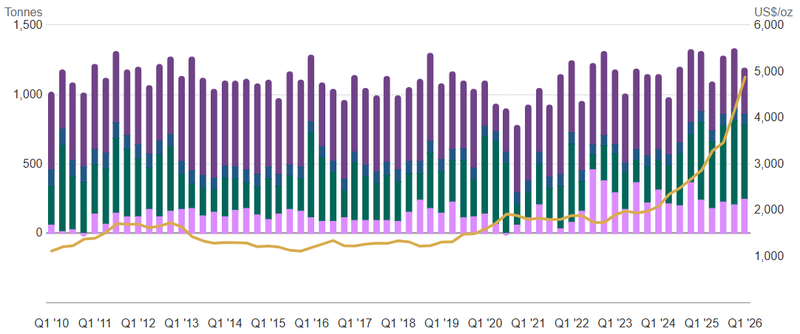
Global gold demand reached a record $193 billion in the first quarter of 2026.
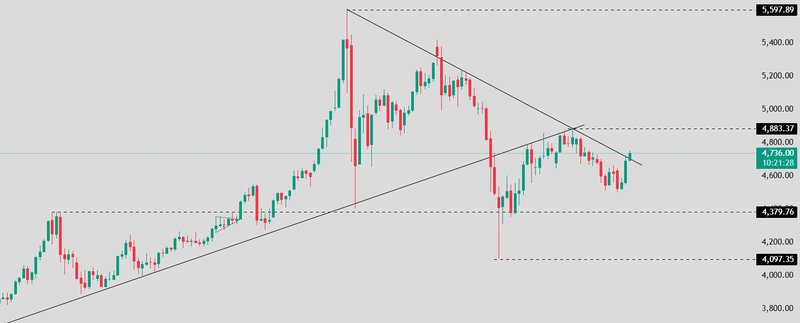
If price closes above 4,880, price will likely start targeting 5,100.
China continues the longest buying streak
China’s gold holdings rose to 74.64 million fine troy ounces at the end of April, extending one of the longest buying streaks seen in years.
The importance of the move is not just the amount of gold being bought. It is what the buying represents. Beijing has been gradually reducing reliance on dollar-based reserve assets while increasing exposure to hard assets like gold. That trend accelerated after years of geopolitical tensions; sanctions concerns and growing unease among emerging economies about depending too heavily on the US-led financial system.
Gold fits naturally into that strategy
Unlike sovereign currencies, gold is politically neutral, highly liquid and less exposed to sanctions or policy decisions from any single country. For central banks trying to diversify reserves without creating major disruption in currency markets, it remains one of the few realistic alternatives.
According to the World Gold Council, global gold demand reached a record $193 billion in the first quarter of 2026, driven largely by central bank buying and strong retail demand across Asia.
Source: World Gold Council
China has become one of the biggest supports for the gold market
Central bank purchases create long-term structural demand, while retail buying in Asia reflects growing concerns around inflation, currency stability and geopolitical uncertainty. Together, they are helping keep gold prices resilient even during periods when higher interest rates or a stronger dollar would normally pressure the metal lower.
Importantly, this is not about replacing the dollar overnight. The dollar still dominates global trade and reserve markets by a very large margin. What is happening instead is a slow diversification process, where countries are trying to reduce long-term dependence on a single reserve system over time.
Technical outlook
Gold is sitting at an important technical point right now, after the latest rally toward the 5,600 area; gold entered a corrective phase when the U.S. – Iran war began. What stands out is that the correction has not completely damaged the broader bullish structure. Price is still holding above the major 4,380 support zone, and the recent recovery from the sharp selloff near 4,100 suggests there is still strong demand underneath the market whenever panic selling appears.
The descending trendline from the highs has been controlling prices for a while, but the latest candles are starting to push back into that resistance area again. The reaction around the 4,880 region is critical because that level lines up closely with both resistance and the breakdown structure from the previous leg lower. If buyers can reclaim that zone cleanly, sentiment could shift quickly back in favor of the bulls.
From a macro side, gold still has strong long-term support behind it. Central bank buying remains elevated globally, geopolitical uncertainty started to disappear, and markets continue to debate how aggressive future Federal Reserve easing could become. Gold usually performs best when real yields begin falling and investors start looking for protection against monetary instability or slowing economic growth. That broader backdrop is one reason why every major dip in this chart has attracted buyers relatively fast instead of collapsing into a sustained bear market.
Upcoming scenarios
The bullish scenario if gold breaks above the descending resistance trendline and price close above 4,880, the market will likely start targeting a retest of the previous highs around 5,100. A breakout like that would probably happen alongside weaker US dollar momentum, fall bond yields.
The bearish scenario starts if this current rebound fails under resistance and price rolls back below the 4,380-support area. That would suggest the market still needs a larger reset after the massive rally earlier on. In that case, stronger economic data, higher real yields, or a more hawkish Federal Reserve could pressure gold lower as investors rotate back toward yield-bearing assets. If 4,380 breaks decisively, the market could revisit the 4,100 low and potentially extend into a deeper consolidation phase before long-term buyers regain control again.
Source: Trading View


