
 Help
Help

Meta AI spending is starting to worry investors despite record earnings
Meta posted another huge quarter, reporting record revenue of $56.31 billion, up 33% from a year ago, while EPS came in at $10.44 versus expectations of around $6.67.

Meta raised its 2026 capital expenditure forecast to between $125 billion and $145 billion.
Meta signed a $6 billion deal with Corning for optical fiber infrastructure and partnered with Oklo.
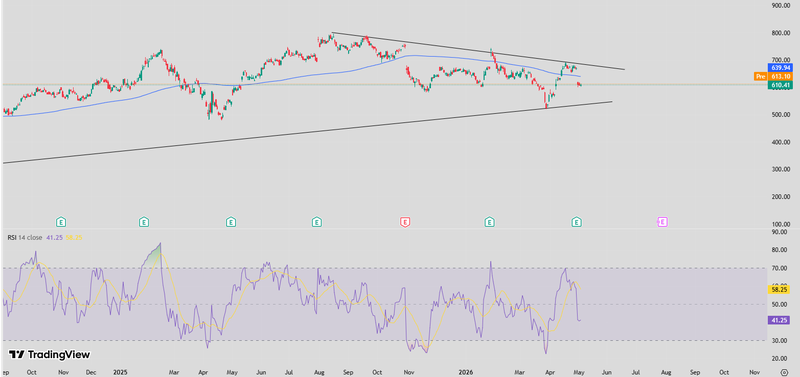
Meta is currently trading inside a symmetrical triangle.
Market focused on spending
Numbers like that would send the stock sharply higher, however Meta raised its 2026 capital expenditure forecast to between $125 billion and $145 billion as the company continues pouring money into AI infrastructure. That immediately revived investor concerns that the path to meaningful AI returns may end up being longer, more expensive and more uncertain than many initially expected.
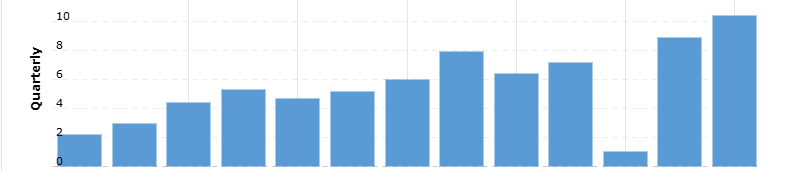
Source: Macrotrends
The reaction says a lot about the current mood around AI
Investors still believe the opportunity is enormous. That has not changed. What is changing is the market’s tolerance for unlimited spending without a clear timeline for returns. Strong earnings alone are no longer enough if companies are also signaling years of massive infrastructure buildouts ahead.
The company recently signed a $6 billion deal with Corning for optical fiber infrastructure and partnered with Oklo on a 1.2-gigawatt nuclear energy campus designed to support future data centers. Those are massive long-term projects that show how quickly the AI race is evolving beyond software and into physical infrastructure.
The conversation is no longer just about chatbots, models or apps. Increasingly, it is about who can secure enough chips, electricity, fiber capacity and data centers to support the next generation of AI systems.
The issue for investors is timing
Management is betting that future leadership in AI will depend heavily on infrastructure scale, especially as AI tools become more integrated into advertising, recommendations, digital assistants and enterprise products across its platforms.
Meta is spending enormous amounts of money today while the long-term payoff remains difficult to measure precisely. Even if the strategy ultimately works, markets are becoming less comfortable simply assuming that every dollar of AI spending will automatically translate into future profits.
Stock sold off despite such strong earnings
The market is not necessarily questioning Meta’s position in AI. If anything, the company looks more committed than ever. The bigger question is whether the entire tech sector may now be entering a phase where the cost of building AI infrastructure starts rising faster than the near-term returns it can generate.
Technical outlook
Meta is currently trading inside a symmetrical triangle that reflects a market still trying to decide between continuation higher and a broader consolidation phase. Unlike the powerful momentum rally seen earlier in the AI cycle, recent price action has become much more range-bound, with the stock repeatedly struggling near descending resistance while still holding above rising long-term support.
That has created a large symmetrical triangle structure, which often signals that a bigger directional move may eventually follow.
The market still views Meta as one of the major beneficiaries of AI monetization, digital advertising recovery and stronger operating efficiency. Cost cuts over the past two years helped improve margins significantly, while AI integration across Meta’s advertising systems continues supporting engagement and revenue quality.
But despite those strengths, the stock has not fully regained the aggressive momentum seen during the earlier rally phase. That likely suggests institutional investors now want to see another leg of earnings acceleration before pushing valuations materially higher again.
The 126-day moving average around the 610–640 region remains important because price continues moving around that area rather than breaking decisively in either direction. The rejection near the 700-resistance zone also shows sellers are still defending higher levels aggressively, while the higher lows since the April rebound suggest buyers remain active during pullbacks.
Momentum indicators have also cooled noticeably. RSI has moved back into a more neutral range after previously reaching overbought levels, reflecting slower momentum and growing uncertainty in the near term.
The scenarios ahead for Meta
The bullish scenario develops if Meta breaks above the descending resistance trendline and reclaims the 680–700 region with stronger volume and sustained momentum. That would likely signal renewed confidence around AI monetization, advertising resilience and future earnings growth.
Under that scenario, the market could begin targeting the 780–800 region over the medium term, especially if broader equity conditions remain supportive and the Federal Reserve eventually shifts toward a more accommodative stance. A breakout would also likely confirm that the recent consolidation was simply a pause within the larger uptrend.
The bearish scenario begins if Meta continues failing below resistance and eventually loses both the ascending support structure and the 126-day moving average decisively. That would suggest the consolidation is turning into a broader corrective phase rather than a continuation pattern.
Weaker advertising growth, rising AI infrastructure spending or deteriorating macro conditions could pressure valuations across large-cap technology. A sustained break below the 580–600 area could then expose the stock to deeper downside toward the broader long-term support trendline closer to 500.
That would not necessarily break the long-term bullish thesis, but it would suggest institutional money is becoming more cautious toward high-growth AI names in the near term.
Source: Trading View


