
 Help
Help 
Micron: AI memory meets its first real test
Micron is no longer just another semiconductor, name riding a familiar cycle it has become one of the clearest ways to express the AI buildout through memory. What is changing is not just demand, but the structure of that demand. AI, cloud computing.
In fiscal Q2 2026, Micron reported $23.86 billion in revenue.
The downside risk becomes more only if $350 breaks.
AI demand is on its peak, and Micron sits at the center
Micron is no longer just another semiconductor name riding a familiar cycle it has become one of the clearest ways to express the AI buildout through memory. What is changing is not just demand, but the structure of that demand. AI, cloud computing, IoT and big data are all expanding simultaneously, and they all rely on one thing: the ability to store, process and move enormous volumes of data. That shifts memory from a supporting component into a core constraint.
In fiscal Q2 2026, Micron reported $23.86 billion in revenue, including record DRAM revenue of $18.8 billion and record NAND revenue of $5.0 billion. More importantly, the company guided Q3 revenue to $33.5 billion $750 million, a sharp step-up that signals demand is not just strong it is accelerating. This is not the typical late-cycle surge driven by inventory restocking; it is tied to structural investment in AI infrastructure.
The key driver here is high-bandwidth memory (HBM). AI models require extremely fast access to data, and HBM has become essential for training and inference workloads. Supply remains tight, and scaling production is complex, which gives Micron a degree of pricing power that the memory industry has historically struggled to sustain. At the same time, enterprise demand is broadening. Companies are adopting multi-cloud architectures, expanding data center capacity and investing in analytics and automation systems that all require higher memory density.
Memory has always been cyclical, and while the AI cycle looks structurally stronger, it is not immune to normalization. The real question now is durability. Can demand stay ahead of supply for long enough to sustain margins, or will the industry eventually fall back into its traditional boom-bust pattern? For now, the evidence leans toward strength, but the market is starting to ask harder questions.
Technical outlook
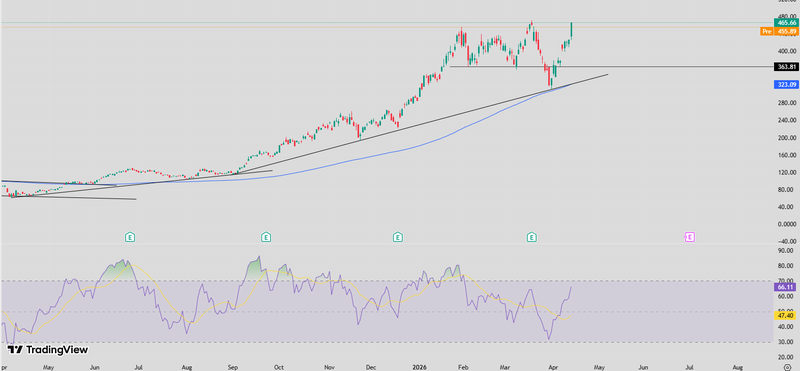
Micron remains in a strong long-term uptrend, but the character of the move has changed. After a powerful rally that pushed the stock toward the $470, price action has transitioned into a broad consolidation phase rather than continuing in a straight line higher. This is often a healthy development, it allows the market to digest gains, but it also introduces uncertainty about the next direction.
The key support zone sits around $350–375, and that level has already proven its importance. The recent correction found buyers there, confirming that demand is still active on dips and that long-term participants are willing to step in at those levels. This area effectively defines the lower bound of the current range and acts as a structural anchor for the trend.
On the upside, the focus is now on the $440–460 resistance zone, with the stock trading around $454. This level has acted as a ceiling before, and the current move is essentially a retest. What matters now is not just reaching this zone, but what happens next.
A clean break above $460, followed by sustained price action above that level, would signal that the consolidation phase is resolving to the upside. That would likely open the path toward $480–500 and potentially higher, aligning with the continuation of the broader AI-driven trend. For that to happen, the market will need confirmation that fundamentals particularly memory pricing and demand remain strong.
On the other hand, failure to break this resistance convincingly could keep the stock trapped in its current range. In that scenario, Micron may continue to rotate between $350 and $460, effectively moving sideways while investors wait for clearer signals from earnings and forward guidance. This would not necessarily be bearish it would simply reflect a market that is pausing to reassess.
The downside risk becomes more only if $350 breaks decisively that would signal that the support base is weakening and that the market is starting to question the strength or sustainability of the AI-driven narrative. In that case, the correction could extend further, and the trend would need to be rebuilt from a lower base.
Source: Trading View


