
 Support
 Coinbase sued over prediction markets alleged as illegal gambling; Shares slide
The New York Attorney General has initiated legal action against Coinbase, alleging that the exchange’s prediction markets constitute illegal gambling due to a lack of appropriate state regulation. This state-level intervention highlights a significant jurisdictional conflict with federal authorities, who generally categorise prediction markets as legitimate financial derivatives.
The New York Attorney General asserts that Coinbase’s event-based prediction markets—covering outcomes such as elections—violate state anti-gambling statutes, sparking a major legal dispute.
A regulatory rift has developed as the Commodity Futures Trading Commission (CFTC) classifies these markets as derivatives, exposing a complex legal ambiguity between state and federal oversight.
Coinbase shares declined by 7.41% to $195.95 following the announcement, as investors assessed the potential reputational and regulatory implications.
From a technical perspective, the stock remains positioned below its 100-day and 200-day Simple Moving Averages (SMAs), though short-term momentum indicators suggest a degree of underlying strength.
New York Attorney General initiates litigation against Coinbase regarding prediction market offerings
According to a report by Reuters, "New York’s Attorney General, Letitia James, has sued Coinbase, alleging that the exchange’s prediction markets violate state laws against illegal gambling." Furthermore, the Attorney General has extended this litigation to the firm Gemini Titan. Coinbase’s prediction market products enable users to speculate on the outcomes of future events, such as political elections, sporting fixtures, or economic developments. The Attorney General contends that these activities constitute gambling, as the final results are contingent upon random phenomena.
However, this move highlights a burgeoning confrontation between federal and state regulators. In contrast to the state's position, the Commodity Futures Trading Commission (CFTC) maintains that prediction markets are financial products (derivatives); consequently, it asserts that they should fall under federal regulatory purview. This divergence underscores a significant legal loophole that is likely to necessitate further judicial analysis and legislative clarification in the coming years.
While a definitive legal resolution to this regulatory conflict is required, mounting reputational risks have impacted on Coinbase’s market valuation. At the close of the trading session, shares had depreciated by 7.41%, finishing at $195.95.
Technical analysis of Coinbase’s shares
From a technical perspective, Coinbase has recently experienced a breakdown of its long-term bullish structure and is currently contending with a significant zone of overhead supply. Key observations include:
- Trend Context: On the daily timeframes, Coinbase continues to trade beneath its 100-day and 200-day Simple Moving Averages (SMAs). This positioning reinforces a prevailing bearish bias. In the short term, however, price action signals a recovery in bullish momentum within the current structure, with the stock trading slightly above a long-term upward trend line.
- Resistance Levels: Should the immediate resistance near $210 be breached—a level where horizontal resistance converges with the 100-day SMA—the next critical technical ceiling is identified at $270, confluent with the 200-day SMA. Reclaiming these benchmarks is a prerequisite for re-establishing broader bullish momentum.
- Support Levels: If the short-term support at $182 is compromised, the next critical floor resides at the $150 mark (a long-term structural support). A sustained move below this threshold would likely accelerate selling pressure and increase the probability of a more profound market correction.
- Momentum Indicators: Both the Moving Average Convergence Divergence (MACD) and the Relative Strength Index (RSI) are currently trending upwards, reflecting the strength of the immediate bullish impulse. However, the RSI is nearing overbought territory, signalling potential headwinds for the short-term structure.
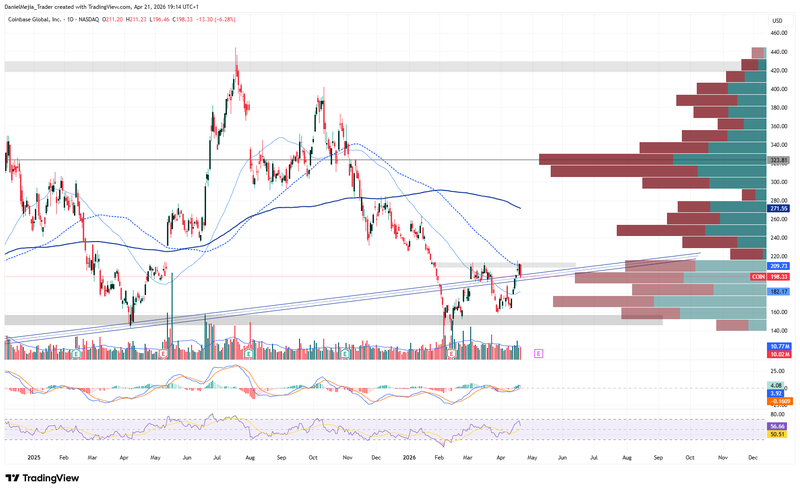
Figure 1. Coinbase Global’s Stock Prices (2025–2026). Source: Data from the Nasdaq Exchange; Own analysis conducted via TradingView.


