
 Support
 Court rejects Trump’s 10% global tariffs; Australia balance of trade hits multi-year low
The US Court of International Trade rejected Trump’s 10% global tariffs, favoring small businesses despite potential appeals. Simultaneously, Australia reported its first trade deficit since 2017 due to surging imports, while McDonald’s beat Q1 2026 earnings expectations.

A US court ruled against Trump's 10% global tariffs, citing lack of legal justification, though a 2-1 decision leaves room for a potential legal appeal.
Australia hit a multi-year trade deficit of -$1.84 billion as a 14.1% import surge outweighed exports, causing the Australian dollar to depreciate.
McDonald’s outperformed Q1 2026 forecasts with $6.52 billion in revenue, yet shares fell slightly following CEO warnings about a tough environment.
US Trade Court rules against Trump’s 10% global tariffs
According to reports from Reuters, the US Court of International Trade has ruled against President Donald Trump’s 10% global tariffs, determining that they lacked sufficient legal justification under Section 122 of the Trade Act of 1974. The ruling was delivered in favour of small businesses to protect their market competitiveness, representing a significant blow to the current administration's trade agenda. This follows a previous setback in February, when the US Supreme Court deemed bilateral tariffs imposed under the International Emergency Economic Powers Act to be unlawful. Notably, the trade court’s decision was reached via a 2–1 majority, leaving the door open for a potential appeal by the government.
While this judicial development is a critical factor for the US administration, market participants remain primarily focused on the Q1 2026 earnings season and the prospects of a peace agreement between the United States and Iran. Such an agreement is widely expected to temper inflationary pressures and influence subsequent monetary policy decisions by global central banks. Following the news, US equity indices declined by an average of 0.37%, while the US Dollar Index (DXY) rose by 0.24%.
Australian balance of trade exhibits deficit unseen since December 2017
Data released by the Australian Bureau of Statistics reveals that the nation’s trade balance swung from a surplus of A$5.03 billion in February to a deficit of –A$1.84 billion in March—the first such deficit recorded since December 2017. This downturn resulted from a 2.7% monthly decline in exports coupled with a sharp 14.1% surge in imports. Analysis from Trading Economics suggests the import spike was driven by robust domestic demand, particularly for capital goods, fuel, and Automatic Data Processing (ADP) equipment.
In response to the trade data, the Australian dollar depreciated by 0.50% against the US dollar, trading at 0.7210.
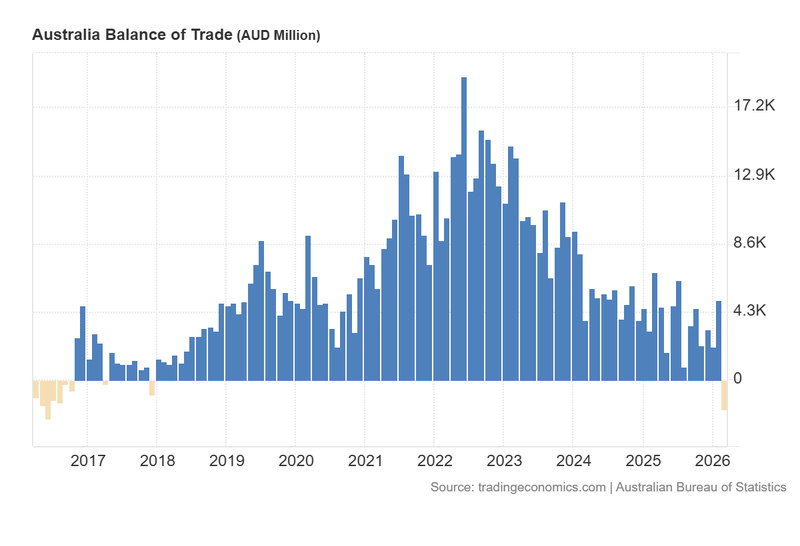
Figure 1. Australia Balance of Trade (2016–2026). Source: Data from the Australian Bureau of Statistics; Figure obtained from Trading Economics.
McDonald’s exceeds Revenue and EPS forecasts, but share price retreats marginally
McDonald’s (MCD) surpassed analyst expectations for both total revenue and earnings per share (EPS), joining a broader trend of US corporations reporting stronger-than-anticipated results during the Q1 2026 earnings season. The company posted revenue of $6.52 billion, outperforming the projected $6.48 billion, while EPS reached $2.83 against an estimate of $2.75. These figures represent a year-on-year (YoY) growth rate of 9.4% in revenue and 6% in EPS. Despite these robust fundamentals, McDonald's shares declined marginally by 0.14% to close at $283.70.
During a conference call, McDonald’s CEO Chris Kempczinski described the current macroeconomic climate as a "challenging environment," a statement that appeared to unsettle investors and dampen the closing share price. Nevertheless, Kempczinski maintained an optimistic outlook for the remainder of the year, suggesting the company is well-positioned to navigate potential shifts in consumer spending.
