
 Support
 US and German confidence hit multi-year lows, while UK retail sales rise
Global sentiment is fracturing as the US-Israel-Iran conflict drives energy prices higher. Michigan consumer sentiment hit an all-time low, and German business confidence fell to levels not seen since 2020. Conversely, UK retail sales showed unexpected resilience, shifting market focus toward the Bank of England’s upcoming interest rate decision.

Michigan consumer sentiment plunged to a record low of 49.8 in April, driven by surging energy costs and one-year inflation expectations reaching 4.7%.
The Ifo Business Climate index hit a six-year low of 84.4, reflecting deep-seated pessimism across major industries amidst Middle Eastern geopolitical instability.
UK retail sales defied consensus forecasts with a 0.7% monthly increase, primarily underpinned by fuel purchases, signalling a degree of consumer fortitude despite the prevailing uncertainty.
Michigan Consumer Sentiment falls to historical low as inflationary risks mount
According to data from the University of Michigan, US consumer sentiment retreated from 53.3 points in March to 49.8 in April—a historic nadir. The report indicates that households are increasingly unsettled by rising energy prices, specifically gasoline and diesel, which are commodities directly linked to the basic consumption patterns of both households and producers.
The ongoing US–Israel–Iran conflict has caused significant disruptions to energy supply chains across the Middle East, particularly concerning the Strait of Hormuz. This maritime passage is a critical chokepoint where approximately 20% of the global oil and natural gas supply transits. Having commenced on 28 February, the conflict is now approaching its two-month mark, with no immediate resolution in sight.
Geopolitical instability has fundamentally altered inflation perspectives. The Michigan report reveals that one-year inflation expectations have risen to 4.7%, while five-year expectations were updated to 3.5%. These indicators suggest that consumers anticipate the conflict will have a protracted impact on both short- and long-term inflation, consequently dampening consumption forecasts. Although US domestic demand has shown notable resilience thus far, the persistence of Middle Eastern hostilities could shift this economic outlook.
Regarding the market reaction, US stock benchmarks closed mixed amidst high geopolitical volatility, exhibiting an unusual divergence. The S&P 500 rose 0.80% to 7,165 points and the Nasdaq 100 increased 1.95% to 27,303, whereas the Dow Jones Industrial Average fell 0.16% at 49,230 points. Simultaneously, the US Dollar Index (DXY) dropped 0.29% to 98.51 points.
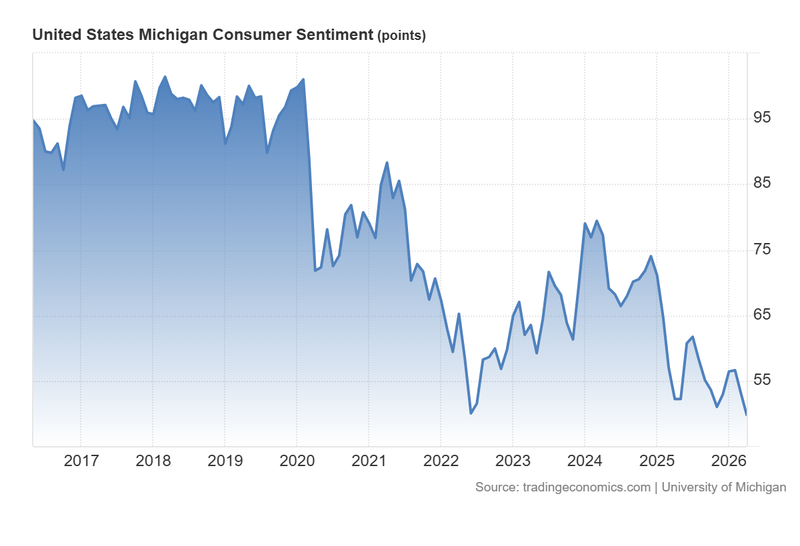
Figure 1. US Michigan Consumer Sentiment (2016–2026). Source: Data from the University of Michigan; Figure obtained from Trading Economics.
German Ifo Business Climate Index decreases to six-year low
Data from the Ifo Institute indicates that the German business climate index dropped from 86.3 in March to 84.4 in April, its lowest level since May 2020. This decline suggests that confidence within German firms has eroded to levels comparable to the height of the pandemic crisis. An analysis by Trading Economics highlights that the most significant contraction within the Ifo index was found in future expectations, which fell from 85.9 to 83.3 points. This erosion of confidence is primarily attributable to the US–Israel–Iran conflict, which has destabilised global economic expectations and introduced a high degree of uncertainty.
Notably, sentiment across almost all major German industrial sectors has been negatively impacted, further undermining hopes for a recovery in an economy that has endured stagnation over the past three years. During this period, quarterly growth rates have consistently hovered near zero in both positive and negative territory.
Following the release of this data, the DAX 40 index dropped 0.11% to 24,128 points. Conversely, the euro appreciated by 0.29% against the US dollar, trading at $1.1717.
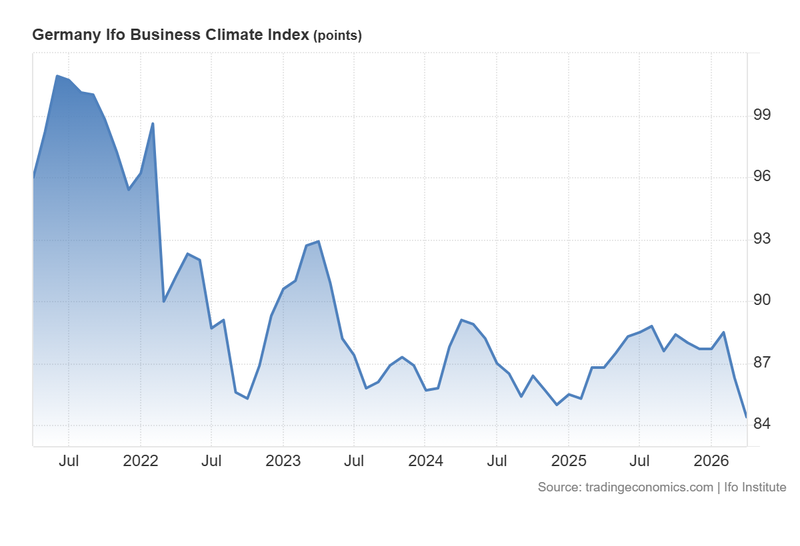
Figure 2. German Ifo Business Climate Index (2021–2026). Source: Data from the Ifo Institute of Germany; Figure obtained from Trading Economics.
UK retail sales rise above forecasts
According to the Office for National Statistics (ONS), UK retail sales increased by 0.7% month-on-month (MoM) in March. This figure significantly exceeded the previous reading of –0.6% and surpassed the consensus forecast of +0.2%. The ONS reported that this monthly growth was primarily driven by an increase in fuel purchases. On a year-on-year (YoY) basis, retail sales growth decelerated slightly from 1.8% to 1.7%, though this remained above the forecast of 1.3%.
While the retail sales report suggests a level of resilience among British consumers, general uncertainty persists amidst geopolitical and economic instability. Market participants have now turned their focus toward the Bank of England (BoE) monetary policy decision, scheduled for release next Thursday, 30 April. At present, the market consensus expects the BoE to maintain the benchmark interest rate at 3.75%.
In response to the data, the British pound advanced 0.50% against the US dollar to $1.3530. Conversely, the FTSE 100 index fell 0.75% to 10,379 points, as investors weighed the probability of a more restrictive or "hawkish" stance from the Bank of England in light of the resilient retail data
