
 Support

SpaceX debt sale calms liquidity fears, but short sellers focus on AI losses
SpaceX’s $25 billion senior unsecured bond sale has shifted the market debate from liquidity risk to earnings quality. The company priced one of the largest investment-grade debt deals of the year, with proceeds mainly aimed at refinancing bridge debt and lowering financing costs, rather than filling a cash shortfall.

SpaceX priced $25 billion in senior unsecured notes.
The company holds roughly $100.8 billion in cash and cash equivalents.
Short interest has reportedly reached about 40 million shares.
Bond sales are not the real problem
The bond sale itself is not the weakest part of the SpaceX story.
A company with more than $100 billion in cash does not look like it is issuing debt because it has run out of money. The more reasonable reading is that SpaceX is using its investment-grade profile to replace higher-cost debt with cheaper, longer-term financing.
That can be a sensible move.
If the company can reduce interest costs and extend maturity, the balance sheet becomes easier to manage. Investors usually like that, especially when the order book is strong and the company can borrow at attractive levels.
But the market is not only looking at the debt. It is looking at why SpaceX needs so much capital in the first place.
Short sellers are targeting the earnings mix
The pressure is coming from the operating story.
Around 40 million SpaceX shares have reportedly been sold short, representing roughly 5% to 7% of the publicly tradable float of 625 million shares. That is not extreme by distressed-company standards, but it is large enough to show that some investors are betting the post-IPO valuation is too aggressive. Their argument is not that SpaceX lacks real business.
The concern is that the profitable part of the company is being asked to carry too much. Starlink reportedly generated $4.42 billion in operating profit, but xAI logged $6.35 billion in operating losses. That effectively wiped out Starlink’s contribution and pushed SPCX into a net loss.
That is the key tension. Starlink proves SpaceX can build a scalable, profitable infrastructure business. xAI shows how quickly that profit can disappear when the company expands into capital-heavy AI ambitions.
Technical outlook
SpaceX has shifted from a strong rally after the IPO into a corrective phase, with the price reflecting a combination of profit-taking, valuation reassessment, and growing macro uncertainty. After rallying toward 220–225, the stock failed to sustain momentum and entered a persistent downtrend, with a descending trendline now defining the broader structure. The recent decline toward 156 leaves price trading close to the lower end of its recent range and only modestly above the major support zone near 147.
A large portion of the selling pressure appears linked to investors locking in gains from AI-related names following an exceptional run across the sector. At the same time, markets have become increasingly sensitive to interest-rate expectations, with concerns that the Federal Reserve could still consider another rate increase later this year and pressure high-growth companies because future earnings become less valuable when discounted at higher yields, making investors more selective about valuation.
Concerns have emerged around profitability after xAI reportedly generated operating losses of approximately $6.35 billion, more than offsetting Starlink’s estimated $4.42 billion operating profit and contributing to a net loss profile for the broader group. Whether those losses are viewed as temporary growth investments or a longer-term profitability challenge will likely remain an important debate among investors.
147.20 is now the most important support level. Holding above this zone would suggest that the current decline remains corrective rather than structural. On the upside, initial resistance sits near 165–170, followed by the descending trendline currently crossing around 162–165. A recovery above that area would be the first indication that selling pressure is beginning to fade. Stronger resistance remains near 185–190, where previous rallies failed.
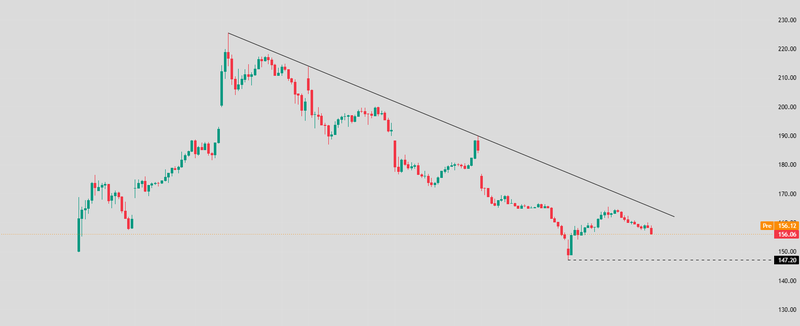
Source: Trading view


