
 Help
Help BoC announces Stablecoin regulations; Ethereum slips
The Bank of Canada announced stablecoin regulations plans for 2027, sparking mixed reactions. While institutionalization could benefit Ethereum’s DeFi ecosystem, doubts of bureaucracy and restrictions led to a market price drop.

The Bank of Canada plans to implement stablecoin regulations by 2027, signaling increased institutional integration within the traditional financial system.
Ethereum (ETH) declined by 2.02% to $2,293 as investors weighed the benefits of enhanced legitimacy against the burdens of heightened compliance and reporting requirements.
ETH maintains a bearish bias trading below its 200-day SMA, while Neutral RSI levels indicate a lack of clear direction.
BoC announces regulations for Canada-based Stablecoins; Ethereum retreats on bidirectional interpretation
According to a report by Reuters, the Bank of Canada (BoC) has announced that a formal regulatory regime for Canada-based stablecoins is slated for implementation by mid-to-late 2027. This development underscores an accelerating trend toward the institutionalisation of cryptocurrency technology and its assimilation into conventional financial infrastructures.
For the Ethereum network, this may be viewed as a fundamentally constructive milestone, given that a significant proportion of the world’s stablecoins are issued and transacted within the Ethereum ecosystem. Consequently, the introduction of a clear legal framework could further entrench Ethereum’s dominance in decentralised finance and potentially stimulate demand for ETH as a core utility asset.
However, a segment of the market has interpreted this development through a more critical lens. Historically, the cryptocurrency sector has been defined by the ethos of decentralisation and its role as a sovereign alternative to the legacy financial system. Increased regulatory oversight is often perceived as an introduction of bureaucratic complexity, stringent compliance mandates, and potential transactional constraints.
Furthermore, some market participants could consider that this regulatory pivot may foreshadow the development of proprietary blockchain-based infrastructures or Central Bank Digital Currencies (CBDCs). Such state-backed alternatives would permit central authorities to exert greater control, oversight, and traceability over digital transactions.
Following the announcement, Ethereum fell 2.02% to settle at $2,293. The asset continues to test a pivotal resistance zone, which appears to be impeding bullish momentum in the immediate term.
Technical analysis of Ethereum
From a technical perspective, Ethereum has recently invalidated its long-term bullish structure and is currently contending with a significant zone of overhead supply. Key observations include:
- Trend Context: Within the long-term overview, Ethereum continues to trade beneath its 200-day Simple Moving Average (SMA). This positioning reinforces the prevailing bearish sentiment. In the short term, however, price action is characterised by a consolidative range pattern that has persisted for approximately three months, reflecting a state of broader market indecision.
- Resistance Levels: Should the immediate resistance near $2,350 be breached, the next significant technical ceiling is identified at $2,650, which aligns with the 200-day SMA. Reclaiming these benchmarks is a necessary prerequisite for re-establishing a sustained bullish trajectory.
- Support Levels: If the primary psychological support at $2,000 is compromised, the next critical floor resides at the $1,800 mark—a vital structural support level. A sustained move beneath this threshold would likely intensify selling pressure and increase the probability of a more profound market correction.
- Momentum Indicators: The Relative Strength Index (RSI) is currently oscillating within neutral territory, suggesting a lack of clear directional conviction. Consequently, a decisive breakout from the current market structure may require a significant influx of institutional liquidity or a major fundamental catalyst.
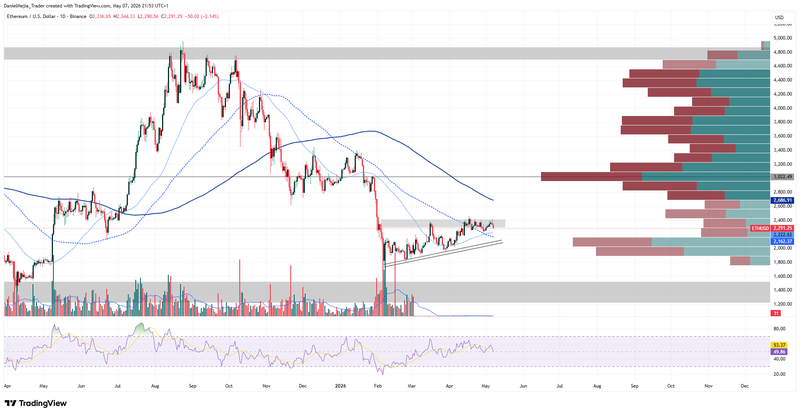
Figure 1. Ethereum Prices (2025–2026). Source: Data from the Binance Exchange; Own analysis conducted via TradingView.


