
 Help
Help Fed’s move toward neutrality weighs on Bitcoin market sentiment
Bitcoin has experienced a retreat as the Federal Reserve transitions toward a neutral policy stance, maintaining interest rates at 3.75%. Elevated geopolitical risks and the recalibration of rate-cut expectations could drive a rotation toward defensive assets.

The Fed maintained interest rates at 3.75% in a divided 8-4 vote, signalling a pivot toward neutrality amidst persistent energy shocks and instability in the Middle East.
CME FedWatch Tool data reveals a significant shift in sentiment, with market participants now deferring expectations for an initial rate cut until December 2027.
Bitcoin continues to trade below its 200-day Simple Moving Average (SMA), with price action oscillating within a short-term consolidative range that reflects prevailing market indecision.
Bitcoin retreats following Fed’s pivot to a neutral stance
Bitcoin has faced downward pressure following the Federal Reserve's decision to maintain its benchmark interest rate at 3.75%. This monetary policy conclusion represents the most divided vote since 1992: eight officials opted to hold the federal funds rate steady within the 3.5%–3.75% range, while four officials dissented. Of those dissenting, three questioned the central bank's inherent bias toward easing, while one member advocated for an immediate rate cut. The US central bank maintained its commitment to a "meeting-by-meeting" decision-making process, citing a shift toward a neutral posture necessitated by current economic and geopolitical volatility—most notably the energy shocks originating in the Middle East.
According to data from the CME FedWatch Tool, market consensus now suggests that the Federal Reserve will not implement a rate cut during 2026. Considering the probabilities reflected in the tool, participants do not anticipate the first interest rate reduction until December 2027. This represents a significant lag compared to previous market assessments.
Consequently, Bitcoin prices declined by 0.80% to $75,670. Digital assets typically face headwinds in market environments characterised by high uncertainty. In such contexts, investors tend to seek safe-haven or defensive assets over high-risk instruments such as cryptocurrencies. Market participants remain focused on the evolution of the Israel-Iran conflict and its ongoing impact on global energy supply chains. Additionally, upcoming economic releases—specifically the PCE Price Index and US unemployment data—will be scrutinised for further clues regarding the Federal Reserve's future monetary trajectory.
Technical analysis of Bitcoin
From a technical perspective, Bitcoin has recently breached its long-term bullish structure and is currently encountering difficulty surmounting a significant resistance zone. Key observations include:
- Trend Context: On longer timeframes, Bitcoin continues to trade beneath its 200-day Simple Moving Average (SMA), a position that reinforces a prevailing bearish bias. In the short term, price action is characterised by a consolidative range that has persisted for approximately two months, reflecting a distinct lack of market conviction.
- Resistance Levels: Should the immediate technical ceiling near $79,000 be breached, the next significant resistance is identified at $84,000, which coincides with the 200-day SMA. Reclaiming these benchmarks is considered a prerequisite for re-establishing broader bullish sentiment.
- Support Levels: If the primary support at $70,000 is compromised, the next critical floor is situated at the $62,000 mark. A sustained move below this level would likely accelerate selling pressure and increase the probability of a more profound market correction.
- Momentum Indicators: Both the Moving Average Convergence Divergence (MACD) and the Relative Strength Index (RSI) are currently trending upwards, reflecting the strength of the immediate bullish impulse. Nevertheless, both indicators are approaching overbought territory, while the MACD is revealing a bearish cross. Consequently, institutional capital flows and fundamental geopolitical catalysts are expected to remain the primary drivers of the market's trajectory.
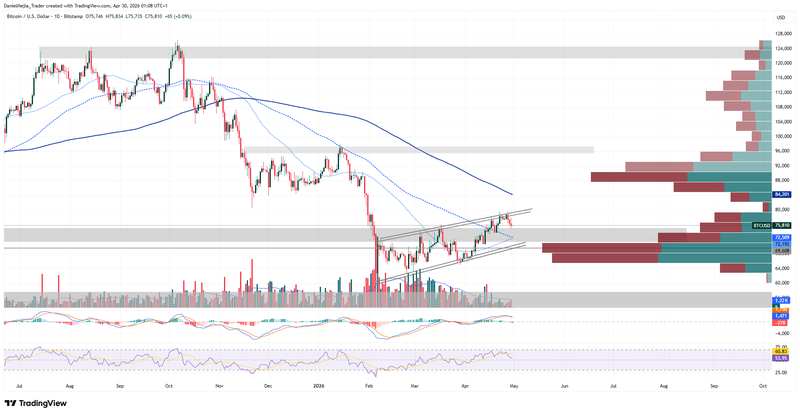
Figure 1. Bitcoin Prices (2025–2026). Source: Data from the Bitstamp Exchange; Own analysis conducted via TradingView.


