
 Help
Help Japan GDP expands; UK unemployment and Canadian inflation rise
The global economy continues to exhibit divergent trends. The UK unemployment rate ticked up to 5.0%, maintaining pressure on the Bank of England amidst sticky domestic inflation. Meanwhile, Canada’s headline inflation accelerated to 2.8% on the back of rising energy costs, and Japan’s GDP outperformed market expectations with a resilient 0.5% expansion in the first quarter of the year.

UK unemployment unexpectedly rose to 5.0% in March, complicating monetary policy for the Bank of England as it grapples with a 3.3% headline inflation rate.
Heightened Middle East tensions pushed Canada’s headline inflation to 2.8% in April via elevated energy costs, though the underlying core reading moderated to a stable 2.1%.
Pressure on the Bank of Canada eased slightly as this critical core inflation metric dropped closer to the central bank's official 2.0% symmetric target.
Japan’s Q1 2026 GDP surpassed market forecasts by growing 0.5%, propelled by robust public investment, steady private consumption, and strong export performance.
UK unemployment rate increases beyond analyst expectations
According to data released by the UK Office for National Statistics (ONS), the unemployment rate rose from 4.9% to 5.0% in the three months to March, exceeding the estimates of analysts who had expected the figure to remain unchanged. Paradoxically, the accompanying employment change metric registered an increase of 148,000 new job positions, outperforming the consensus forecast of a 107,000 increase.
While the ONS labour market report exhibited mixed results, the upward trajectory of the headline unemployment rate has remained intact over the past three years, intensifying pressure on the Bank of England (BoE) regarding its upcoming monetary policy decisions. The BoE faces a dual dilemma: a labour market sector displaying signs of cooling alongside persistent inflationary pressures. Currently, the headline inflation rate stands at 3.3%, driven by a complex geopolitical backdrop in the Middle East that has kept international energy prices elevated due to the unresolved US-Israel-Iran conflict.
In response to these developments, the British pound fell by 0.23% to trade at $1.3395 against the US dollar.
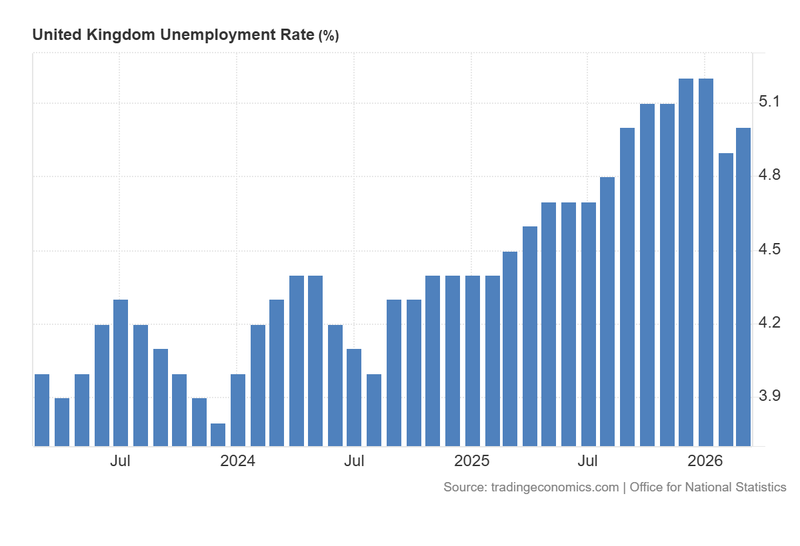
Figure 1. United Kingdom Unemployment Rate (2023–2026). Source: Data from the Office for National Statistics of the UK; Figure obtained from Trading Economics.
Canadian inflation rate accelerates, but remains below analyst estimates
Data published by Statistics Canada reveals that the annual headline inflation rate accelerated from 2.4% in March to 2.8% in April (year-on-year change), landing slightly below the market consensus estimate of 3.1%. This YoY print represents the highest inflation level recorded since May 2024. On a month-on-month basis, the headline consumer price index (CPI) rose by 0.4%. Conversely, the core inflation rate—which strips out the more volatile components of energy and unprocessed food—decelerated from 2.5% to 2.1% over the same period.
The Statistics Canada report indicates that the primary catalyst behind the acceleration in headline inflation was energy prices, which rose as a consequence of the ongoing US-Israel-Iran conflict in the Middle East. Most notably, transportation costs surged from 3.7% to 7.6%. While headline inflation in Canada has reached its highest value in approximately two years, the core reading appears well-controlled and close to the Bank of Canada’s (BoC) 2% target, thereby reducing immediate pressure on the central bank to implement a more restrictive monetary policy stance.
Regarding the foreign exchange market reaction, the Canadian dollar depreciated marginally against its US counterpart, closing the session at 1.3744.
Japanese GDP surpasses forecasts, exhibiting economic resilience
According to preliminary data from the Cabinet Office of Japan, the country's quarterly gross domestic product (GDP) growth rate accelerated from 0.2% in Q4 2025 to 0.5% in Q1 2026, beating the analyst consensus forecast of 0.4%. This latest expansion marks the second consecutive quarter of economic growth and represents the highest reading since Q3 2024.
An analysis compiled by Trading Economics suggests that the most significant contributors to this growth were public investment, which rose by 1.4%, and exports, which increased by 1.7%, alongside a 0.3% advance in private consumption. These figures align closely with Tokyo's ongoing fiscal initiatives aimed at supporting macroeconomic growth through targeted public spending, complemented by an expansion in automobile and technology exports driven by robust international demand.
Despite the underlying strength exhibited by the Japanese economy, the yen depreciated by 0.21% against the US dollar to trade at ¥159.06. In tandem, the benchmark Nikkei 225 equity index eased marginally, closing down 0.36% at 59,706 points.
