
 Help
Help US–Iran deal hopes lift equities and sink oil prices; ADP, Ivey PMI beat forecasts
A potential US–Iran peace agreement lifted equities and pushed oil lower as traders priced in less supply risk and softer inflation pressure. The S&P 500 and Nasdaq 100 set fresh records, while Brent and WTI fell sharply. Stronger-than-expected ADP private payrolls and a robust Canadian Ivey PMI added to the data-driven backdrop.

Reports of a possible US–Iran framework eased geopolitical risk, lifting risk appetite and prompting a sharp fall in crude as traders priced in a lower threat to supply and inflation.
US indices surged, with the S&P 500 and Nasdaq 100 reaching new record highs and the Dow closing close to its peak, as investors rotated towards risk-sensitive assets.
ADP private payrolls rose to 109,000 in April, above the 99,000 forecast, led by education and health services and trade, transport and utilities.
Canada’s Ivey PMI climbed to 57.7, its strongest reading in seven months, with improvements in employment, inventories and supplier deliveries.
Hopes about a potential US–Iran deal drive US stocks while oil prices fall sharply
According to Reuters, citing US, Pakistani and Iranian sources familiar with US-Iran negotiations, Washington and Tehran may be close to a preliminary diplomatic framework. President Donald Trump said that discussions with Iran had made “very good progress” and that a deal was possible, although Iranian officials have not confirmed any agreement. Meanwhile, Axios reported that Iran is reviewing a proposed memorandum that could open a 30-day negotiation period towards a broader deal.
Although no official confirmation of a final agreement has been issued by all countries involved, these developments have strengthened market expectations of a possible diplomatic resolution. Such an outcome could ease concerns over global energy supply disruptions, improve the outlook for oil supply stability and reduce inflationary pressures tied to geopolitical tensions. As a result, investors may be increasing exposure to risk-sensitive assets, including equities.
Regarding the market reaction, the US stock benchmarks rose in tandem: the S&P 500 increased by 1.46% to 7,365 points and the Nasdaq 100 appreciated by 2.08% to 28,599 points, both reaching new record highs. The Dow Jones Industrial Average advanced by 1.24% to 49,910 points, a level very close to its record high. Conversely, the oil benchmarks Brent and WTI dropped sharply: Brent futures (BRNN6) fell by 7.90% to $101.20 per barrel, while West Texas Intermediate futures (CLM6) declined 7.22% to $95.12 per barrel.
ADP employment change is above analysts’ forecasts, signalling renewed job growth
According to data from Automatic Data Processing (ADP), private employment growth accelerated from 61,000 new positions in March to 109,000 in April, above analysts’ forecast of 99,000. This reading marks the highest level since January 2025, although the broader downward trend observed over the past five years remains one of deceleration.
The ADP report showed that the largest increase in employment came from the “Education and Health Services” sector, with +61,000 jobs, followed by “Trade, Transportation, and Utilities” with +25,000. Conversely, the largest loss of jobs in April was recorded in “Professional and Business Services”, which shed 8,000 positions.
Market participants are now focused on the US Bureau of Labor Statistics (BLS) employment report due next Friday, 8 April. At times, the ADP report has provided clues about non-farm payroll performance; however, over recent months, this relationship has been less reliable.
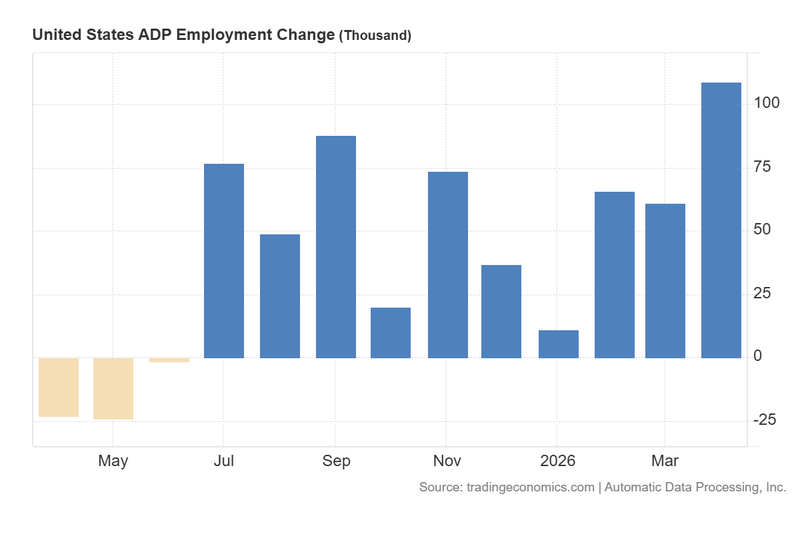
Figure 1. US ADP Employment Change (2025–2026). Source: Data from Automatic Data Processing (ADP) Inc.; Figure obtained from Trading Economics.
Canadian Ivey PMI surprises to the upside with strong expansion
According to data from the Ivey Business School of Canada, the Ivey PMI rose from 49.7 points in March to 57.7 in April, comfortably above the forecast of 49.9 points. The PMI reached its highest level in seven months, indicating expansion as it remained above the 50-point threshold. According to an analysis by Trading Economics, the Ivey PMI improved across several components, most notably “Employment” (from 51.1 to 54.7), “Inventories” (from 49.4 to 56.5), “Supplier Deliveries” (from 38.8 to 44.3) and “Prices” (from 75.7 to 76.6).
In market terms, the Canadian dollar depreciated against the US dollar by 0.13% to 1.3640, during a highly volatile session driven by geopolitical factors.
