
 Help
Help US PPI beats forecasts, reviving inflation concerns; EIA oil inventories fall
The US PPI surged to 6% in April, driven by a 15.6% gasoline price spike amid Middle East tensions. This inflation jump prompted Fed officials to consider potential rate hikes. Meanwhile, EIA oil inventories fell more than expected, and Presidents Trump and Xi met in Beijing to discuss critical bilateral trade and security issues.

US PPI jumped 1.4% monthly, reaching a 6% annual high fueled by gasoline costs, signaling that producer price pressures may soon hit consumers.
Fed officials suggest interest rate hikes remain possible if inflation persists, reacting to the PPI report as markets weigh higher-for-longer risks.
EIA crude inventories dropped by 4.3 million barrels, exceeding forecasts and reflecting higher demand and export needs amid Middle East instability.
Presidents Trump and Xi Jinping met in Beijing with top tech CEOs to address bilateral trade relations, the status of Taiwan, and energy supply security.
US PPI jumps to multi-year high, reviving concerns of inflationary risks
According to data released by the US Bureau of Labour Statistics (BLS), the Producer Price Index (PPI) rose by 1.4% in April on a month-on-month basis, significantly exceeding analyst expectations of a 0.5% increase. Consequently, the year-on-year (YoY) PPI accelerated from 4.3% in March to 6% in April—its highest level since December 2022. The BLS report indicates that this prominent increase is primarily attributable to a 15.6% monthly jump in gasoline prices, a direct consequence of the escalating US-Israel-Iran conflict in the Middle East.
While US corporations have largely absorbed rising costs over recent quarters—stemming from both tariffs and energy overheads—there is a growing risk that these pressures will be transferred to final consumers should they persist. As a leading indicator, the PPI often serves as a precursor to broader inflation data, as rising production costs eventually filter through to domestic consumption.
In response to these figures, members of the Federal Open Market Committee (FOMC) have suggested that further interest rate hikes could remain on the table. According to Reuters, Boston Federal Reserve President Susan Collins and Minneapolis Federal Reserve President Neel Kashkari have stated that interest rate hikes could be justified if inflationary pressures persist or intensify.
Following these economic releases, US equity benchmarks delivered a mixed performance: the S&P 500 gained 0.58% to close at 7,444 points, while the Nasdaq 100 appreciated by 1.04% to 29,366. Conversely, the Dow Jones Industrial Average fell by 0.14% to 49,697. Meanwhile, the US Dollar Index (DXY) advanced by 0.19%, reaching 98.45 points.
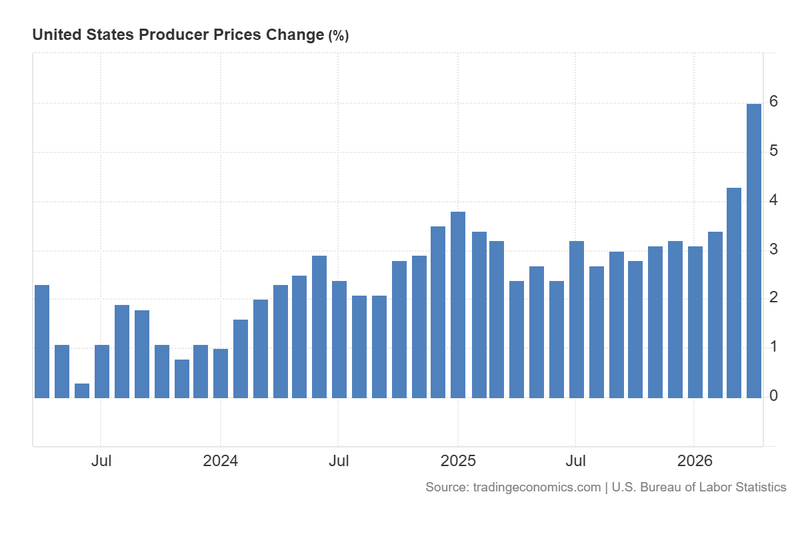
Figure 1. US Producer Price Index (2023-2026). Source: Data from the US Bureau of Labour Statistics; Figure obtained from Trading Economics.
EIA inventories contract beyond forecasts, marking third consecutive week of declines
Data from the US Energy Information Administration (EIA) revealed that crude oil inventories fell by 4.306 million barrels in the latest weekly assessment. This drawdown was significantly deeper than the anticipated reduction of 2.1 million barrels and the previous week’s decline of 2.313 million barrels. Furthermore, gasoline stocks saw a reduction of 4.084 million barrels. These figures underscore a notable increase in demand, bolstered by a rise in exports as global markets seek to secure energy commodities amidst the ongoing conflict in the Middle East.
Market reaction to the data was varied; West Texas Intermediate (WTI) futures contracts eased marginally by 0.80% to settle at $101 per barrel. In contrast, gasoline futures experienced a sharp correction, falling by 6.15% to $3.47 per gallon.
Donald Trump and Xi Jinping convene in Beijing
US President Donald Trump and Chinese President Xi Jinping have a high-level summit in Beijing. President Trump was accompanied by a delegation of prominent business leaders, including Elon Musk (Tesla), Tim Cook (Apple), and Jensen Huang (Nvidia). The bilateral talks are expected to address several critical and sensitive topics, including international trade protocols, technological cooperation, the status of Taiwan, and the ongoing regional tensions involving Iran and the US and the security of the Strait of Hormuz.
