
 Help
Help 
From expansion to execution: Oracle’s Q2 test
Oracle’s latest move with Bloom Energy is more than just a partnership, it highlights where the real bottleneck in AI is shifting. The agreement to secure 1.2 gigawatts of fuel-cell capacity, alongside a $400 million investment tied to warrants for up to 3.53 million shares.
Oracle has raised over $100 billion in debt to fund its aggressive AI data center expansion.
$150 remains critical. A clean break below that level would weaken the structure.
AI meets energy
Oracle’s latest move with Bloom Energy is more than just a partnership it highlights where the real bottleneck in AI is shifting. The agreement to secure 1.2 gigawatts of fuel-cell capacity, alongside a $400 million investment tied to warrants for up to 3.53 million shares, signals that power is now as critical as computing. AI infrastructure is no longer limited by chips alone; it is increasingly constrained by energy availability and cost stability. By locking in dedicated energy supply, Oracle is positioning itself ahead of a constraint that many competitors are only beginning to address.
The market reaction nearly a 13% surge in stock reflects that shift in thinking. Investors are no longer just asking whether Oracle can compete in AI, but whether it can sustain and scale it. Energy control becomes a strategic advantage, especially as data centers become more power-intensive and grid reliability becomes less predictable.
However, this opportunity comes with a cost. Oracle has raised over $100 billion in debt to fund its aggressive AI data center expansion. That level of leverage makes execution critical. In a lower-rate world, this strategy might look straightforward. In today’s environment where policy remains restrictive and financing costs are elevated the margin for error is thinner.
The question investors is asking before the earnings is can Oracle translate AI momentum into consistent revenue and margin expansion? If it does, the leverage becomes a growth accelerator. If it does not, the balance sheet could quickly shift from a strategic tool to a structural risk.
Technical outlook
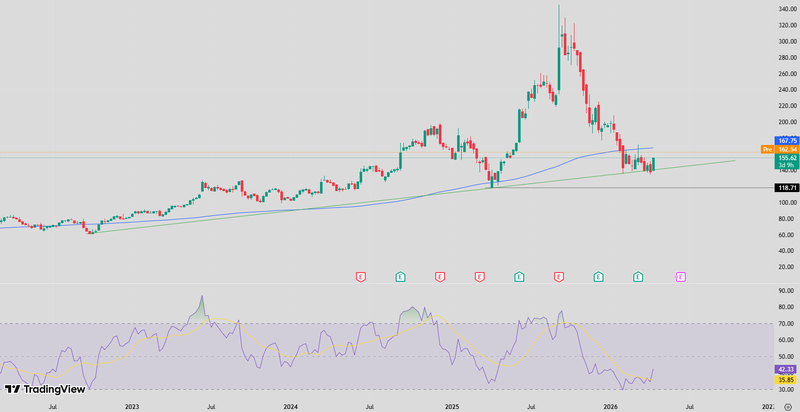
Oracle is in a reset phase following a sharp correction from its 2025 highs near $340. The magnitude of that decline matters, but what matters more now is where the stock is stabilizing. The current range around $150–160 is not arbitrary. It aligns closely with a long-term rising trendline as well as a key moving average zone, making it a structurally important level. This is where long-term buyers typically reassess value, and where the market decides whether the broader uptrend remains intact or begins to break down.
Recent price action suggests that selling pressure is no longer accelerating. The sharp downside momentum seen earlier has eased, and the market appears to be absorbing supply rather than extending the decline. Buyers are stepping in around this support zone, which indicates underlying demand is still present. That said, stabilization is not the same as reversal. The stock is not yet showing strong upward momentum it is simply no longer falling aggressively.
On the upside, the first meaningful hurdle sits in the $165–170 range. This level has acted as a ceiling in recent sessions, where rallies have struggled to sustain follow-through. A decisive break above that zone would be significant. It would signal that buyers are regaining control and could shift short-term momentum back to the upside. If that happens, the next logical target becomes the $180–200 area, which previously acted as a consolidation range during the earlier phase of the trend. A move into that region would mark a transition from stabilization into recovery.
On the downside, $150 remains critical. A clean break below that level would weaken the structure and expose lower support zones around $135–120, effectively extending the correction, momentum indicators, particularly RSI, reinforce this view. The indicator has moved out of overbought conditions and is now closer to neutral, suggesting the market is no longer stretched but not yet strong.
Source: Trading View


