
 Help
Help Brent falls sharply on Strait of Hormuz reopening but holds key technical levels
Brent crude prices fell significantly following the reopening of the Strait of Hormuz, a critical maritime corridor. Market participants are currently focused on the pivotal $90.00 support level as potential diplomatic discussions between the United States and Iran are anticipated over the coming days.

The reopening of the Strait of Hormuz triggered a 9.07% decline in Brent prices, substantially easing global geopolitical tensions.
Potential weekend discussions between Washington and Tehran offer a "peace dividend", signalling a pivot towards negotiation that could stabilise global energy costs.
Brent is currently testing a critical $90.00 support zone, where the 50-day Simple Moving Average (SMA) and the 50% Fibonacci retracement level converge.
Brent retreats to the $90 threshold amid rising hopes of a conflict resolution in the Middle East
Brent crude futures (BRNM6) experienced a sharp 9.07% depreciation, tumbling to $90.38 per barrel as geopolitical tensions in the Middle East showed signs of a significant thaw. This sell-off was precipitated by a convergence of diplomatic breakthroughs, most notably the announcement by Iranian Foreign Minister Abbas Araqchi that the Strait of Hormuz would remain open to all commercial vessels following a ceasefire agreement in Lebanon, according to Reuters. Hopes for a broader resolution were further bolstered by comments from the US President Donald Trump regarding potential high-level talks between Washington and Tehran this weekend, signalling a shift from confrontation towards active negotiation.
Market sentiment and macroeconomic implications
Market participants are currently viewing these official communications as a pivotal "peace dividend" that could fundamentally reshape the near-term economic landscape. By pricing in the possibility of a sustained agreement, investors are effectively de-escalating the geopolitical risk premium that has previously fuelled global inflation and hampered economic growth projections. Should these discussions materialise into a long-term settlement, the resulting stabilisation of energy costs could provide a vital reprieve for the global economy, easing the upward pressure on consumer prices and mitigating systemic risks to international trade.
Persistent hurdles, and technical support in Brent prices
Despite the optimistic price action, the path to a comprehensive energy market recovery remains fraught with logistical and structural challenges. Elevated insurance premiums and inventory bottlenecks continue to strain global supply chains, while significant damage to energy infrastructure across the Gulf necessitates a detailed recovery strategy. Although the current price of $90.38 marks a substantial retreat, it is presently holding at a key technical support level. Investors remain cautious, as the price floor will likely depend on whether upcoming negotiations provide the specific framework required to facilitate infrastructure repairs and restore full operational capacity to the region.
Technical analysis of the Brent futures contract
From a technical perspective, while the Brent futures contract has maintained a predominantly bearish trend over the last four years, price action is currently undergoing a significant shift in its medium-term structure. Key observations include:
- Trend Context: Throughout the medium term, Brent futures remained contained within a bearish channel pattern. However, the contract recently decisively breached key resistance levels to the upside and is currently trading significantly above its 50, 100, and 200-day Simple Moving Averages (SMAs). In the short term, the price has returned to the 50-day SMA and is testing a key zone where immediate support and the 50% Fibonacci retracement converge.
- Resistance Levels: If the psychological resistance level of $100.00 per barrel is decisively breached, the next significant technical ceiling is identified at $110.00—the subsequent prominent psychological barrier. A sustained move above the $110.00 mark would signal a potential extension into higher price territories.
- Support Levels: Should a broader market correction occur, immediate support is identified at $90.00 per barrel—a level where the 50-day SMA, the 50% Fibonacci retracement, and a short-term support converge. If this level fails to hold, the next relevant floor sits at $82.00, a technical zone where the 61.8% Fibonacci retracement and a long-term structural pivot point coincide. A breach of the $82.00 zone would significantly increase the probability of a deeper market correction.
- Momentum Indicators: Both the Moving Average Convergence Divergence (MACD) and the Relative Strength Index (RSI) exhibit a descending trajectory, signalling a strengthening of downward momentum in the short term. Nevertheless, it is highly probable that fundamental and geopolitical factors will remain the predominant drivers of the prevailing market direction.
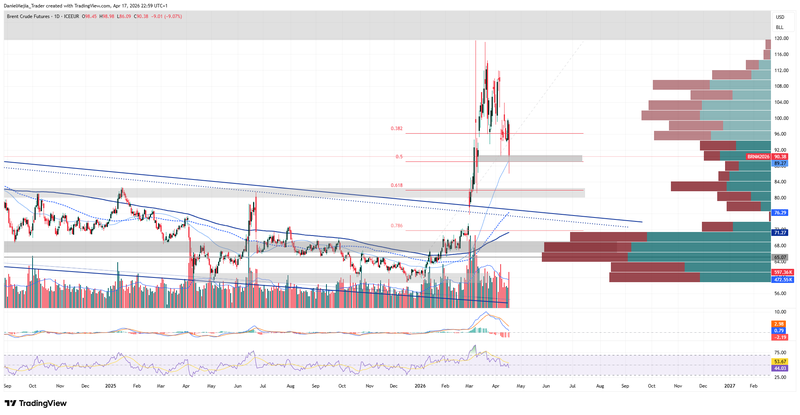
Figure 1. Brent Futures Contract (2024–2026). Source: Data from the ICE-EUR Exchange; own analysis conducted via TradingView.


