
 Support
 Hawkish Fed tone curtails risk appetite, pressuring Ethereum valuation
Ethereum fell 2.8% to $1,744 as the Federal Reserve’s hawkish tone, higher interest rate expectations, and limited forward guidance reduced demand for risk-on assets. Updated economic projections signalling tighter monetary policy through 2026 added further downward pressure on the cryptocurrency.

Ethereum fell 2.8% to $1,744 as hawkish Federal Reserve signals dampened risk appetite across digital asset markets.
The Fed maintained the target range for the federal funds rate at 3.50%–3.75%, but updated projections revealed a more restrictive macroeconomic outlook and diminished scope for monetary easing through 2026.
Nine of nineteen policymakers now anticipate an interest rate hike by the end of 2026, while the newly appointed Fed Chairman, Kevin Warsh, offered minimal forward guidance to market participants.
Hawkish Fed weighs on risk assets, sending Ethereum lower
Ethereum decreased during the market session amid a more restrictive tone from the Federal Reserve, which suppressed appetite for riskier assets due to mounting expectations that the central bank could lift interest rates in ahead periods. The Fed elected to leave its benchmark policy rate unchanged within the 3.50%–3.75% target range while maintaining a predominantly hawkish bias. Alongside the policy decision, the central bank released its updated Summary of Economic Projections, which reflected a less favourable macroeconomic outlook amidst heightened geopolitical tensions in the Middle East.
Regarding the future path of interest rates, the new Fed Chairman, Kevin Warsh, emphasised that he would not provide forward guidance on the central bank’s upcoming moves, arguing that financial markets should not rely on policy signalling when forming expectations. Another notable aspect of the Fed’s new leadership was a considerably shorter and less detailed policy statement compared with historical communications. This shift may indicate a deliberate effort to reduce the volume of information provided to markets regarding the likely trajectory of future monetary policy decisions. Nevertheless, the updated economic projections explicitly signalled that nine of nineteen policymakers now anticipate a rate hike by the end of 2026, underscoring a hawkish shift amongst rate setters.
Within the current macroeconomic context, Ethereum depreciated by 2.80% to trade at $1,744, driven by a contraction in demand for risk assets. From a market structure perspective, the cryptocurrency is currently confronting short-term structural resistance, which could hinder its near-term recovery.
Technical analysis of Ethereum
From a technical perspective, Ethereum maintains a downward trajectory. A detailed assessment of the current market structure reveals several key observations:
- Trend Context: Within a long-term framework, Ethereum continues to trade below its 50-day, 100-day, and 200-day Simple Moving Averages (SMAs). This sustained position beneath these key moving averages reinforces the prevailing bearish market sentiment.
- Resistance Levels: Should immediate structural resistance near $1,800 be breached to the upside, the primary technical ceiling is identified at $2,000—a prominent psychological barrier. A decisive break above this level would likely allow Ethereum to reclaim higher valuation territory.
- Support Levels: If the long-term structural support at $1,500 is invalidated, the next critical floor lies at the $1,000 mark, which represents a prominent psychological zone. A sustained close below this threshold would likely intensify selling pressure and significantly heighten the probability of a deeper market correction.
- Momentum Indicators: Both the Moving Average Convergence Divergence (MACD) and the Relative Strength Index (RSI) are currently trading in neutral zones, reflecting a lack of a predominant short-term directional bias in the market.
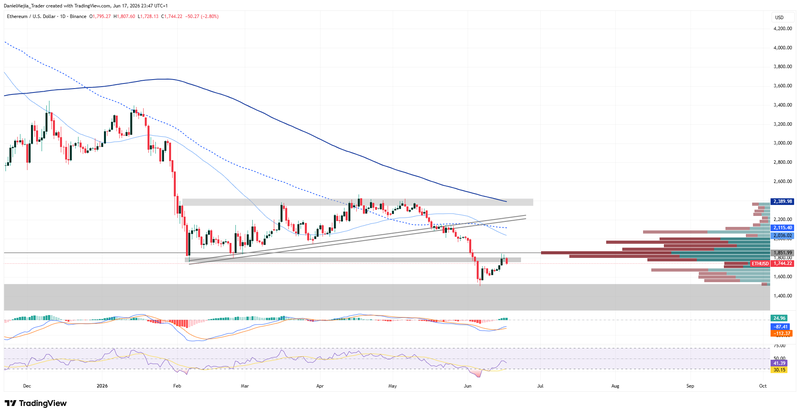
Figure 1. Ethereum Prices (2025–2026). Source: Data from the Binance Exchange; own analysis conducted via TradingView.


