
 Support
 US Senate examines crypto regulation bill; Ethereum falls
The United States Senate has introduced a comprehensive regulatory framework designed to tighten crypto exchange transparency with the aim of bolstering institutional confidence. Despite digital assets could benefit of this legislative mov in the long-term, Ethereum declined as cautious investors adopt a "wait-and-see" approach ahead of the bill's formal implementation.

The Senate’s CLARITY Act establishes a robust regulatory environment, incorporating stringent AML requirements and enhanced exchange oversight to cultivate greater investor trust.
Despite a constructive legislative outlook, Ethereum fell by 2.48% to $2,281, reflecting short-term market apprehension as traders await final parliamentary approval.
From a technical perspective, Ethereum remains positioned below its 200-day Simple Moving Average (SMA), confined within a three-month consolidation range that underscores a lack of definitive market direction.
US Senate deliberates the CLARITY Act; Ethereum softens
According to a report by Reuters, the US Senate Banking Committee has introduced a landmark piece of legislation entitled the “CLARITY Act.” This bill seeks to formalise a regulatory framework for the burgeoning cryptocurrency sector. Although the legislation requires further approval before being enacted into law, market participants view it as a constructive development; it is expected to fortify market integrity for digital assets and encourage broader participation from institutional investors.
The primary pillars of the CLARITY Act include more rigorous anti-money laundering obligations for crypto-intermediaries, as well as tighter oversight for exchanges, brokers, and dealers to ensure statutory compliance and operational transparency. Furthermore, the act contains provisions for tokenisation, aiming to create a more seamless interface between traditional financial systems and digital assets.
Despite the positive long-term implications of clearer regulatory mandates for the digital asset ecosystem, Ethereum retreated by 2.48% to close at approximately $2,281. This contraction suggests that market participants remain risk-averse, preferring to observe the final approval and implementation of the bill before expanding their exposure to the asset class.
Technical analysis of Ethereum
From a technical standpoint, Ethereum is currently navigating a consolidation pattern that denotes significant market uncertainty. Key observations include:
- Trend Context: Within a long-term framework, Ethereum continues to trade beneath its 200-day Simple Moving Average (SMA). This technical positioning reinforces a prevailing bearish sentiment. In the short term, however, price action is defined by a consolidative range that has persisted for approximately three months, reflecting a state of broader market indecision.
- Resistance Levels: Should the immediate resistance near $2,380 be breached, the primary technical ceiling is identified at $2,650, which converges with the 200-day SMA. Reclaiming these benchmarks is considered a necessary prerequisite for re-establishing a sustained bullish trajectory.
- Support Levels: If the psychological support at $2,000 is compromised, the next critical floor resides at the $1,800 mark—a vital structural support level. A sustained move beneath this threshold would likely intensify selling pressure and heighten the probability of a more profound market correction.
- Momentum Indicators: Both the Moving Average Convergence Divergence (MACD) and the Relative Strength Index (RSI) are currently oscillating within neutral territory, suggesting a deficit of clear directional conviction. Consequently, a decisive breakout from the current market structure may require a significant influx of institutional liquidity or a major fundamental catalyst.
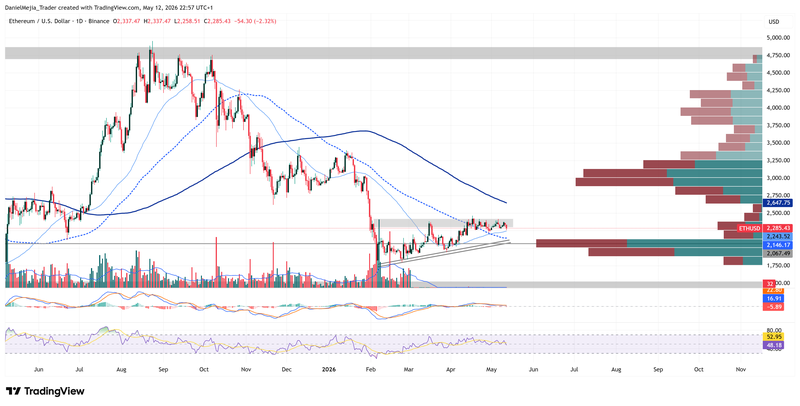
Figure 1. Ethereum Prices (2025–2026). Source: Data from the Binance Exchange; Own analysis conducted via TradingView.


