
 Support
Bitcoin’s rally is being rebuilt by institutions
Bitcoin is up more than 16% in April and on track for its first double-digit monthly gain since May 2025

ETF inflows have reached $2.5 billion this month.
Capital B’s acquisition of 6 additional Bitcoin.
If inflows remain strong bitcoin’s rally remains constructive.
Capital flows are controlling the current rally
Bitcoin is up more than 16% in April and on track for its first double-digit monthly gain since May 2025, but the more important part is not the percentage move; it is the composition of the demand behind it.
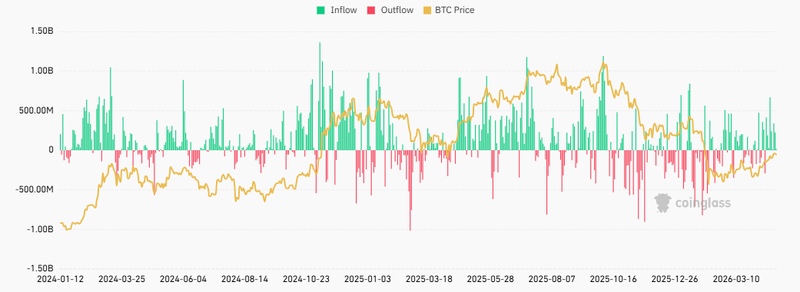
This rally is increasingly being driven by capital, not just sentiment. ETF inflows have reached roughly $2.5 billion this month, putting April on pace to more than double March’s total and marking a sharp reversal after four consecutive months of net outflows. That matters because ETF flows have become one of the clearest gauges of institutional demand in the post-spot ETF market structure. When flows turn positive after a prolonged withdrawal phase, it usually signals that allocation behavior is changing, not just short-term positioning.
That shift matters because Bitcoin is no longer trading as a purely retail-driven asset. Its ownership structure has changed; the ETF mechanism has institutionalized marginal demand. That means price reactions increasingly reflect capital allocation decisions rather than speculative momentum alone. In practical terms, it creates stronger absorption during volatility and tends to stabilize pullbacks when inflows remain persistent.
Source: Coinglass
Corporate bitcoin accumulation
Capital B’s acquisition of 6 additional Bitcoin, bringing its total holdings to 2,943 BTC, may not be large enough to move the market on its own, but it reflects a broader pattern that continues to build beneath the surface. Public companies adding Bitcoin to treasury reserves reinforce the transition of Bitcoin from a trading asset into a balance-sheet asset.
And when both institutional funds and treasury accumulation align, it changes the market's quality.
What makes this phase particularly notable is that Bitcoin has maintained strength despite an environment that has not been uniformly supportive for risk assets. Rising geopolitical tensions, elevated oil prices, and uncertainty around global monetary policy would normally weigh on speculative assets. Instead, Bitcoin has held firm and continued attracting capital.
Bitcoin’s next move depends on institutional flow strength
The market is no longer treating Bitcoin purely as a high-beta risk asset. At times, it is beginning to trade more like a macro-allocation vehicle, sitting somewhere between growth exposure and alternative-reserve diversification.
That does not make it defensive, but it does make it structurally more mature, the immediate question now is whether this inflow cycle has enough depth to sustain another leg higher. Historically, strong ETF inflow streaks tend to create reflexive upside… where rising prices attract more capital, and that capital reinforces price strength. That feedback loop is one of the defining characteristics of Bitcoin’s ETF era.
If inflows remain strong, Bitcoin’s upside path remains constructive in the near term, especially as institutional desks rebuild exposure after months of outflows. But if inflows begin slowing while prices remain elevated, the market becomes vulnerable to profit-taking, particularly after a 16% monthly move. The broader takeaway is that Bitcoin’s strength in April looks less like a bounce and more like a re-accumulation phase.


