
 Support
Bitcoin returns above $80,000 signals renewed institutional confidence
Bitcoin pushed back above the $80,000 level for the first time since February, as improving geopolitical sentiment and growing institutional demand combined to drive another wave of momentum into the crypto market.

Bitcoin has increasingly traded as a high-liquidity macro asset.
Morgan Stanley’s Bitcoin Trust increased its holdings to 2,620 BTC.
Crypto industry and the Senate Banking Committee reportedly reached a compromise on stablecoin yield provisions within the CLARITY Act.
Shift in sentiment
The rally accelerated after President Donald Trump announced a US-led mission to escort merchant vessels through the Persian Gulf and described recent discussions with Iran as “positive.” Markets interpreted the comments as a sign that the risk of a broader regional escalation may be easing, helping improve overall risk appetite across global assets.
That shift in sentiment mattered for crypto because Bitcoin has increasingly traded as a high-liquidity macro asset during periods of major geopolitical or monetary uncertainty. When fears around energy disruption and global trade instability began cooling slightly, capital quickly rotated back toward risk-sensitive areas of the market, including digital assets and large-cap technology stocks.
Move above $80,000 was not driven by geopolitics alone
Institutional participation continues to deepen across the Bitcoin market, and recent developments suggest large financial firms are becoming more comfortable expanding exposure despite volatility and regulatory uncertainty.
Morgan Stanley’s Bitcoin Trust increased its holdings to 2,620 BTC, while BlackRock’s European Bitcoin ETP surpassed $1.1 billion in assets under management. Those numbers matter because they reinforce the broader trend that institutional demand has not disappeared after the earlier ETF-driven rally. Instead, exposure continues to grow gradually across both US and European investment products.
Institutional flow remains the most important structural support
Bitcoin rallies were often dominated by retail speculation and leverage-heavy trading activity. The current cycle looks different in several ways. Large asset managers, pension-related capital and regulated investment vehicles are now playing a much bigger role in overall market participation.
That does not eliminate volatility, but it does create a stronger long-term demand base than in previous crypto cycles. At the same time, the regulatory backdrop in Washington also improved materially this week.
The crypto industry and the Senate Banking Committee reportedly reached a compromise on stablecoin yield provisions within the CLARITY Act, removing one of the larger obstacles slowing the bill’s progress. While the legislation is still moving through the political process, the compromise is being viewed positively because it signals that lawmakers and industry participants may finally be moving toward a workable regulatory framework rather than constant confrontation.
That distinction is important
Markets do not necessarily need fully favorable regulations to rally. Often, they simply need greater clarity and lower uncertainty. For institutional investors especially, a clearer legal framework around stable coins and digital asset operations makes it easier to justify larger long-term allocations into the sector.
The combination of improving regulation, rising institutional adoption and stabilizing geopolitical sentiment created a strong backdrop for Bitcoin’s breakout above resistance.
Technically, the move above $80,000 is also psychologically significant because it places Bitcoin back into a momentum expansion phase after several months of consolidation and uncertainty. Large round numbers tend to attract both media attention and additional speculative flows, particularly once previous resistance levels begin turning into support.
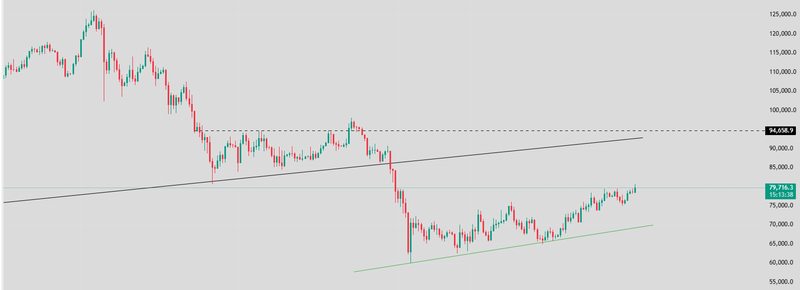
Source: Trading View


