
 Support

AI optimism meets funding strain and Fed risk
Nasdaq’s surge to record new highs, despite the dual pressures of inflation and geopolitical conflict, is largely driven by a market that is looking past current headlines toward long-term growth

MIT report found that 95% of corporate AI projects have failed to deliver results.
If price maintains above 26,100, price discovery could push toward 28,000.
AI optimism controlling the current rally
Nasdaq’s surge to record new highs, despite the dual pressures of inflation and geopolitical conflict, is largely driven by a market that is looking past current headlines toward long-term growth. Investors are currently prioritizing the "AI revolution," where massive corporate spending on data centers and semiconductors provides a solid fundamental floor for tech valuations regardless of the macro environment. This optimism is bolstered by corporate earnings that have remained surprisingly resilient, with the majority of tech giants beating profit expectations and proving they can pass on inflationary costs to consumers.
The most concern thing is that companies rely on external debt to fund growth; the latest BCA research shows that tech "hyperscalers" have doubled their capital spending as a share of cash flow to 70%, nearing a critical 100% threshold, and the recent MIT report found that 95% of corporate AI projects have failed to deliver results, raising fears that investor enthusiasm far outpaces actual productivity gains, on the other hand if inflation prints higher than 3.3% and the Fed hints at rate hikes (rather than just delays), those lofty valuations become impossible to justify.
Investors would likely rush to sell high-flying AI "growth" stocks to lock in profits before their future earnings are further discounted by higher rates, The biggest danger is that the "AI trade" is incredibly crowded. Many hedge funds and retail investors are using leverage borrowed money to bet on Nasdaq. If a tightening tone causes a sharp 5-10% drop, it could trigger margin calls, forcing these investors to sell even more to cover their debts. This creates a waterfall effect where selling begets more selling, leading to the explosion of liquidity.
Technical outlook
The market breadth is healthy, with approximately 62% of Nasdaq 100 stocks trading above their 50-day average and 50% above their 126-day average, and RSI showing overbought readings above 65-71.
The current price, $26,800, now acts as a critical pivot to continue the rally, while the $23,800 zone represents the last structural base before expansion and therefore a more meaningful support in case of deeper retracement.
if price maintains above 26,100–26,800 and pullbacks remain shallow toward 25,000–25,500, the structure supports continuation into a momentum-driven extension phase, where price discovery could push toward 28,000. However, if price fails to hold above 26,000 and rotates lower, especially with increasing volatility, the breakout risks turning into exhaustion, opening the path toward 23,700 as the first downside rebalancing target.
A sustained move below 23,700 would shift the structure from acceleration to correction, exposing 22,800 and potentially 21,100. Overall, the trend remains bullish, but the market is now at a stage where holding key levels matters more than simply pushing higher, and the behavior around 26K will define whether this is continuation or the start of a broader consolidation.
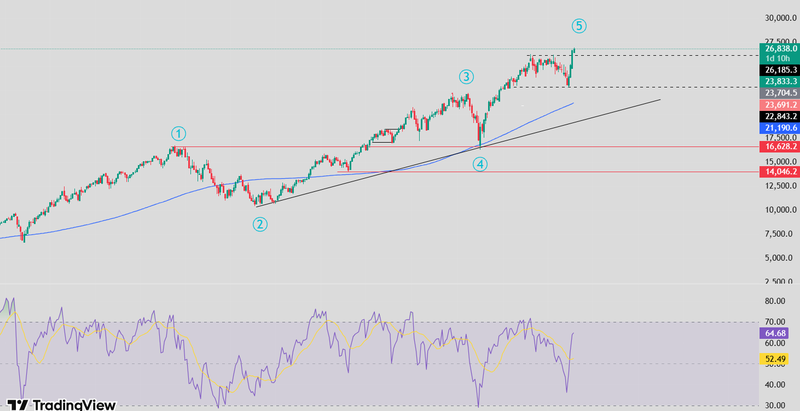
Source: Trading View


