
 Help
Help 
Crypto inflows accelerate as Clarity Act brings regulation back to the center
Crypto funds attracted $1.4 billion last week, the strongest weekly inflow since January. Bitcoin products led with around $1.1 billion, taking year-to-date inflows to about $3.1 billion.

Digital asset investment products attracted $1.4 billion last week.
The renewed inflows are arriving as Washington prepares to debate and vote on the Clarity Act.
Whether inflows continue, and whether the Clarity Act survives the political process.
Crypto flows are starting to look more durable
Crypto funds are seeing a stronger recovery in investor demand. Digital asset investment products attracted $1.4 billion last week, the strongest inflow since the third week of January, while total assets under management rose to around $155 billion.
That also marks the seventh inflow in the past eight weeks, the best run since October. The pattern matters because it suggests the recovery is no longer being driven only by short-term price momentum. Money is coming back into the asset class in a more consistent way.
Bitcoin remains the clear leader. Funds tied to the largest cryptocurrency attracted roughly $1.1 billion, showing that investors still view Bitcoin as the cleanest expression of institutional crypto exposure. Ethereum also saw a meaningful rebound, drawing $328 million, its strongest weekly intake since January.
Investors are not blindly chasing every corner of crypto. They are returning first to the assets with the clearest liquidity, strongest institutional access and most developed investment products.
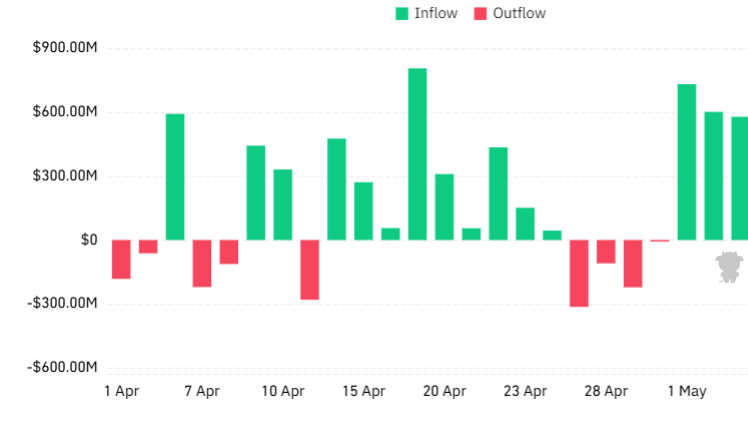
Source: coinglass
Regulation is becoming part of the bullish story
The renewed inflows are arriving as Washington prepares to debate and vote on the Clarity Act, one of the most comprehensive attempts so far to build a federal rulebook for digital assets.
For crypto markets, that matters. Legal uncertainty has been one of the biggest barriers to broader institutional participation. Investors have spent years dealing with the risk that regulators could shift their interpretation of tokens, exchanges and market structure without a stable framework in place.
The Clarity Act is being watched closely because it could reduce that uncertainty. If passed, it would draw clearer lines between digital commodities, securities, trading platforms and decentralized finance activity.
Bitcoin’s legal status is the key market issue
The most important part for markets is Bitcoin’s classification.
The bill is expected to strengthen Bitcoin’s position as a digital commodity under federal law, making it harder for future regulators to reverse that treatment without new legislation. That distinction matters because Bitcoin’s value as an institutional asset depends not only on scarcity and liquidity, but also on whether investors can understand the regulatory lane it sits in.
If Bitcoin is clearly treated as a commodity rather than a security, it gives asset managers, exchanges and custodians a more stable foundation to build around. It also reduces one of the major legal uncertainties that has followed the asset for years.
The bill is not only Bitcoin
The Clarity Act goes beyond Bitcoin. It also touches stablecoins, anti-money-laundering requirements, token fundraising, decentralized finance and tokenized securities.
That wider scope is important because crypto’s next phase will not be built only around price speculation. It will depend on whether market infrastructure can become more acceptable to regulators, banks, asset managers and payment companies.
The bill would also place more compliance responsibility on parts of the crypto ecosystem. That could be positive for established players with the resources to adapt, but more difficult for smaller firms that built their models around lighter oversight.
Crypto’s next rally may depend on Washington as much as price action
The market is now watching two things at the same time: whether inflows continue, and whether the Clarity Act survives the political process.
If the bill advances, it could give crypto one of its strongest regulatory tailwinds in years. If it stalls, the market may still hold up, but some of the recent optimism could fade quickly.
Investors are returning crypto funds. Bitcoin and Ethereum are leading the recovery. And Washington is giving markets something they have been waiting for since the last cycle: a clearer rulebook.


