
 Support
 Japan exports, US building permits top forecasts; Australian unemployment increases
Japan's exports surged 14.8% in April, pushing the Nikkei 225 up 3.14%. Meanwhile, US building permits beat forecasts at 1.44 million, lifting the Dow Jones to a record high despite rising mortgage rates. Conversely, Australia's unemployment rate hit a multi-year high of 4.5%, complicating policy for the RBA.

Japan's April exports jumped 14.8%, beating the 9.3% forecast, driven by electrical machinery and strong European Union and ASEAN demand.
The Nikkei 225 soared 3.14% to 61,683 points, propelled by Japan's robust trade surplus and high international revenues for Tokyo-listed firms.
US building permits rose 5.8% to 1.44 million, boosting major stock indices and showcasing housing sector resilience despite a 6.51% mortgage rate.
Australia's unemployment rate climbed to a high of 4.5%, pressuring the RBA as it balances slowing labor markets with a 4.6% energy-led inflation.
Japanese exports signal solid performance as balance of trade tops market expectations
According to data released by the Ministry of Finance of Japan, exports increased by 14.8% in April (year-on-year change). This represents an acceleration from the 11.5% growth recorded in March and comfortably surpassed the market consensus forecast of a 9.3% expansion. Concurrently, Japanese imports advanced by 9.7% year-on-year, exceeding the projected 8.3% increase but moderating from March’s 10.9% growth rate. Consequently, the balance of trade printed a surplus of ¥301.9 billion, significantly outperforming expectations of a ¥29.7 billion deficit, though marking a contraction compared to the previous month's surplus of ¥643 billion.
An analysis from Trading Economics indicates that the most significant contributions to Japanese export growth came from electrical machinery (28.6%), manufactured goods (15.3%), machinery (12.5%), chemical products (8.8%), and transport equipment (6%). On a regional basis, the most prominent increases in demand originated from the European Union (26.9%), ASEAN (19.9%), China (15.5%), the United States (9.5%), and India (8.9%). Specific sectors underpinning this strong performance included motor vehicles, microchips, semiconductor manufacturing equipment, optical instruments, and plastics.
Following these positive economic releases, the Nikkei 225 index rallied 3.14% to close at 61,683 points, bolstered by the fact that a vast number of corporations listed on the Tokyo Stock Exchange derive substantial revenues from international sales. Conversely, the Japanese yen experienced a marginal depreciation of 0.05% against the US dollar.
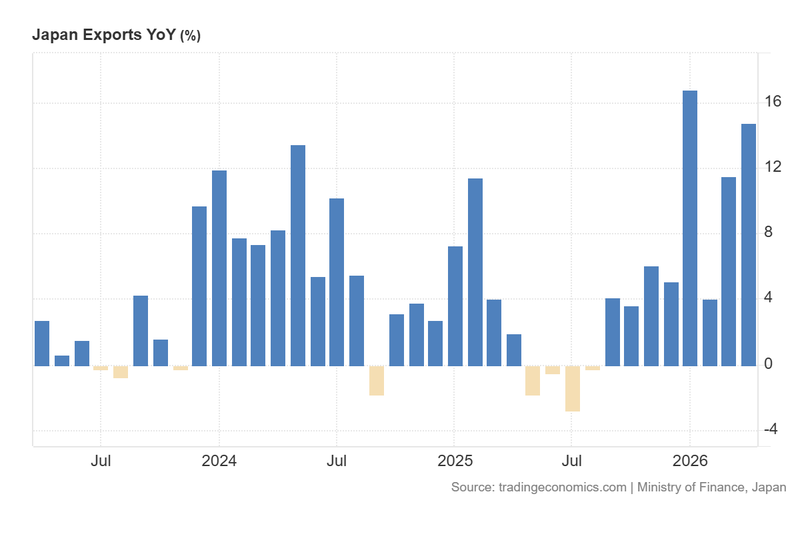
Figure 1. Japan Exports YoY (2023-2026). Source: Data from the Ministry of Finance of Japan; Figure obtained from Trading Economics.
US building permits surpass analysts’ forecasts, exhibiting resilience in the real estate sector
Data from the US Census Bureau revealed that building permits rose by 5.8% on a monthly basis to a seasonally adjusted annual rate of 1.44 million in April, printing above the market consensus estimate of 1.39 million. An increase in building permits typically signals a positive economic outlook among real estate developers, given that these projects require substantial capital expenditure and extended construction timelines. In tandem, the US Census Bureau reported that monthly housing starts contracted by 2.8% to an annualised rate of 1.46 million, though this figure still managed to exceed the forecast of 1.41 million.
Given that both real estate indicators printed above consensus estimates, the data suggests a broader improvement in business confidence. This resilience comes despite the average 30-year fixed mortgage rate reaching 6.51% (according to data from the Federal Reserve Bank of St. Louis), which represents a noteworthy increase in borrowing costs for consumers compared to the 6.06% levels observed at the beginning of 2026.
Consequently, US equity benchmarks advanced in tandem, lifted by the robust residential construction data and mounting optimism that diplomatic efforts between the US, Israel, and Iran could yield a peace agreement. The S&P 500 rose 0.17% to 7,445 points, the Nasdaq 100 advanced 0.20% to 29,357, and the Dow Jones Industrial Average appreciated by 0.55% to settle at 50,291 points—marking a new all-time high.
Australian unemployment rate increases above market consensus estimate
According to data from the Australian Bureau of Statistics, the seasonally adjusted unemployment rate rose from 4.3% in March to 4.5% in April, marking its highest level since November 2021. The reading came in above the expectations of analysts, who had predicted the rate would hold steady. This development compounds the pressure on the Reserve Bank of Australia (RBA), which now faces a complex dual challenge: a softening labour market contrasted against an annual inflation rate of 4.6%, the latter driven by a sharp rise in energy prices stemming from ongoing conflicts in the Middle East.
Regarding the foreign exchange market reaction, the Australian dollar recorded a marginal depreciation of 0.17% against the US dollar by the market close.
