
 Help
Help Cardano logs 30% monthly loss amid risk-off sentiment in crypto markets
Cardano declined as crypto markets turned risk-averse amid tensions in the Middle East, inflation concerns, and expectations of tighter Federal Reserve policy. ETF outflows, capital rotation into defensive assets, and pressure from US equities have added further strain.
Cardano lost around 30% over the month and 9.9% on the day, underperforming larger cryptocurrencies as risk aversion has hit lower-cap altcoins particularly hard.
Conflict in the Middle East, higher energy prices, and inflation concerns have increased expectations of a prolonged period of elevated Federal Reserve rates, or even further tightening.
Bitcoin ETFs recorded a 13th consecutive day of outflows, as investors rotated capital into perceived more defensive assets, including Treasuries, precious metals, and US technology equities.
Cardano extends losses, down 30% monthly as risk aversion weighs on crypto
The digital asset market is being pressured by a combination of factors that is generating significant risk aversion among market participants. Among the most relevant are rising inflation risks linked to the US–Israel–Iran conflict in the Middle East, which continues to keep energy prices elevated. This geopolitical pressure is increasing market expectations that the Federal Reserve could adopt a more restrictive stance, maintaining higher-for-longer interest rates or even raising rates further in order to contain price pressures.
Consequently, notable outflows are taking place from spot crypto ETFs, as institutional investors reallocate funds towards more defensive assets such as US government bonds and precious metals. A CNBC report indicates that Bitcoin ETFs registered a 13th consecutive day of outflows, reducing total assets across these funds from $107.8 billion in May to $82.8 billion. Additionally, a Reuters report suggests that the SpaceX IPO, expected in mid-June, may be redirecting speculative capital away from cryptocurrencies and into US technology equities.
Against this backdrop, Cardano has lost around 30% of its value over the last month. At market close, the crypto asset had declined by 9.9%, reflecting the fact that smaller-cap altcoins are being affected more severely than mega-cap crypto assets such as Bitcoin or Ethereum.
Technical analysis of Cardano
From a technical perspective, Cardano has exhibited a clear bearish trend. Key observations include:
- Trend context: On longer timeframes, Cardano maintains a structure of lower highs and lower lows, and it continues to trade below its 50-day, 100-day, and 200-day Simple Moving Averages (SMAs), reinforcing the prevailing bearish bias. In the short term, the price remains under significant selling pressure.
- Resistance levels: If the immediate resistance near $0.25 is recovered, the next significant technical barrier appears at $0.30, which converges with the 200-day SMA. A decisive move above the $0.30 area would suggest scope for a materially higher valuation.
- Support levels: If the current bearish trend continues, the next important floor lies at $0.10, a key psychological level. A sustained fall below this threshold would likely intensify selling pressure and increase the risk of a deeper correction towards the historical low of $0.03.
- Momentum indicators: The Moving Average Convergence Divergence (MACD) is crossing the zero line and following a downward trajectory, suggesting that bearish momentum could continue. Conversely, the Relative Strength Index (RSI) is trading near extreme levels, indicating caution regarding the intensity of the current selling pressure.
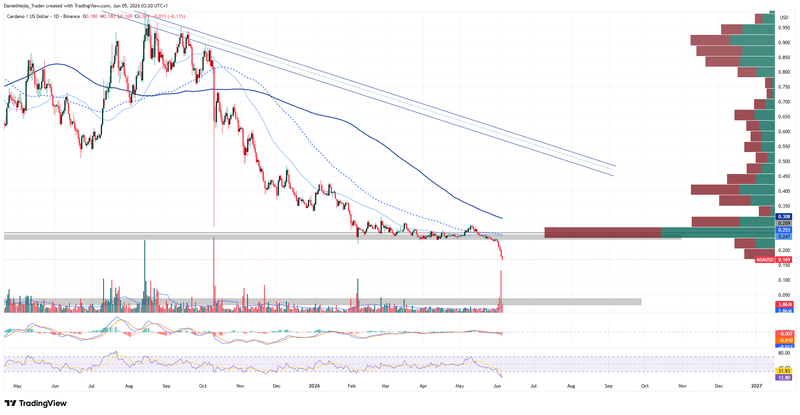
Figure 1. Cardano Prices (2025–2026). Source: Data from the Binance Exchange; own analysis conducted via TradingView.


