Help
Help Goldman Sachs targets on Bitcoin ETF amid rising institutional demand
Goldman Sachs has submitted a filing at the US Securities and Exchange Commission for a Bitcoin premium income ETF, an investment vehicle that utilises an options-based strategy to provide investors with monthly yields. This strategic move underscores the intensifying institutional appetite for sophisticated digital asset products within regulated frameworks.
The proposed ETF by Goldman Sachs employs a premium-based options strategy designed to generate consistent monthly income, trading off potential upside for reduced price volatility.
This filing represents a significant milestone in the convergence of traditional finance and digital assets, signalling a shift toward yield-bearing cryptocurrency products.
Bitcoin is currently testing a critical resistance threshold; meanwhile, ascending MACD and RSI indicators suggest a constructive shift in short-term bullish momentum.
Goldman Sachs seeks SEC approval for Bitcoin ETF underpinned by premium-based options strategy
According to reports from Bloomberg, the Goldman Sachs Group has filed an application with the US Securities and Exchange Commission (SEC) for a new Bitcoin-linked ETF. Unlike spot ETFs, which involve the direct acquisition and holding of the underlying asset, the Goldman Sachs proposal outlines a "Bitcoin premium income ETF." This product is designed to generate monthly income by selling (writing) options on Bitcoin-linked instruments. The objective is to offer investors a cryptocurrency-adjacent product that provides regular income while dampening the impact of market volatility through the collection of option premiums. However, a primary constraint of this structure is that returns are capped during periods of rapid price appreciation, as the fund prioritises premium income over long-term capital gains.
Whilst the proposal remains subject to SEC approval, Goldman Sachs’ entry into this space provides further legitimacy to the cryptocurrency market. It reflects a broader trend where institutional investors are increasingly seeking to integrate digital assets into diversified portfolios and funds. Furthermore, traditional retail investors are gaining access to an expanding array of investment vehicles linked to cryptocurrencies—mainly Bitcoin and Ethereum—allowing them to capture returns within a centralised market infrastructure.
Following the circulation of the report, Bitcoin rose by 1.06% to trade at $74,970. The asset is currently testing a pivotal resistance level which, if successfully breached, could catalyse a significant shift in the prevailing price action environment.
Technical analysis of Bitcoin
From a technical perspective, Bitcoin has recently experienced a breakdown in its long-term bullish structure and is currently contending with a significant resistance zone. Key observations include:
- Trend Context: On longer timeframes, Bitcoin continues to trade below its 100-day and 200-day Simple Moving Averages (SMAs), a positioning that reinforces a prevailing bearish bias. In the short term, however, price action is characterised by a consolidative range pattern that has persisted for approximately two months.
- Resistance Levels: Should the short-term resistance near $75,000 be breached—a level where horizontal resistance converges with the 100-day SMA—the next critical technical ceiling is identified at $87,000 (proximate to the 200-day SMA). Reclaiming these benchmarks is considered a prerequisite for re-establishing a broader bullish conviction in the market.
- Support Levels: If the primary support at $68,000 is compromised, the next critical floor is located at the $54,000 mark. A sustained move below this level would likely accelerate selling pressure and heighten the probability of a more profound market correction.
- Momentum Indicators: Both the Moving Average Convergence Divergence (MACD) and the Relative Strength Index (RSI) are currently trending upwards, reflecting the relative strength of the immediate bullish impulse. Nevertheless, while short-term momentum is constructive, institutional inflows and fundamental catalysts are expected to remain the primary drivers of the market's trajectory.
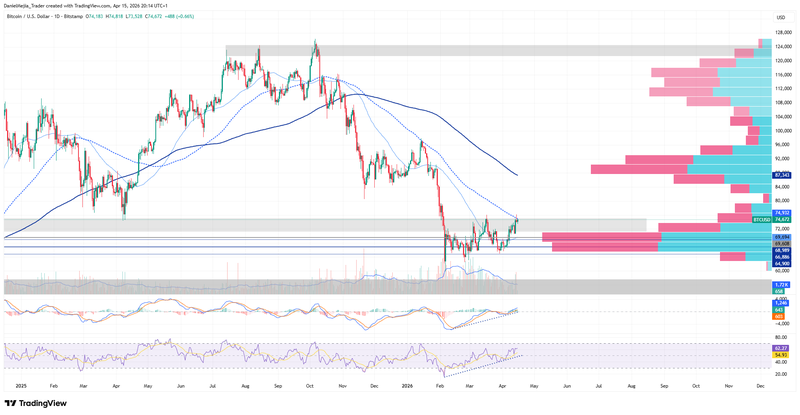
Figure 1. Bitcoin prices (2025–2026). Source: Data from the Bitstamp Exchange; Own analysis conducted via TradingView.