Help
Help 
How many more inflation shocks can the Fed afford to look through?
The Federal Reserve has spent years arguing that inflation spikes tied to supply shocks should not automatically trigger a policy response. That logic still holds, at least for now. But after yet another surge in consumer prices — this time driven by the Iran-linked energy shock — the harder question is no longer whether the Fed should react immediately, but how many more “temporary” shocks households and businesses will tolerate before they stop believing inflation will ever return to 2%.
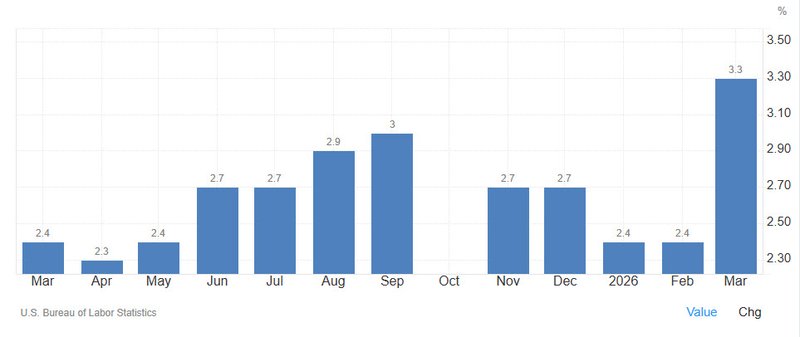
March headline inflation jumped sharply as gasoline prices surged.
The Fed still has reason to look through an energy-driven price shock for now.
The bigger danger is a gradual rise in long-term inflation expectations.
If those expectations lose their anchor, the Fed may have no choice but to act.
Another inflation spike, another test for the Fed
The Federal Reserve is once again being asked to decide whether a fresh jump in inflation deserves a policy response or patience. On the surface, the answer still appears to be patience. March consumer-price data were hotter than February, but the broad story did not look like a classic overheating economy. Higher gasoline prices tied to the conflict with Iran pushed headline inflation sharply higher, while core inflation remained comparatively steadier.
Source: TradingEconomics
That distinction matters. Central banks are supposed to look through temporary supply shocks when they can, especially when the source of inflation is not excess domestic demand but a sudden rise in imported energy costs. Raising interest rates into that kind of shock can easily do more harm than good.
The case for waiting still exists
For now, the Fed has good reasons not to overreact. Strip out energy, and price pressures across much of the economy have continued to cool more gradually. The labor market also remains ambiguous rather than alarming, with an unusual mix of weak hiring and limited layoffs that does not yet deliver a decisive message in favor of looser or tighter policy.
In that environment, waiting still makes sense. If the oil shock fades, inflation could resume its slow descent without the Fed needing to intervene. That has been the central bank’s hope each time it has faced a temporary disruption over the past few years.
The real problem is not March — it is the accumulation of shocks
But this is where the issue becomes more uncomfortable. One temporary shock is manageable. Several temporary shocks, spread over years, start to look less temporary.
That is the deeper risk now confronting the Fed. Inflation has spent five years running above target in one form or another, interrupted repeatedly by crises, wars, tariffs, fiscal expansion and energy disruptions. At some point, consumers and businesses may stop treating these episodes as exceptions and begin to see them as the normal state of the economy.
That shift in mindset is what the Fed should fear most.
Expectations matter more than the shock itself
As long as households and firms believe inflation will eventually return to 2%, the central bank retains room to stay patient. But if that confidence erodes, inflation becomes much harder to contain. Businesses become quicker to raise prices, workers become quicker to demand higher wages, and financial markets begin to assume that the Fed’s target is more aspiration than anchor.
So far, that break has not happened in a decisive way. Longer-term inflation expectations remain relatively contained. But the margin for comfort is shrinking. Another oil shock on its own may not unmoor expectations. A sequence of repeated shocks, each waved through as temporary, could eventually do exactly that.
The White House is not making the Fed’s life easier
The policy environment around the Fed has also become more difficult. Trade barriers, geopolitical escalation, fiscal looseness and repeated attacks on institutional independence all add to the sense that the inflation backdrop is becoming structurally less stable.
That does not mean each decision from Washington is inflationary on its own in a simple mechanical sense. It means the broader policy mix is making it harder for the Fed to persuade the public that price stability is steadily returning. The more disruptive the political environment becomes, the less forgiving inflation psychology may be.
For now, the Fed can still wait
The Fed is not yet at the point where it needs to abandon its wait-and-see posture. Core inflation has not exploded, growth is not collapsing, and the latest energy surge may still prove temporary. In that sense, patience remains the correct default setting.
But patience is no longer costless. Every time inflation rises again and the central bank explains why it should be ignored, it spends a little more of its credibility. And credibility, unlike oil, is not easily replenished once the market starts to think it is running low.
The next risk is not just inflation — it is disbelief
That is the real lesson from the latest shock. The immediate question is whether the Fed can afford to look through another burst of inflation. The more important one is whether the public will keep allowing it to do so.
If long-term inflation expectations begin to climb, the debate changes instantly. At that point, the Fed would no longer be deciding how to treat a temporary energy shock. It would be fighting to preserve belief in the idea that 2% still means something.
And once that fight starts, waiting gets a lot more expensive.