Help
Help 
Oil futures vs physical oil: why the market may be underpricing the Hormuz supply shock
The oil futures curve is sending a calmer message than the physical market warrants. With roughly 15 million barrels a day still bottled up around the Strait of Hormuz and global inventories being drained at an extraordinary pace, the front end of the market has reacted, but longer-dated prices remain surprisingly restrained. That disconnect matters because it risks understating both the scale of the current supply shock and the amount of higher prices that may still be needed to restore balance
Around 15 million barrels a day of oil supply remains trapped by the Hormuz disruption.
Roughly 500 million barrels have already been pulled from global inventories, with that figure potentially reaching 1 billion by June.
Front-month Brent has surged, but longer-dated futures have risen far less, softening the signal for new production.
If inventories keep falling and Hormuz does not normalize quickly, the futures curve may need to reprice much higher.
The physical market is screaming tightness, but the futures curve sounds oddly relaxed
The oil market is dealing with a massive supply vacuum, yet the longer end of the futures curve is behaving as though the disruption is already halfway to resolution.
Roughly 15 million barrels a day of supply, equivalent to about 15% of global oil demand, remains bottled up by the Strait of Hormuz crisis. Another way to understand that shock is through inventories. To bridge the disruption, the global system has already drawn down an estimated 500 million barrels from stockpiles. At the current rate, that figure could reach 1 billion barrels by June, and possibly even sooner.
The current supply gap is not disappearing just because a ceasefire exists
Even if a ceasefire eventually holds and traffic through Hormuz reopens, the market will not simply snap back to normal. The missing barrels have already moved through the global system in the form of inventory draws, delayed cargoes and interrupted flows.
That matters because the damage does not end when a political headline improves. Tankers still need to clear backlogs. Stored oil still needs to move. Shut-in production still needs to restart. Mines and other security threats still need to be dealt with. In other words, even in the best-case scenario, normalization would be slow.
That makes the current gap between the physical market and the financial market harder to justify.
The front end has reacted, but the back end has not
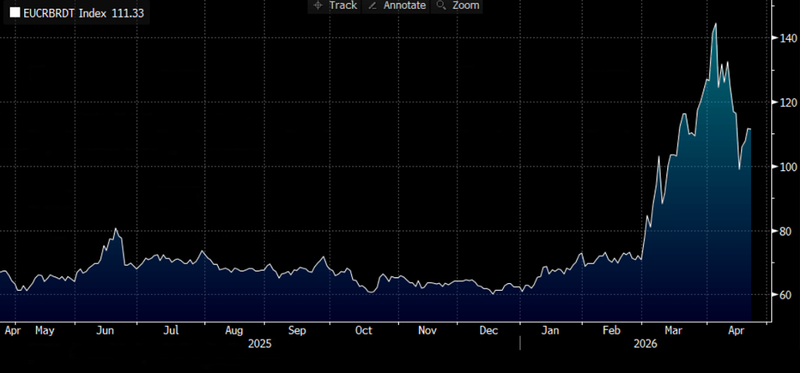
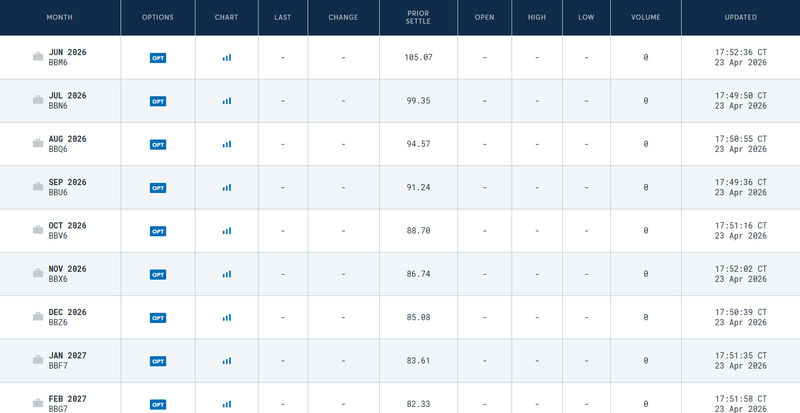
Brent has climbed back above $100 a barrel, but the move is heavily concentrated in the front of the curve. Front-month contracts have surged, while longer-dated futures remain far more subdued. By comparison, 2027 prices have risen much less, even though the shock now hitting inventories and physical flows could take months to unwind.
Source: Bloomberg
That discrepancy is critical because the back end of the curve is what producers watch when making drilling and investment decisions. If those prices do not rise enough, they will not send a strong incentive to add supply. And if supply is not encouraged, then inventories will keep carrying too much of the burden.
This is why the current curve looks misleading. It captures near-term panic, but it may still be underestimating the medium-term consequences of such a large and persistent disruption.
Source: CME Group
Inventories are falling at a pace the market rarely sees
Inventory draws are the clearest physical expression of a tight market. When supply is not covering demand, stockpiles make up the difference. That is exactly what is happening now.
A draw of roughly 500 million barrels over two months would already be extraordinary by historical standards. Even looking only at OECD commercial stocks, which are more transparent than global totals, a move of that scale would rank among the sharpest on record. If the current trend continues into June, the decline in global inventories would move well beyond the scope of normal market stress.
And yet futures prices have sold off from their early-April highs even while stockpiles continue to drain and the strait remains effectively closed.
That suggests the financial market is leaning heavily on the belief that today’s crisis will eventually be resolved before the inventory damage becomes even more severe.
Hedge funds may have amplified both the rally and the pullback
Part of the explanation lies in market structure rather than fundamentals alone.
Speculative money reportedly piled into the front end of the curve when the conflict intensified, helping to exaggerate the initial surge in nearby futures. That pushed front-month spreads dramatically wider in a very short period. But high volatility, strategic stock releases and repeated headline swings from Washington then forced many of those same positions to unwind, either to lock in profits or manage risk.
That selling helped cool the front end of the curve. But a technical reset is not the same thing as a physical resolution. If conditions remain tight and inventories keep falling, the market may eventually need to buy back that risk in a more forceful way.
Even the optimistic scenario still points to continued tightness
The key mistake in the calmer futures pricing may be the assumption that reopening Hormuz would immediately solve the problem.
Even under an optimistic scenario, the market would still have to work through delayed tanker traffic, accumulated local storage, damaged logistics and the restart of shut-in wells. The pace of inventory draws might slow, but the system would still be short barrels for some time. That means the physical tightness would continue even after the headlines improved.
And the market is not even at that optimistic stage yet. Threats are still being exchanged. Blockades remain in place. Shipping has not normalized. The gap between physical scarcity and financial pricing remains wide.
Producers are not seeing a strong enough long-term signal
This is where the futures curve becomes more than just a trading debate. If producers do not see sufficiently strong longer-dated prices, they are less likely to accelerate drilling or expansion plans. That limits the market’s ability to rebuild supply and refill inventories once the crisis eventually fades.
Industry expectations already reflect that hesitation. Many participants appear to expect limited growth in US production over the next year or two, which implies that current prices, especially farther out the curve, are not providing enough incentive to materially change output plans.
That is another reason the market may be understating the seriousness of the current shock. If physical barrels are this scarce, but future prices are not high enough to unlock a supply response, then the adjustment may have to come through even higher prices later.
The longer the vacuum lasts, the harder it will be to refill
This is ultimately the heart of the problem. The oil market can absorb a shock by drawing inventories for a while. But the bigger the vacuum becomes, the more difficult and time-consuming it will be to refill those stocks later.
At some point, prices along the curve may need to rise more sharply to encourage excess production. If that does not happen, the market may achieve balance the harder way — by destroying demand.
The exact trigger for a more violent repricing is impossible to predict. It could come when inventory losses approach 1 billion barrels. It could come earlier if tensions re-escalate. But the broader point is straightforward: the futures market still looks too comfortable with a disruption that is anything but comfortable in the physical world.
The market may be calm, but that does not mean it is right
Right now, the gap between physical flows and financial pricing looks unusually large. The physical market says barrels are acutely scarce. The futures market, especially beyond the front months, is still leaning toward an orderly resolution.
That may prove correct. But if normalization keeps slipping and inventories keep falling, the calm in the back end of the curve will start to look less like wisdom and more like denial.
In that case, the futures market is not forecasting stability. It is merely delaying recognition of how much tighter the oil system has already become.
The market may be calm, but that does not mean it is right