Help
Help 
Oil price today: why the physical crude squeeze is easing even with Hormuz still shut
The panic in the physical oil market is fading, at least for now. Cargo premiums that exploded after the Strait of Hormuz disruption have fallen sharply as refiners pull back, run down inventories and hunt for replacement barrels elsewhere. But this is not the same as a return to normal. The market is still living off temporary fixes, and if Hormuz stays effectively closed, the next squeeze may be even harder to absorb
Physical crude premiums have dropped sharply even though Hormuz remains heavily disrupted.
Buyers are holding back, wary of overpaying if a US-Iran deal suddenly reopens the strait.
Refiners are coping by cutting runs, drawing inventories and sourcing barrels from farther afield.
Traders warn the relief may prove temporary if demand picks up before supply truly recovers.
The physical oil panic has cooled, but the problem has not gone away
The cost of securing a real cargo of crude is falling fast, a sharp reversal from the bidding frenzy that gripped the market just weeks ago. That easing has come despite the fact that the Strait of Hormuz remains effectively shut and millions of barrels are still trapped inside the Gulf.
On the face of it, that makes little sense. The market has lost more than 10% of global supply because of the Iran war and its fallout. Yet premiums for immediate physical barrels have collapsed from crisis highs, in some cases dropping close to levels seen before the conflict erupted.
The explanation is not that the supply shock has disappeared. It is that buyers have stepped back.
Refiners are no longer scrambling the way they were in the first weeks of the war
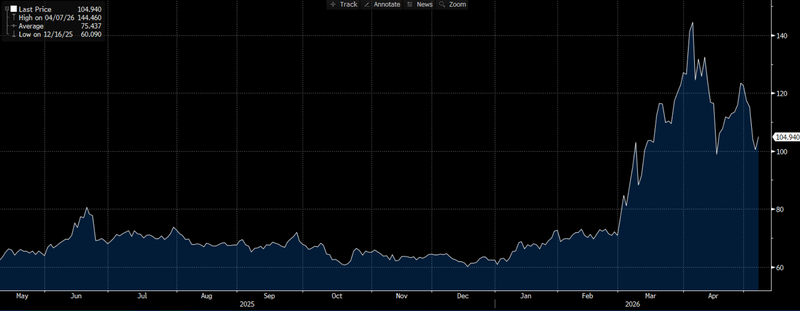
In the early phase of the crisis, the market behaved exactly as expected. Refiners chased prompt cargoes, traders bid aggressively for immediate delivery, and physical premiums surged to extraordinary levels. North Sea grades that help set Dated Brent soared, Oman crude traded at eye-watering premiums, and the physical market briefly looked like it was pricing outright scarcity rather than just disruption.
Source: Bloomberg
That phase has faded. The easing that started in the second half of April has accelerated, with North Sea premiums dropping as much as 90% from their peak. Some prompt cargoes from West Africa and Mediterranean CPC have even traded at small discounts to benchmark levels.
That does not mean the market is loose. It means buyers are acting differently.
Buyers are stepping back for two main reasons
One reason is tactical. Some buyers appear reluctant to pay inflated prices while Washington and Tehran are still circling around a possible deal. If Hormuz were to reopen suddenly, anyone who bought at the top would be left holding very expensive crude into a falling market.
The second reason is more structural, at least in the short term. Refiners, especially in Asia, are learning to operate with less. They are drawing inventories, cutting processing rates, delaying purchases and turning to replacement barrels from the US, Latin America and other non-Gulf suppliers. In other words, they are adapting to disruption rather than trying to outbid one another through it.
That shift in behavior is what has taken some of the heat out of physical pricing.
The market is relying on workarounds, not solutions
This is the part that matters most. The current calm is being built on stopgap measures.
The world entered this crisis with relatively comfortable supply. Governments have released record volumes from strategic stockpiles. Saudi Arabia and the UAE have rerouted some exports through pipelines and, where possible, still moved some tankers through the Gulf. The US and Brazil have ramped up shipments. At the same time, demand has softened, partly because high prices are starting to bite and partly because some plants in Asia and the Middle East have been forced to slow or shut.
That combination has helped delay the full impact of Hormuz’s closure. But delay is not the same as resolution.
The physical market still looks tight, just not panicked
The numbers show how much the immediate panic has faded. WTI Midland, for example, traded on Friday at a premium of just $1.50 a barrel in the Platts window used to help set the North Sea benchmark. In April, that premium had reached $22.
The structure of the Brent market tells a similar story. The deep backwardation that dominated the height of the crisis has narrowed sharply. The six-week Brent CFD spread has fallen from around $28 a month ago to just over $2.
Oman crude has seen the same pattern. Premiums that had soared to extreme levels earlier in the war have come back down hard, even though it remains one of the few Middle Eastern grades still accessible without relying on a full passage through Hormuz.
This is relief, yes, but it is relief created by demand restraint and inventory drawdowns, not by a genuine recovery in supply.
Asia has done most of the adjusting
Much of the pressure release has come from refiners in Asia. They have not found a perfect substitute for Middle Eastern crude, but they have found enough alternatives to avoid a new bidding war. More importantly, they have simply bought less oil.
They are processing less crude into fuels, leaning harder on existing inventories and shortening procurement windows. In some cases, benchmark mechanisms themselves are becoming less active because the market has shifted toward very prompt trading rather than normal forward buying.
That can make prices look weaker than the underlying fundamentals really are. A market can still be fundamentally short and yet print softer premiums if buyers are temporarily stepping away.
Europe and Asia may not stay quiet for long
The risk is that this lull does not last.
Europe’s spring refinery maintenance is nearing its end, which could bring demand for June cargoes back into the market. In Asia, run rates in Japan and South Korea are already starting to recover after falling earlier in the war. Once refiners need to raise throughput again, they will have to come back to a market that still has a major supply hole in it.
And by then, inventories will be lower.
That is the deeper problem. The market is buying time by burning through stocks and doing the bare minimum. Eventually that strategy reaches its limit.
A billion-barrel hole does not stay hidden forever
The industry has effectively dug a massive supply hole for itself. The market has already lost around a billion barrels of supply in cumulative terms, and that deficit does not vanish just because physical premiums have cooled for a few weeks.
If Hormuz does not reopen properly and refinery demand begins to normalize, today’s calmer market could quickly turn into another price spike. What looks like stability now may simply be the pause before the next squeeze.
That is why the current easing should be read carefully. The physical oil market is not saying the crisis is over. It is saying buyers have stepped back and improvised. For the moment, that is enough.
But only for the moment.