
 Help
Help

SpaceX IPO order book closes as demand hits $250 billion
The SpaceX IPO is entering its final order-taking stage with investor demand reportedly reaching about $250 billion. The company is seeking to raise $75 billion, making the deal roughly 3.3 times oversubscribed before pricing and its expected Nasdaq debut.

SpaceX IPO demand has reached about $250 billion.
The company is seeking to raise $75 billion.
The deal is currently about 3.3 times oversubscribed.
SpaceX futures imply a possible 20% first-day gain.
SpaceX IPO demand builds before order book closes
The SpaceX IPO is moving into its final stretch as the order book closed. The company is seeking to raise $75 billion in what is expected to become the largest IPO in history.
Demand for the offering has reportedly climbed to about $250 billion, up from roughly $150 billion earlier in the week. That means investors have placed more than three dollars in orders for every one dollar of stock being sold. In market terms, the SpaceX IPO is now about 3.3 times oversubscribed.
Why the SpaceX IPO is different
SpaceX is not a normal IPO.
The company is attempting to raise more than twice the amount Saudi Aramco raised in its 2019 listing. That alone puts the deal in a separate category. Most IPOs are judged by whether demand is strong enough to cover the shares available. SpaceX is being judged by a much higher standard because expectations around the deal are enormous.
The offering also includes a larger allocation to retail investors than is typical for major IPOs. That matters because SpaceX is not only attracting institutions. It has a powerful brand among individual investors who see the company as a direct way to gain exposure to rockets, Starlink, artificial intelligence, satellite infrastructure and Elon Musk’s broader technology ecosystem.
This mix of institutional demand and retail interest could make early trading especially active.
What 3.3 times oversubscribed means
An IPO being 3.3 times oversubscribed means demand is more than three times larger than the shares available. In practice, investors may ask for more shares than they expect to receive, especially when a deal is viewed as hot.
That is part of the normal book-building process. An investor may order 200 shares while expecting to receive far fewer. Banks then decide how to allocate shares among institutions, retail buyers and other eligible investors.
For SpaceX, the key issue is not whether the IPO is covered. It clearly is. The bigger question is how much excess demand remains after allocations are made. If many investors receive less stock than they wanted, some may try to buy shares once trading begins, creating potential upside pressure.
SpaceX futures point to a strong debut
Early price signals suggest investors are already expecting a first-day gain.
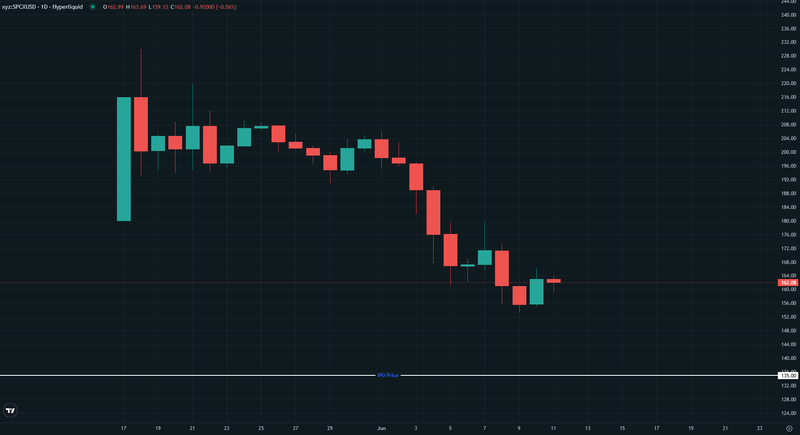
SpaceX share futures were recently trading around $162 on Hyperliquid, a crypto-based platform that offers perpetual futures. That price is about 20% above the expected IPO level. If that kind of move were reflected in the stock market debut, SpaceX would be valued at roughly $2.1 trillion.
A $2.1 trillion valuation would place SpaceX alongside the largest companies in the US market, near the level of the sixth-largest company in the S&P 500 by market capitalization.
Futures pricing is not a guarantee of where the stock will open. It is a market signal, not a final verdict. But it does show that traders are preparing for a potentially strong debut and elevated volatility.
Source: TradingView
The valuation question remains critical
The excitement around the SpaceX IPO does not remove the valuation risk.
A $75 billion raise already makes the IPO historic. A post-listing valuation above $2 trillion would raise the bar even further. At that level, investors are not only pricing SpaceX as a rocket and satellite company. They are pricing it as a future mega-cap platform across space, communications, AI infrastructure and possibly data services.
That creates a powerful long-term story, but also a demanding one. SpaceX will need to prove that Starlink growth, launch economics, government contracts and AI-linked opportunities can support one of the most aggressive public-market valuations ever assigned to a newly listed company.
Strong demand can drive the first trade. Fundamentals decide whether the stock can hold the valuation later.
What investors should watch next
The next key steps are pricing and the first day of trading. Pricing is expected after the order book closes, with trading expected to begin shortly after on Nasdaq.
The first session will be important for several reasons. A strong opening would confirm that demand was not limited to the order book. A weak or flat debut would suggest that much of the excitement was already captured in the IPO price.
Investors should watch three things closely: the final level of oversubscription, the opening price compared with the IPO price, and trading volume during the first session. These signals will show whether demand remains strong once SpaceX moves from private allocation to public trading.


