
 Support
BoE and Fed diverge as markets question which central bank can stay hawkish longer
The divergence between the Bank of England and the Federal Reserve is becoming less about rates and more about conviction.
Markets now see roughly a 50% chance of another rate hike in June.
Question is no longer who cuts first, it is who can afford to wait longer.
If price breaks through the 1.37–1.38 resistance, could opening the path toward the 1.42.
The division inside the BoE is becoming more visible
Markets now see roughly a 50% chance of another rate hike in June, reflecting how uncertain the policy outlook has become following the recent energy shock and persistent inflation pressures.
Some policymakers remain concerned that keeping rates unchanged for too long could allow higher energy costs to spill into wages, services and broader inflation expectations. Others worry that tightening further could put unnecessary pressure on an economy that is already showing signs of slowing.
Same tension is now appearing inside the Fed
The Fed’s latest decision to hold rates produced one of the largest dissents in decades, with several regional presidents arguing that the central bank’s current easing bias may already be premature. That disagreement matters because it signals growing concern among some officials that markets may be underestimating how persistent inflation risks could become if energy prices remain elevated.
There is also increasing attention on how inflation itself is being framed politically and institutionally with a new Fed chair approaching, some market participants are becoming concerned that policymakers may rely more heavily on inflation measures that exclude volatile energy prices to justify eventual rate cuts. Critics argue that doing so risks understating the real inflation pressure consumers are experiencing, especially during periods of geopolitical energy shocks.
Balance between slow growth and second round of inflation
Central banks often focus on core inflation because energy prices can swing sharply in both directions. But politically and economically, households still feel the impact of gasoline, electricity and heating costs directly. If energy inflation remains elevated long enough, it rarely stays isolated from the broader economy.
Both central banks are held but neither is comfortable. The BoE is wrestling with rising inflation and political noise, while the Fed is managing internal division and a leadership shift that could redefine how inflation itself is interpreted.
For markets, the question is no longer who cuts first, it is who can afford to wait longer.
Technical outlook
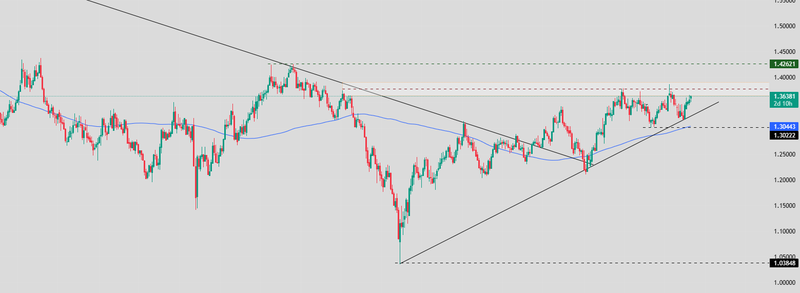
GBP/USD is starting an uptrend after a long-term bearish cycle; the most important technical development is the successful break above the long-term descending trendline that previously controlled price action for an extended period. That breakout significantly changes the character of the market because it indicates that sellers are losing dominance while buyers are beginning to establish a sequence of higher lows and stronger support zones.
The pair is now trading above its 126-day moving average, which reinforces the improving medium-term outlook. Price action around the 1.30443 area is especially important because that region has transformed from resistance into support and the recent correction have failed to break beneath this level, suggesting institutional demand is absorbing weakness. The ascending support trendline from the major bottom near 1.03848 also remains intact, confirming that the broader recovery structure continues to strengthen gradually.
Monetary policy divergence between the Fed and the BoE. Markets increasingly appear to believe that the aggressive US dollar strength cycle may be moderating as inflation cools and expectations for future Federal Reserve easing grow. At the same time, the British pound has benefited from relative resilience in services inflation and expectations that UK rates could remain restrictive for longer than previously anticipated. This narrowing policy differential has helped stabilize sterling after the severe volatility associated with earlier UK fiscal instability and global dollar dominance.
Upcoming scenarios
The bullish scenario develops if GBP/USD maintains support above the 1.30 region and successfully breaks through the 1.37–1.38 resistance band. That area represents a major supply zone where sellers repeatedly emerged in previous rallies, so a sustained breakout would likely trigger a significant shift in market positioning. Under that scenario, traders would increasingly interpret the move as confirmation of a broader structural dollar weakening cycle, potentially opening the path toward the 1.42 region and possibly higher over the medium term. Continued moderation in US inflation, lower Treasury yields, and stable UK economic conditions would likely reinforce this upside continuation.
The bearish scenario begins if the pair fails again beneath the 1.37 resistance region and loses the ascending support structure near 1.30. Such a move would indicate that the recent breakout lacks long-term conviction and that the broader market remains vulnerable to renewed dollar strength. A resurgence in US economic outperformance, sticky inflation, or more hawkish Federal Reserve policy could quickly strengthen the dollar again and pressure sterling lower. If price breaks below the 1.30 support area decisively, the pair could retrace toward the 1.25 region and potentially revisit deeper support zones, suggesting the current rally was corrective rather than the beginning of a sustained macro reversal.
Source: Trading View


