
 Support
 Brent climbs amid renewed geopolitical tensions in the Middle East
Brent crude reached $114.44 per barrel amidst escalating tensions in the Middle East and renewed concerns regarding the stability of the Strait of Hormuz. As the standoff between the US, Iran, and Israel intensifies, fears of supply chain disruptions have driven prices above key technical levels.

Heightened tensions in the Strait of Hormuz and reports of attacks in the UAE propelled Brent to $114.44, its highest valuation since mid-2022, as market participants price in mounting supply risks.
US and Gulf nations seek a UN resolution against Iran, while the US President Donald Trump threatens to Iran about a potential military action to protect global maritime navigation routes.
The Brent futures contract exhibits robust short-term bullish momentum; however, it is currently approaching a prominent resistance zone. Geopolitical developments remain the primary catalyst for prevailing market direction in crude pricing.
Brent futures approach $115 as Middle East tensions intensify
Oil benchmarks rallied sharply at the session close as geopolitical friction in the Middle East intensified. The Brent futures contract (BRNN6) climbed to $114.44 per barrel, marking its highest level since June 2022. Concurrently, West Texas Intermediate (WTI) futures (CLM6) rose by 4.43% to settle at $106.40 per barrel, while Gasoline futures (RBM6) gained 3.80% to reach $3.73 per gallon—similarly hitting a peak not seen since June 2022.
According to Reuters, Iran has intensified attacks targeting United Arab Emirates territory and commercial vessels within the Strait of Hormuz. Simultaneously, the US President Donald Trump has threatened military intervention to ensure the freedom of navigation in the region. These developments represent a significant escalation in the US-Israel-Iran standoff, heightening concerns that the conflict could broaden into a regional confrontation or evolve into a prolonged maritime disruption.
Reuters further reports that the United States, in coordination with Gulf Arab nations, is drafting a United Nations Security Council resolution to condemn Iranian actions in the Strait. Meanwhile, Tehran has reiterated its sovereign claims over the strategic waterway—shared with Oman—underscoring the acute diplomatic and military friction.
Collectively, these events indicate a sharp resurgence in the geopolitical risk premium within energy markets, which had tempered in recent weeks. Should these tensions persist or escalate, upward pressure on oil and refined product prices is likely to be sustained. From a technical standpoint, Brent prices are nearing to a key structural resistance amidst high geopolitical instability and severe disruptions to the oil supply chain.
Technical analysis of the Brent Futures Contract
From a technical perspective, the Brent futures contract is exhibiting strong bullish momentum, underpinned by the severe supply chain disruptions in the Middle East. Key observations include:
- Trend Context: In the short term, the Brent contract has decisively breached key resistance levels and is trading significantly above its 50, 100, and 200-day Simple Moving Averages (SMAs). Concurrently, momentum indicators and the volume structure support this bullish trajectory, although the market remains characterised by a high-volatility environment.
- Resistance Levels: Should the structural resistance level of $120.00 per barrel be decisively breached, the next significant technical ceiling is $130.00. This level represents a major psychological barrier and a critical resistance zone in historical price action. A sustained move above the $130.00 mark would signal a potential extension into higher price territories.
- Support Levels: In the event of a market correction, immediate support is identified at the $100.00 per barrel psychological zone. If this level fails to hold, the next relevant floor is situated at $90.00—a technical zone that converges with the 50% Fibonacci retracement of the most recent bullish impulse. A breach of the $90.00 zone would significantly increase the probability of a deeper market correction.
- Momentum Indicators: Both the Moving Average Convergence Divergence (MACD) and the Relative Strength Index (RSI) exhibit upward trajectories, signalling a strengthening of bullish momentum in the short term. However, as these indicators approach overbought territory, it is highly probable that fundamental and geopolitical factors will remain the predominant drivers of the prevailing market direction.
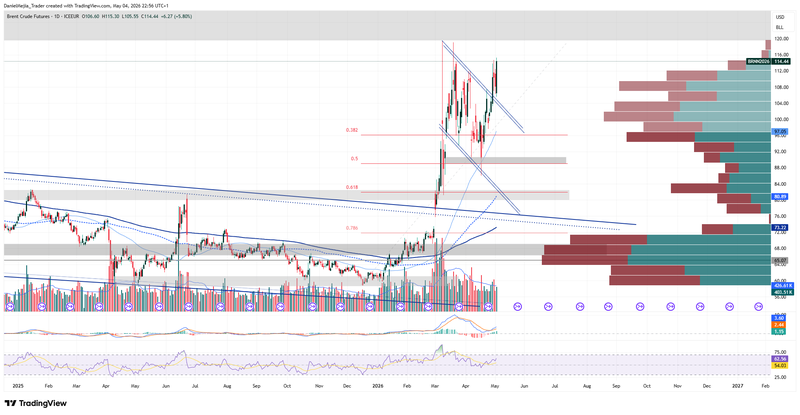
Figure 1. Brent Futures Contract (2024–2026). Source: Data from the ICE-EUR Exchange; own analysis conducted via TradingView.


