
 Support
 Dollar index rises as expectations grow for a more hawkish Federal Reserve stance
The US Dollar Index has strengthened as market expectations shift towards a more hawkish Federal Reserve posture. A resilient labour market and rising energy prices suggest that interest rates are likely to remain unchanged throughout upcoming monetary policy meetings.
Markets are currently pricing a high probability that the Federal Reserve will maintain interest rates at current levels through 2026, driven by energy-led inflationary pressures and labour market resilience.
Ongoing hostilities in the Middle East persist, maintaining upward pressure on energy prices and exacerbating global economic uncertainty.
A marginal rise in jobless claims and a 4.3% unemployment rate indicate a stabilising labour market.
Confluence of rising energy prices and labour market stability increases likelihood of paused rate cuts
Geopolitical instability has continued to impact energy prices, triggering heightened concerns regarding potential economic pressures—most notably, rising inflationary risks and a potential global economic deceleration should central banks adopt a more restrictive stance to maintain price control. The US President Donald Trump announced a ceasefire extension this week. However, Iranian officials have stated that a ceasefire will not be considered until the US Navy reopens Iranian ports. Consequently, hostilities across the Middle East continue to simmer, keeping energy markets on edge.
Simultaneously, data from the US Department of Labour revealed that continuing jobless claims rose from 1,809,000 to 1,821,000 in the latest weekly assessment, slightly exceeding the consensus estimate of 1,820,000. Similarly, initial jobless claims increased to 214,000, marginally above the forecast of 212,000. While both indicators were higher than anticipated, they signal overall labour market stability. Notably, there has been a discernible downward trend in continuing claims since October 2025, suggesting that unemployment remains contained. Furthermore, the most recent unemployment rate release showed a slight decline to 4.3%, reinforcing the narrative of a stabilising labour market.
As a result, market expectations are increasingly pricing in a more restrictive policy stance for the 2026 period. Data from the CME FedWatch Tool indicates a probability of over 75% that the Federal Reserve will leave rates unchanged for upcoming sessions, extending this pause at least until the April 2027 meeting. While FeedWatch probabilities tend to be volatile, this suggests a relevant shift on market expectations.
In response, the Dollar Index (DXY) appreciated by 0.21% to 98.80 points as the probability of a sustained restrictive stance increased. The US dollar tends to gain value against a basket of major currencies—including the euro, sterling, and the yen—as higher interest rates make government bonds more attractive. This drives increased demand for the currency, given that US Treasury bonds are denominated in US dollars.
Technical analysis of the Dollar Index (DXY)
From a technical perspective, the Dollar Index remains positioned within a primary long-term bearish trajectory. However, the current market structure indicates a potential short-term bullish pivot:
- Trend Context: Over the medium term, the index continues to trade within a descending channel pattern. Nevertheless, the recent rally has propelled the DXY above its 100-day and 200-day Simple Moving Averages (SMAs). The index is currently respecting a key support level, which may serve as a launchpad for further bullish momentum; nevertheless, market uncertainty remains in force.
- Resistance Levels: To the upside, the 100.50 level represents a formidable technical hurdle. A decisive breakout above this threshold would shift the market's focus towards the 104.0 handle. A sustained move above 104.0 would signal a major transition into a higher, more aggressive trading range.
- Support Levels: On the downside, immediate support is identified at 98.00. Should this floor be breached, the next critical area of interest is 96.5, representing significant short-term structural support. A failure at the 96.5 level would likely facilitate a deeper bearish correction.
- Momentum Indicators: Both the Moving Average Convergence Divergence (MACD) and the Relative Strength Index (RSI) are trending at neutral levels, indicating a lack of a predominant market direction. Nevertheless, the role of macroeconomic fundamentals will be pivotal in determining the sustainability of further technical gains.
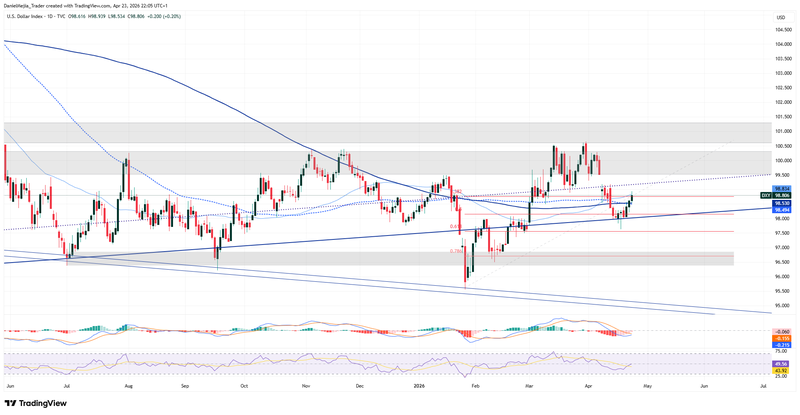
Figure 1. Dollar Index DXY (2025–2026). Source: Data from the Intercontinental Exchange (ICE); own analysis conducted via TradingView.


